The Complete Guide to Reading the Nakago — Deciphering a Sword's History from Yasurime, Mekugi Holes, and Mei
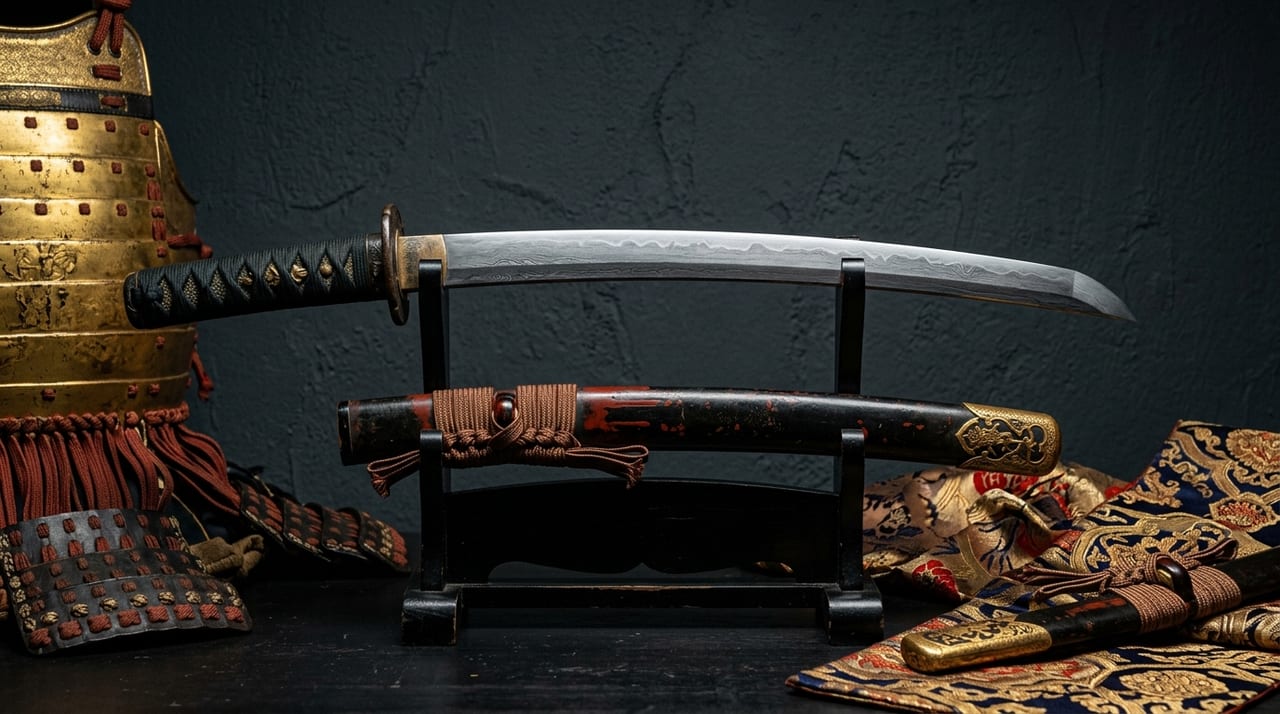 * Image is for illustrative purposes only.
Table of Contents
The Nakago — the Sword's "Official Document"
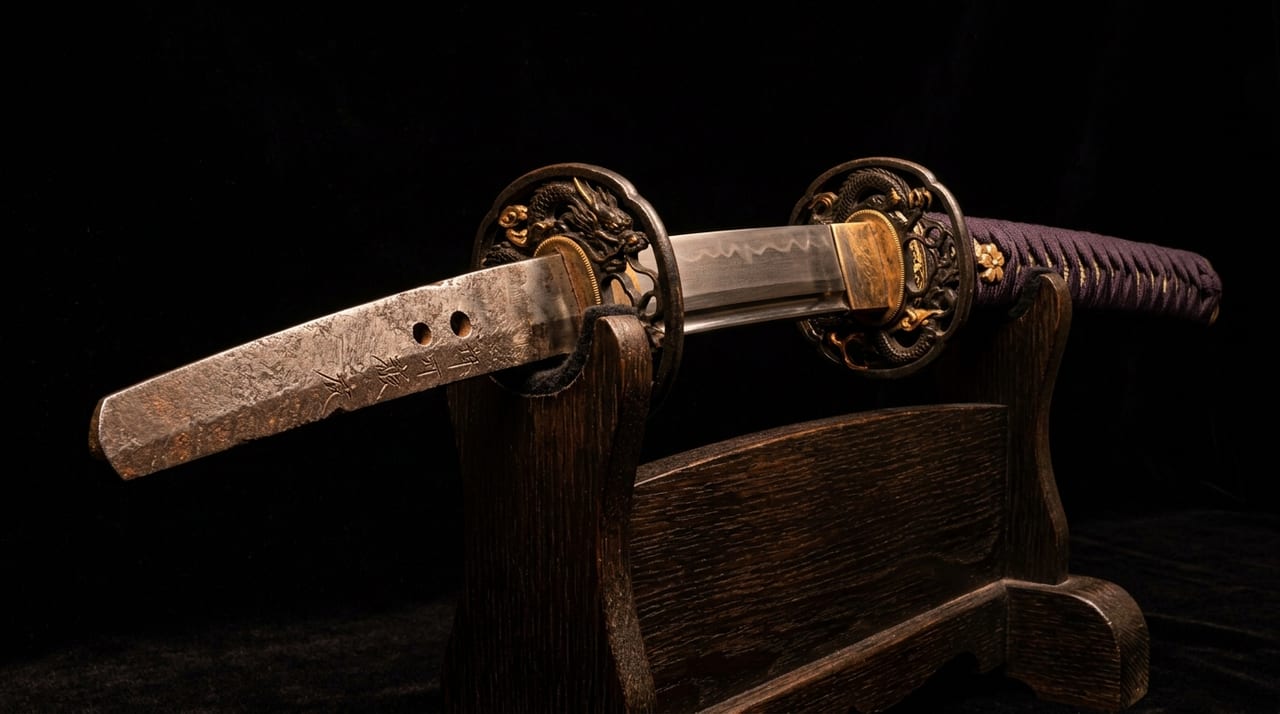
The nakago of a nihontō is the portion of the blade that fits inside the tsuka and is normally hidden from view. The nakago concentrates the following information:
- Mei (signature): the tōkō's name, year of manufacture, province name, and so on
- Yasurime (file marks): the pattern of file strokes applied to the nakago surface
- Mekugi holes: the holes for the mekugi that secure the blade in the tsuka
- Color and texture of the rust: evidence of aging over time
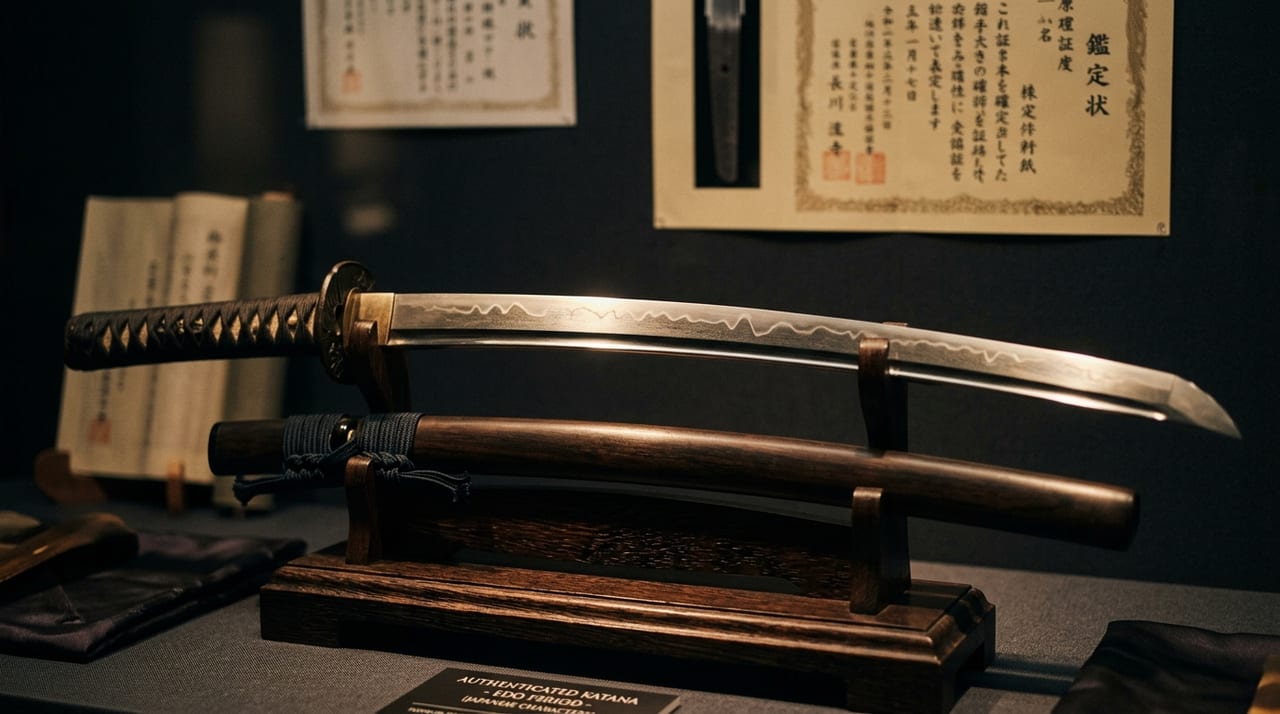
By reading these elements together, one can determine a sword's history, authenticity, and whether it has been altered. The nakago is an "indelible record," and the ability to read it accurately is the core of nihontō appraisal.
Yasurime (File Marks) — the Tōkō's "Signature"
Yasurime are the pattern of marks made by a metal file on the nakago surface. They serve not only as a finishing treatment but also as a practical non-slip surface when tsuka wrapping cord is wound around the hilt; above all, they serve as an important clue to the "characteristics of the tōkō and place of origin."
Types of Yasurime
Katte-sagari: file marks running diagonally downward to the right. The most common form, seen at many places of origin.
Sujikai: file marks crossing diagonally. Seen in Bizen, Mino, and elsewhere.
Kiri: horizontal file marks. Seen in the kotō period and in Yamashiro-den, among others.
Higaki: file marks forming a continuous V-shape pattern. A special form seen in certain schools.
Keshō-yasuri: decorative file marks applied for aesthetic purposes. Seen on the suriage area of tachi, among other places.
Yasurime Tendencies by Period and Place of Origin
| Period / Place of Origin | Typical Yasurime |
|---|---|
| Kotō period (general) | Kiri, katte-sagari |
| Bizen-den | Sujikai |
| Yamato-den | Katte-sagari |
| Sōshū-den | Katte-sagari, irregular |
| Edo period (shintō) | Katte-sagari, keshō-yasuri |
However, since yasurime may have been reworked in later eras, making a judgment based on them alone is risky.
Mekugi Holes — Traces of a Sword's History of Use
A mekugi hole is the hole for the mekugi that secures the blade in the tsuka; the number of holes is an important clue indicating a sword's history of use and alteration. The machining of the holes themselves is covered in Mekugi Hole Machining and Precision Nakago Finishing.
One hole: the most standard configuration. Swords from the early modern period onward typically have one hole.
Two or more holes: when there are two holes, it generally means one of the following:
- The sword was mounted in two different tsuka (re-mounting of the hilt)
- Suriage (shortening of the blade) was performed, and a new hole was drilled when the nakago was shortened
- Ō-suriage — when a sword that was originally a tachi was converted into an uchigatana
Position and age of holes: older holes have deep rust; newer holes have shallow rust. When there are multiple holes, comparing the degree of rust on each allows one to determine which hole is older.
How to Read the Mei (Signature)
The mei consists of characters carved into the nakago by the tōkō using a chisel.
Types of Mei
Omote-mei: the mei on the face that faces outward when the sword is worn at the hip (with the edge upward). Normally contains the tōkō's name.
Ura-mei: the mei on the face that faces inward. Often contains the year of manufacture, the place of dedication, the owner's name, and so on.
What Can Be Read from the Content of the Mei
- Tōkō name: the most direct evidence of "who made it." However, false mei are numerous
- Province name: can indicate the place of origin, such as "Yamashiro-no-kuni" or "Bizen-no-kuni"
- Court title: the official title held by the tōkō, such as "Mutsu-no-kami" or "Musashi-no-kami"
- Era name: the year of manufacture, such as "Hōreki x-nen"
- Circumstances of the sword's making: provenance information such as "owned by such-and-such family" or "dedicated to such-and-such shrine"
Suriage-mei and Mumei (Unsigned)
When a tachi is shortened (suriage) into an uchigatana, the original mei may be cut away. A sword whose mei has been lost through suriage is called mumei.
In some cases of suriage, the section containing the original mei was folded over to the opposite side and forge-welded to preserve the mei (this is called "orikaeshi-mei"; its distinctive feature is that the mei appears upside down). Also, gaku-mei (also called tanzaku-mei) — in which the mei is cut out in a strip and inlaid — is a separate technique.
Nakago Shape — Characteristics by Period and Place of Origin
The overall shape of the nakago (its length, form, and the shape of its tip) is also an important element in appraisal.
Bōhi nakago (rod-shaped): a slender nakago. Common in tachi of the Kamakura to Muromachi periods.
Funazoko nakago: the tip takes on a curved, boat-bottom shape. Seen at certain places of origin.
Kurijiri: the tip has a rounded, chestnut-like shape. Common in Yamato-den, among others.
Kiri: the tip is cut straight. The most common form.
The relationship between nakagojiri shape and keshō-yasuri is covered in detail in Nakagojiri Shape and Keshō-yasuri.
Nakago Rust — Appraising Signs of Age
Rust on the nakago is evidence of aging over time and an important clue for judging the era of a sword.
Characteristics of old rust: deep, dry in appearance, a bluish-gray called "ai-iro rust." Seen especially on the nakago of kotō.
New rust (red rust): reddish rust is relatively recent. However, even old swords can develop red rust depending on storage conditions.
Artificial treatment of rust: a forgery technique called "sabi-ire," in which rust on the nakago is artificially induced, also exists. Distinguishing it from natural rust is often difficult, and expert appraisal is required.
Conclusion — The Nakago Does Not Lie (As a Rule)
The yasurime, mekugi holes, mei, shape, and rust of the nakago are all traces of hundreds of years of time. The condition of the blade itself may change as it is restored and polished in later eras, but the nakago is inherently something that cannot be altered — this is why the nakago carries such high evidentiary weight. Skillful forgeries do of course exist, but by combining multiple points of observation one can draw closer to the truth of a sword. The habit of carefully observing the nakago steadily sharpens one's eye for nihontō appraisal.