Guntō Polishing Techniques — The Challenge of "Industrial Swords and Traditional Swords" That Showa-Era Togishi Faced
 * Image is for illustrative purposes only.
Table of Contents
The Fundamentals of Japanese Sword Polishing — The Traditional Process and the Togishi's Pride
Japanese sword polishing is broadly divided into two stages: shitaji-togi (base polishing) and shiage-togi (finish polishing).
Shitaji-togi begins with the arado (coarse stone) and progresses gradually to finer stones — nakado (medium stone) and shikido — removing surface irregularities in the blade's steel and jihada and establishing the sword's form (sugata). Here the togishi checks the balance of the sword's sori, sakihaba, and motohaba, correcting warps that arose during forging while exposing the jihada. It is at this stage that differences in the togishi's skill show most clearly.
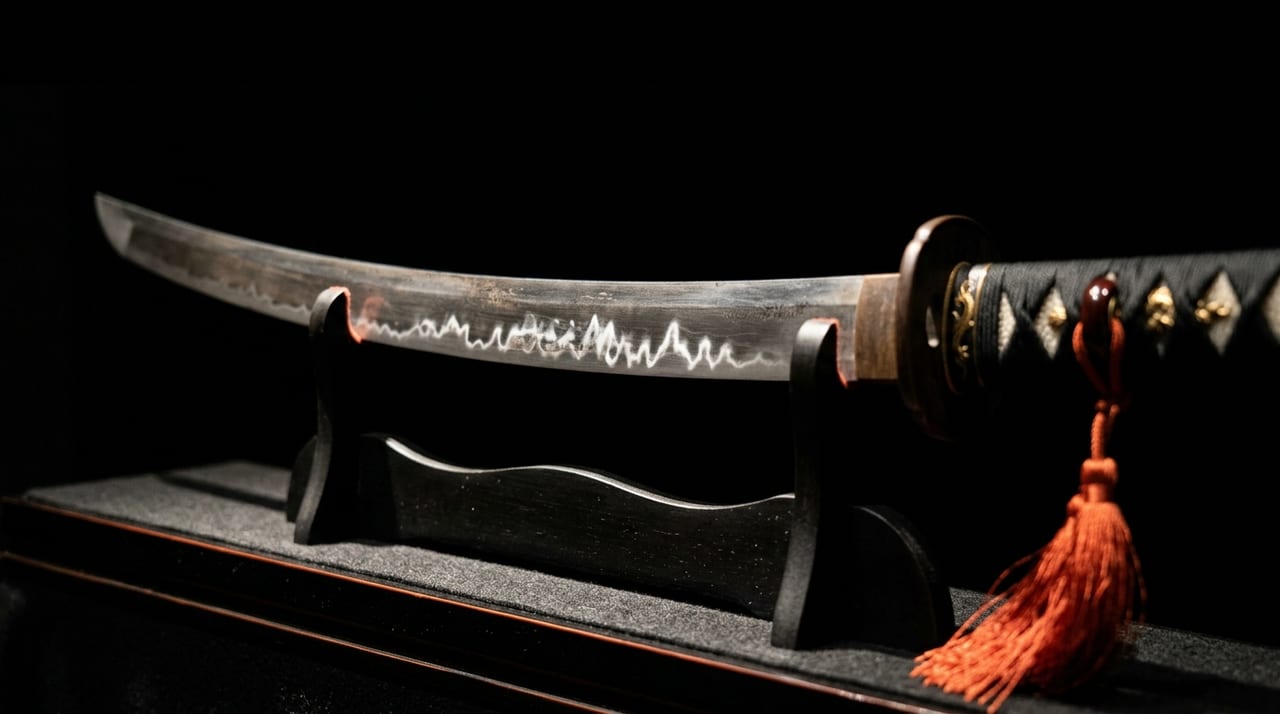
Shiage-togi is a precision process using natural whetstones to draw out the jihada and the scenery of the hamon to the fullest. Ultra-fine-grained stones such as the nagurando and uchigumorido, together with the hari (small whetstone pieces affixed to the fingertips), are used for extremely fine polishing. In particular, the hadori process — which brings out the hamon — carefully reveals the hamon line stroke by stroke from the hamachi to the kissaki. Techniques at this stage vary subtly by school, and each tradition carries on methods handed down as closely guarded secrets, including the Hon'ami-ryū and Yamashiro-den polishing styles.
Traditional togishi held as their supreme mandate "polishing that draws out the most beautiful form of a given sword," and they carefully devised a polishing plan tailored to the sword's individual character — the characteristics of the hamon, the nature of the jihada, and the origin of the steel. The time devoted to a single sword could span from several weeks to several months, and the togishi's work was less a craftsman's trade than the practice of a fine artist.
The Impact of Showa-Era Guntō Demand on the Togishi Industry
The rapid surge in guntō demand from the early Showa period through the Pacific War transformed the very structure of the togishi industry.
All army officers at the time were obligated to carry a guntō, and as the front expanded, demand grew rapidly. In Showa 14 (1939), the "Army Commissioned Swordsmith System" (Rikugun Jumei Tōkō Seido) was established, permitting only tōkō of a certain standard to forge guntō, yet even so the output of properly forged blades could not keep pace with demand.
To meet this excess demand, industrially manufactured guntō known as "Shōwatō" appeared. Mass-produced in factories such as Tokyo Gas and Electric Engineering (later Tokyo Gas and Electric Co., Ltd.), these swords were manufactured from uniformly machine-forged steel and possessed fundamentally different materials and construction from the traditional orikaeshi tanren using tamahagane.
As polishing demand overwhelmingly exceeded the total number of togishi, jitsuyo-togi (practical polishing) — a lower standard than traditional art polishing — became widespread, and speed-prioritized finishing was standardized. Even skilled togishi found themselves having to handle multiple blades a day, and "skip polishing" — reducing the number of whetstone grades used — became rampant. This practice left minute polishing scratches on the blade surface, a technique that was nearly forbidden by the standards of proper art polishing, yet the realities of wartime forced such compromises.
The Struggle with Industrial Swords — The Material Barrier Faced by Togishi
The polishing behavior of traditionally forged tamahagane swords and industrially made Shōwatō differs entirely. This difference became the greatest technical challenge for Showa-era togishi.
Tamahagane possesses jihada created by uneven carbon content. Its distinctive patterns — itame, mokume, and masame — gradually emerge as polishing progresses. The togishi adjusts polishing pressure, angle, and choice of whetstone while reading these responses.
The steel of industrially made Shōwatō, on the other hand, has uniform carbon content and possesses no jihada. Because no layers are created by orikaeshi tanren, the hamon appears only as a uniform wave of the yaki-ire, and the blade lacks the scenery (keshiki) of a traditional sword — the complex interplay of nie and nioi within the hanaka.
A further problem was the hardness characteristics of industrial steel. While industrially made swords with their uniform yaki-ire had high surface hardness, they were prone to leaving fine scratches during polishing and tended to clog the surface of natural whetstones. Some togishi devised techniques for pseudo-creating the appearance of hamon patterns by "imprinting patterns through polishing" on the surface of industrial swords, but this must be called an expedient that deviated from the true path of sword polishing.
The procurement of whetstones was also a serious problem. High-quality natural whetstones — particularly the uchigumorido produced in Kameoka, Kyoto — were already scarce during the war years, and as priority procurement of military supplies progressed, distribution to togishi became severely constrained. The situation continued in which inferior substitute whetstones had to be used, causing a further decline in polishing quality.
"Military Polishing" and "Art Polishing" — The Coexistence of Two Standards
Showa-era guntō polishing clearly divided into two distinct standards according to the client's position and purpose.
| Standard | Client / Subject | Content |
|---|---|---|
| Military polishing | Polishing for practical purposes | Prioritizing hatsuke (ensuring cutting-edge sharpness) above all, with the finishing of jihada and hamon scenery omitted or greatly simplified. The number of whetstone grades was also kept to a minimum. This was the standard at which practical utility in the field — the blade not chipping, resistance to rust, good fit in the saya — was demanded over the sword's "visual beauty" |
| Art polishing | Masterwork swords by commissioned tōkō and works by Yasukuni tōkō (swords forged in the sword hall within the Yasukuni Shrine precinct), ordered personally by officers | Polishing to the same standard as traditional art swords. The polishing of Yasukuni swords by renowned togishi — even in surviving examples — employs a meticulous use of different whetstones and carefully draws out fine details within the hanaka such as chikei and kinsuji. The cost and time involved ran to several times, or even ten-plus times, that of military polishing |
The coexistence of these two standards tells us that under the single label of "guntō," an extremely broad spectrum existed — from industrially mass-produced items to the very finest of traditional craftsmanship.
Contemporary Restoration Polishing of Showa Guntō — New Challenges Facing Togishi
Many of the Showa guntō that survive and circulate today have accumulated rust, corrosion, and polishing scratches through long storage and poor maintenance. The polishing work required to restore these has become one of the important tasks entrusted to contemporary togishi.
- Rust-removal togi: For minor rust, it can be removed by polishing from the arado. However, deep tensabi (pitting rust) has eaten into the steel of the blade itself, so attempting to remove it inevitably means cutting away part of the blade. It is necessary to proceed while carefully judging the impact on the remaining hamon; destroying the hamon by forcing rust removal would be putting the cart before the horse.
- Art restoration polishing of traditionally forged swords: Traditional art polishing techniques are required for restoring valuable Showa swords such as Yasukuni swords and works by commissioned tōkō. As of 2026, the going rate is approximately 500,000 to 2,000,000 yen per sword, though costs vary greatly depending on the sword's condition, the togishi's skill, and the depth of polishing. When jihada damage is extensive in particular, shitaji-togi alone may require several months.
- Handling of industrial swords: Investing in costly art polishing for mass-produced Shōwatō of low artistic value is not economically rational. In many cases, practical polishing using modern whetstones and tools is sufficient for such swords.
When considering restoration polishing, it is essential to first have an expert (a togishi or sword dealer) assess the sword's condition and confirm the sword's provenance and whether a kanteisho exists, before drawing up a polishing plan. The value of Showa guntō varies greatly from piece to piece, and the preconception that "a guntō is of low value" must be avoided. With appropriate polishing and preservation, a single sword that survived the turbulent era of the Showa period can continue to pass on its value as a historical testimony to future generations for a long time to come.
For details on the polishing process itself, see the related column The Work of the Togishi; for the lineage of contemporary tōshō who forge gendaitō with tamahagane, see Contemporary Tōshō Styles.