The Evolution of Guntō Saya Finishing Techniques: From Lacquer to Leather — How Wartime Changed the Saya Craftsman's Work
 * Image is for illustrative purposes only.
Table of Contents
Traditional Lacquered Saya: Techniques Before the Shōwa Era
Finishing the saya of a Japanese sword has long been a specialized craft handled by lacquer artisans called nuri-shi. It is not mere "painting" but a complex craft in which woodworking, material processing, and design are all seamlessly integrated, and it was not uncommon for a single piece to take several months to complete.
- In kiji (wooden core) fabrication, light, fine-grained woods such as hō, shirotsuga, and kiri are carved from two matched pieces and shaped to conform to the blade. This step determines the dimensional precision of the interior cavity, and thus greatly governs how smoothly the blade slides in and out. Division of labor between kiji woodworkers and nuri-shi was common, and differences in wood species and finishing methods were seen by production region, including Tokyo, Kyoto, and Okayama.
- In undercoating (shitaji-nuri), the foundation is built up by alternating layers of sabi-urushi and nuno-urushi. Cloth-laying (nuno-kise), in which hemp cloth or washi paper is bonded with lacquer, is sometimes combined to prevent the wooden core from cracking or warping. The undercoating process alone is repeated five to ten or more times, with each coat requiring at least two to three days to dry. Drying in a humidity-controlled chamber called a muro was the traditional method, and management of temperature and humidity directly affected the quality of the final finish.
- In the middle and top-coating stages, colored and specialized lacquers are used. A wide variety of lacquers were chosen according to the design and purpose, including kuro-urushi (black lacquer), shu-urushi (vermillion lacquer), and tame-urushi.
- In the final step of polishing and burnishing, a variety of finishing techniques are employed, such as ishime-nuri, hakeme-nuri, shu-tamari-nuri, and kawari-nuri.
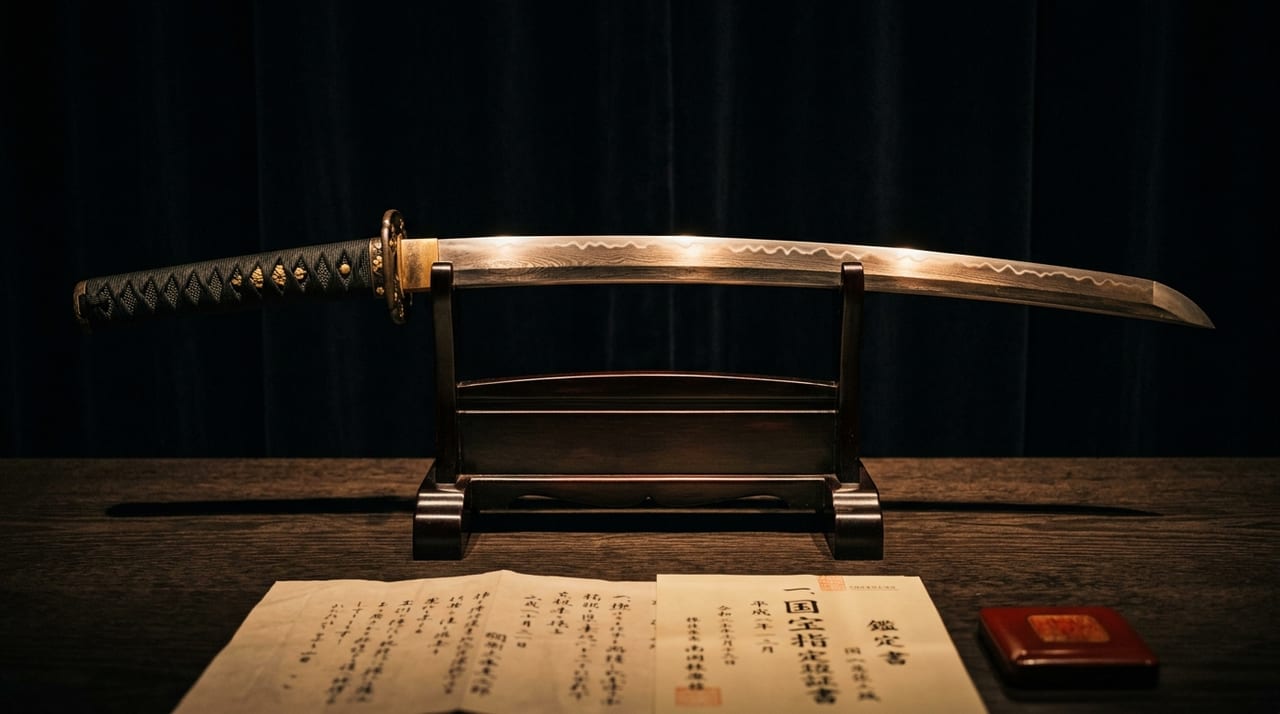
Saya produced by celebrated nuri-shi have received high artistic evaluation even among tōsōgu, and have sometimes been traded individually with a kanteisho.
Standardization of Leather-Covered Saya in Shōwa-Era Guntō
The adoption of "brown leather wrapping" (cha-kawa-tsutsumi) as the standard for the Type 98 guntō established in 1938 was driven by multiple overlapping factors.
- Weather resistance and combat suitability: While lacquered saya did possess a degree of water and moisture resistance, they had their limits in the hot, humid environments of Southeast Asia and the South Pacific islands, which became the main theaters of the Pacific War. In tropical rainforest regions with annual rainfall exceeding 3,000 millimeters, the risk of lacquer surfaces swelling and peeling was high, and the durability of leather-covered saya was valued in actual combat. The relative ease of field repairs even when the leather was damaged also contributed to its advantage at the front.
- Adaptation to mass production was also a factor that could not be ignored. Lacquered saya required weeks to months to finish a single piece. As wartime mobilization accelerated and demand for guntō surged, maintaining lacquering processes placed severe pressure on arsenal production schedules. With leather covering, the drying and waiting steps were greatly reduced, and craftsmen who had acquired the techniques in a relatively short time could handle the work, even without the skills of a seasoned nuri-shi.
- The problem of craftsman resources was also a consideration. While training a lacquer artisan required a decade or more of apprenticeship, leather-working craftsmen were distributed throughout the country, sustained by demand for harnesses, shoes, and military equipment. At the military arsenals in Osaka, Nagoya, and Tokyo, existing leather businesses were incorporated into the manufacturing process for guntō saya.
Materials and Specifications of Leather-Covered Saya: Details of the Type 98
The leather used for the saya of the Type 98 guntō was fundamentally brown-dyed cowhide, and the wooden core was primarily hō wood. The leather was approximately 1.5 to 2 millimeters thick and was adhered and sewn to encase the entire wooden core. Particularly careful finishing was required at the reinforcement near the koguchi, and at the joining points with the obitori, kurikata, and kojiri.
The fittings were mostly iron, and in later production, brass and zinc alloys were also used due to material shortages. The combination with brown leather gave the guntō a rugged, no-frills impression befitting its utilitarian purpose. On the other hand, in high-grade koshirae commissioned privately by officers, examples were seen in which, while following the Type 98 form, the fittings were made of silver or gold-plated, or lacquering was used in place of leather.
From 1944 onward, as material shortages intensified with the deteriorating war situation, the quality of leather declined, and instances of synthetic leather and cloth covering being used as substitute materials have been confirmed. During the same period, the omission of fittings and the roughening of wooden cores also progressed, and by just before the end of the war, there was a marked disparity in quality standards.
The Survival of Lacquer Techniques: The Continuation of Art Swords and Traditional Koshirae
Even after the standard for guntō shifted to leather covering, the craft of lacquered saya continued to survive as the koshirae for art swords.
Traditional lacquered saya continued to be sought for swords commissioned privately by officers and for iai swords and performance swords produced after the war. From the late 1940s onward, as the reappraisal of Japanese swords as works of art progressed, the elegance of kuro-urushi and shu-urushi, and their value as a ground treatment that sets off shakudō and gold and silver inlay, came to be recognized anew. Present-day sword craftsmen still produce traditional lacquered saya, which have become an indispensable element of koshirae for high-grade swords.
Throughout history, "preserving the essence while evolving techniques in response to the demands of the era" — the work of saya craftsmen embodies the very essence of such craftsman culture.