Kudayari — The Mechanism of the Tube-Spear and the Itō-ryū and Owari Kan-ryū
 * Image is for illustrative purposes only.
Table of Contents
When people picture a spear, many imagine holding the shaft with both hands and thrusting forward. Yet the spearmanship of the Edo period included a form called kudayari — a spear through whose shaft a short tube is threaded, allowing the shaft to slide inside the tube as the thrust is delivered. The spearhead itself is no different from an ordinary spear, but a single fitting added to the shaft fundamentally changed how the spear was handled. This article sets out the mechanism of the kudayari, the person traditionally credited with its invention, the schools that used it, and the differences from the soyari.
What Is the Kudayari?
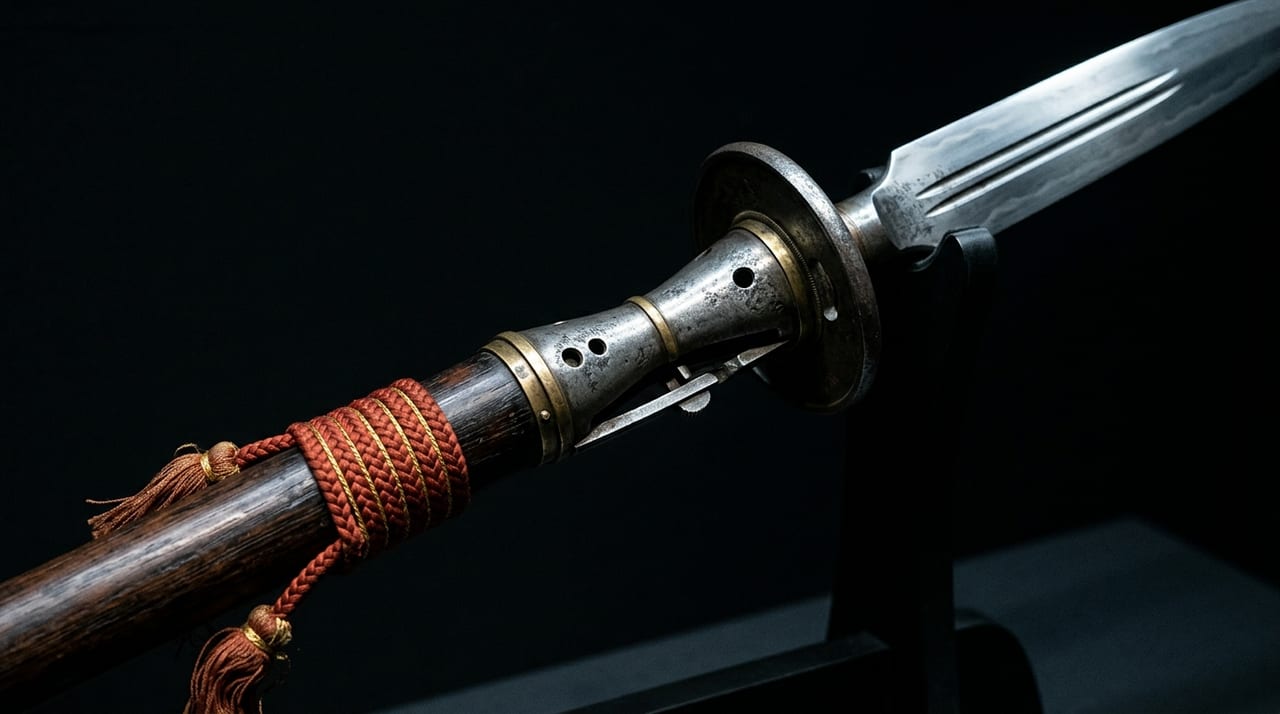
The kudayari is a spear threaded with a tube through the shaft to make the thrust smoother. A tube roughly one fistful in length (about 10 cm) is loosely threaded onto the shaft of a soyari, and the tube is not fixed to the shaft. The user holds the tube with the left hand and the shaft with the right hand. Keeping the left-hand tube largely in place, the user thrusts by pushing and pulling the shaft with the right hand. Because the shaft does not rub directly through the left hand, both the thrust and the withdrawal become faster.
When classifying spear types, the kudayari is sometimes counted alongside the soyari, kamayari, and kagiyari. However, whereas the kamayari and jūmonji yari are named for the shape of the blade, the kudayari is named for the mechanism of the shaft and how it is used. Types of spears classified by blade shape are covered in Types and Classification of Yari (Spears).
Shape and Material of the Tube
The tube is not simply a straight cylinder. It is most often made in the ryūgo form — narrowed in the middle for easier gripping. In addition to metal, some tubes are made of nerikawa. Some tubes are also fitted with a round tsuba to protect the fist.
The key points of the kudayari are as follows.
- A tube of about 10 cm is loosely threaded onto the shaft; the tube is not fixed to the shaft
- The tube is held in the left hand (mukaite) and the shaft in the right hand (shitate)
- Thrusting is done by pushing and pulling the shaft with the right hand, sliding the shaft through the tube in the left hand
- The tube is most often the ryūgo form; versions made of metal and nerikawa exist
- Some tubes are fitted with a round tsuba to protect the fist
Methods of attaching the spearhead to the shaft include inserting the nakago into the shaft and inserting the shaft into a socket-type blade. This is a separate matter from the presence or absence of a tube; even for a kudayari, the method of attaching the blade can be understood in the same way as for an ordinary spear. The difference in attachment methods is summarized in Differences Between Fukuro Yari and Nakago Yari.
The Person Traditionally Credited with Its Invention
It is traditionally said that the kudayari was devised by Itō Kii-no-Kami Suketada of Ōshū at the end of the Sengoku period. This is a matter of tradition, and neither Suketada's dates of birth and death nor the year he devised the kudayari are clearly established.
The kudayari subsequently came into wide practice in the Edo period. The lineage descending from Suketada is known as the Itō-ryū (also called the Kenkō-ryū), and other schools associated with the kudayari include the Nihon Kakuten-ryū, Isshin-ryū, Gyōkaku-ryū, and Kan-ryū. Even after the age of warfare came to an end, the kudayari continued to be practiced as a martial art by domain samurai, handed down within each school.
The Owari Kan-ryū — A School That Carries the Kudayari to This Day
Among schools of kudayari, the most prominent one whose practice has continued to the present day is the Owari Kan-ryū. It is also known as the Kan-ryū, Tsuda-ryū, and Tsuda Kan-ryū.
The school's founder was Tsuda Gonnojō Nobuyuki (1655–1698), a samurai of Owari domain and a branch of the Itō-ryū kudayari. Nobuyuki received the innermost transmission at the age of 16 and became the spear magistrate of Owari domain in Genroku 5 (1692). He is said to have realized that the tube harbored a function worth cultivating, and to have named his style "Kan-ryū" to express the idea of penetrating everything with a single principle.
The characteristics of the Owari Kan-ryū are as follows.
- A tube is threaded onto a long spear measuring 3.6 meters (two ken) in length
- Emphasis is placed on rapid thrusting in a spiral motion, with priority given to the speed of withdrawal and striking power
- Jigeiko (free sparring) in the school's own protective equipment is the core of training, and the school holds to the motto "begin with matches, end with forms"
- Under the patronage of the Owari Tokugawa house, transmitting the school to other domains was forbidden, and it is therefore also called the Otome-ryū
The Owari Kan-ryū continues to be transmitted today at dojos such as the Shunpūkan Dojo in Nakagawa Ward, Nagoya.
How to View the Difference from the Soyari
The difference between the kudayari and the soyari lies not in the shape of the blade but in the presence or absence of a tube and the technique of handling it. With the soyari, both hands grip the shaft directly, and the shaft slides through the hands during the thrust. With the kudayari, the left hand grips the tube, so the shaft slides through the tube. This allows even a long spear to be thrust forward quickly and withdrawn quickly.
From the perspective of viewing the spear as a bladed weapon, the following points are worth keeping in mind.
- The term kudayari refers to the mechanism of the shaft, not the shape of the blade
- Even when only the surviving blade of a spear is examined, it is often impossible to determine whether it was used as a kudayari
- Since the tube is a fitting attached to the shaft, when the blade and shaft have been handed down separately, the tube may no longer survive
Many spear blades were forged by tōkō in the same manner as swords. The jigane and hamon of the blade, and the mei on the nakago, can be appreciated with the same eye as a sword. At the same time, when one also considers the mechanism of the shaft and the technique of use — as in the kudayari — the ingenuity with which the spear was developed as a martial tool becomes clear. For renowned spear blades, The Three Great Spears of the Realm (Tenka Sanmeiyari) is also a useful reference.
Summary
The kudayari is a spear through whose shaft a tube of about 10 cm is threaded, allowing the shaft to slide through the tube in the left hand during thrusting. It is traditionally said to have been devised by Itō Kii-no-Kami Suketada at the end of the Sengoku period, and in the Edo period it was widely practiced in schools including the Itō-ryū, Nihon Kakuten-ryū, and Kan-ryū. Among these, the Owari Kan-ryū founded by Tsuda Gonnojō Nobuyuki of Owari domain continues to be transmitted as a spearmanship tradition using a tube-fitted spear 3.6 meters in length.
When one's attention extends beyond the shape of the blade to the mechanism and use of the shaft, the depth of the spear as a weapon comes into view. Those who wish to compare actual spears and swords can browse and purchase works currently listed in the Online Catalog (Sword Listings). Questions about listed items can be sent via the Contact Form.