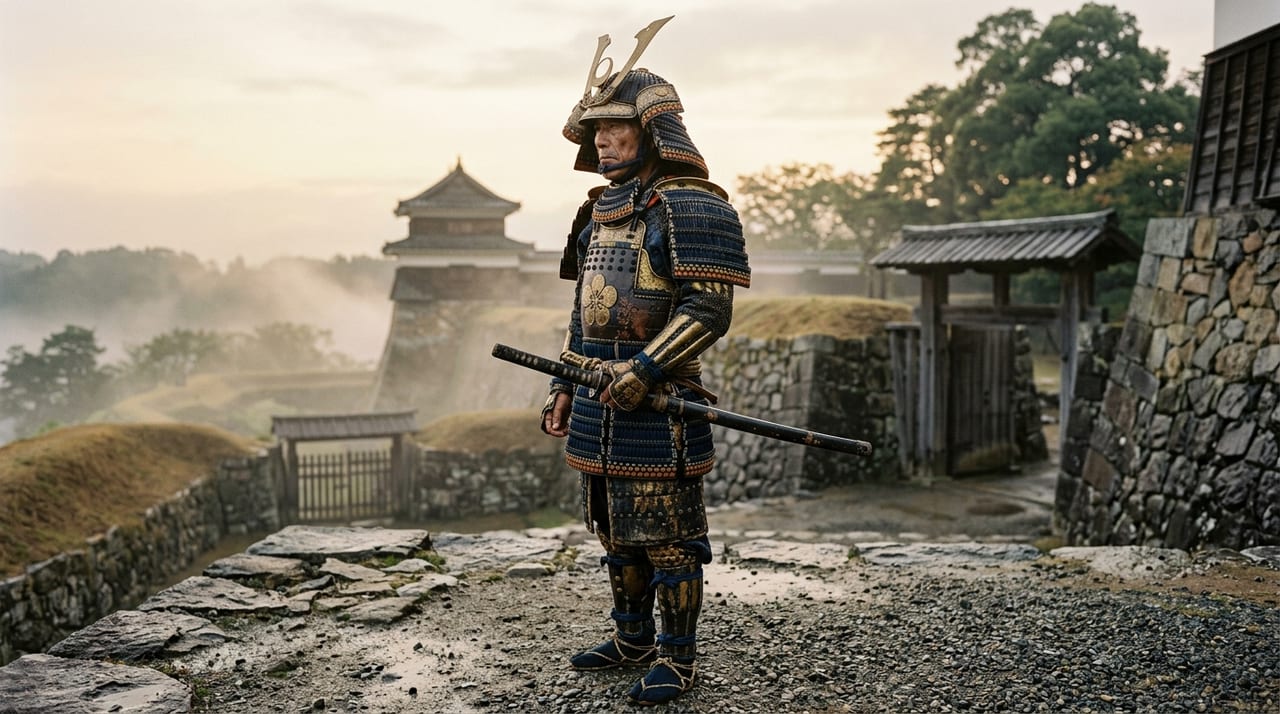
 * Image is for illustrative purposes only.
Yamauchi Kazutoyo
山内一豊
Founder of the Tosa Domain — A Late-Blooming General Who Acquired a Fine Horse Through His Wife's Wise Help and Won All of Tosa Province for His Service at Sekigahara
Description
Yamauchi Kazutoyo, a Late-Blooming General
In Tenbun 15 (1546), Yamauchi Kazutoyo was born as the third son of Yamauchi Moritoyo, a senior retainer of the Iwakura Oda in Owari Province. He is known as a warrior who rose to success through the wise naijo no kō of his wife, Chiyo, and as the protagonist of the most famous “virtuous wife” legend in Japanese history. He served Toyotomi Hideyoshi, fought campaigns across many provinces, and at the Battle of Sekigahara showed swift loyalty to Tokugawa Ieyasu, which earned him promotion to the lordship of all of Tosa Province. His life was by no means flashy, but his sound judgment, deep trust in his wife, and keen eye for the currents of the times laid the foundation for the Yamauchi family's Tosa Domain, a daimyo house that continued for more than a century.
Chiyo's Wisdom — The Story of Buying a Fine Horse
The most famous episode concerning Yamauchi Kazutoyo is the story of the fine horse bought through his wife, Chiyo. In Tenshō 9 (1581), when Kazutoyo needed an impressive horse for Oda Nobunaga's umazoroe (cavalry inspection), he was lamenting that he did not have enough money, and Chiyo offered the gold she had saved as her dowry. With this gold Kazutoyo bought a fine horse, caught Nobunaga's eye at the umazoroe, and is said to have seized the opportunity for advancement. However, this anecdote appears in Arai Hakuseki's Hankanfu and other works, which were compiled nearly a century after Kazutoyo's death, and no primary source supporting it survives. The story is so well known that it is printed even in school textbooks as a typical example of the naijo no kō, and it has been passed down as a symbol of the depth of the love and trust between Kazutoyo and Chiyo. But Kazutoyo's qualities as a warrior were also high, and it could be said that without Chiyo's help, the opportunity to display those qualities would never have come.
The Decision at Sekigahara
Kazutoyo's decision at the Battle of Sekigahara in Keichō 5 (1600) was the most important moment of his life. As many generals wavered over whether to side with Tokugawa Ieyasu or Ishida Mitsunari, Kazutoyo swiftly declared his support for Ieyasu and went further by boldly surrendering Kakegawa Castle to Ieyasu unconditionally. This quick and clear decision greatly raised Ieyasu's opinion of him, and in the postwar reward for merit, Kazutoyo received a major increase: from about 60,000 koku at Kakegawa to all of Tosa Province, 98,000 koku (later raised by reassessment to a little over 200,000 koku). However, it is also said that the plan to surrender the castle was originally Horio Tadauji's idea, which Kazutoyo put forward before him. Also well known is the anecdote that Chiyo, who was in Ōsaka, informed Kazutoyo of Ishida Mitsunari's uprising by secret letter.
Founding of the Tosa Domain and Later Years
In Keichō 6 (1601), Kazutoyo entered Tosa Province (present-day Kōchi Prefecture) and founded the Tosa Domain of the Yamauchi family. He began construction of Kōchi Castle and worked to govern the land of Tosa, but he died in Keichō 10 (1605). The Yamauchi family continued to rule the domain until the bakumatsu period, laying the foundation for a land that produced the Tosa Loyalist Party, Sakamoto Ryōma, and others. It is also said that the “humility to accept help from others” and the “decisiveness to read the right moment” that Kazutoyo left behind were inherited by the character of Tosa.
Chiyo and Kazutoyo — A Model of the Japanese Married Couple
The relationship between Yamauchi Kazutoyo and Chiyo has been widely praised since the Edo period as a typical model of the ideal married couple in Japan. It has been passed down that Kazutoyo was able to earn martial merit and fame only because of his wife's wise help. This dramatic life of a married couple, also depicted in the NHK Taiga Drama “Kōmyō ga Tsuji” (2006), remains beloved by many people today. In the field of swords as well, just as Kazutoyo gained the opportunity to rise through Chiyo's gold, fine swords have been deeply engraved in Japanese history as objects with the power to change the status and fate of a warrior.