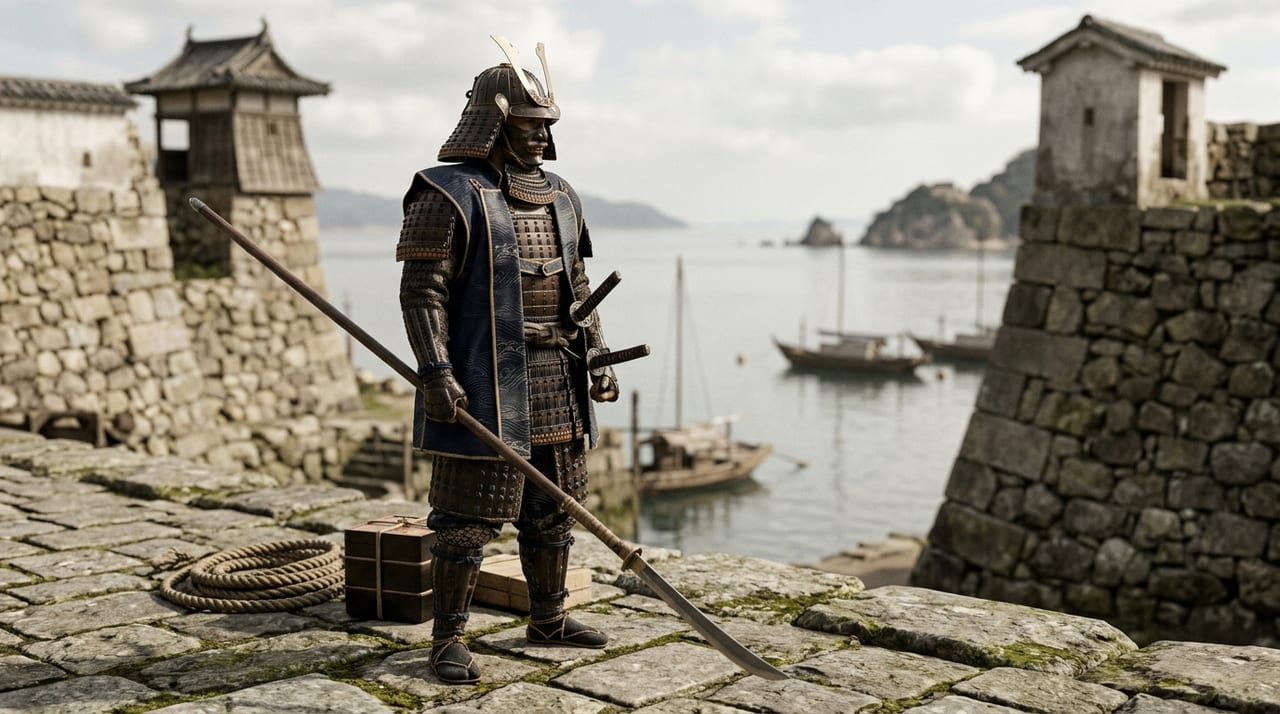
 * Image is for illustrative purposes only.
Tanaka Shinbei
田中新兵衛
One of the "Four Great Assassins" of the Bakumatsu Era, Satsuma Domain Retainer
Description
Life
Born in 1832 in Kagoshima, Satsuma Province. He is also said to have been the son of a boatman or a medicine dealer, and he was not born into a samurai family. The wealthy merchant Moriyama Shinzō, of the Sonnō Jōi faction, purchased a samurai status for him, which gave him the quasi-samurai (bashin) standing of a private retainer of the Satsuma domain. From childhood he devoted himself to martial arts, and tradition holds that he excelled at swordsmanship.
Swordsmanship
His exact line of teachers has not been definitively established, but since he grew up in the castle town of Kagoshima, he is thought to have studied one of the branch schools of Jigen-ryū, which was widely practiced among Satsuma retainers.
Major Assassinations
In 1862 he went to Kyoto and threw himself into the Sonnō Jōi movement. In the 7th month of that year, he attacked and beheaded Shimada Sakon, a retainer of the Kujō family who had cooperated with the shogunate during the Ansei Purge, and his head is said to have been displayed at Pontochō. Thereafter, tradition holds that he was also involved in the assassinations of Homma Seiichirō, Watanabe Kinzaburō, and others. Alongside Okada Izō and others, he was counted among the "Four Great Assassins" of the Bakumatsu period.
Suspicion in the Assassination of Anenokōji Kintomo and His Death
On July 5, 1863 (Bunkyū 3, 5th month, 20th day), the pro-sonnō court noble Anenokōji Kintomo was assassinated outside the Sakuhei Gate of the Kyoto Imperial Palace. A sword and Satsuma geta left at the scene led to suspicion falling on Shinbei, and he was arrested. During interrogation, he seized a lapse in vigilance, disembowelled himself with a wakizashi, and then, turning the blade, stabbed his own carotid artery and died, so the truth of the incident was never established. He was 32.
Connection to Swords
Shinbei's beloved sword is said to be the work of the Satsuma swordsmith Oku Izumi-no-kami Tadashige. Its blade measured two shaku three sun (about 70 cm), and tradition holds that its hilt, wrapped in black-lacquered shark skin, bore the engraved inscriptions "Chinju" and "Ei." The sword left at the scene of the Anenokōji assassination was determined to be his, which decided his own fate, and in this respect his blade is inseparably tied to the incident.
Later Reputation
Including his involvement in assassinations whose truth remains unclear, and having taken his own life without saying much, he is remembered in Bakumatsu history as "the man who said nothing," a singular swordsman-assassin who is still told of today.
Notable Swords
- Blade attributed to Oku Izumi-no-kami Tadashige