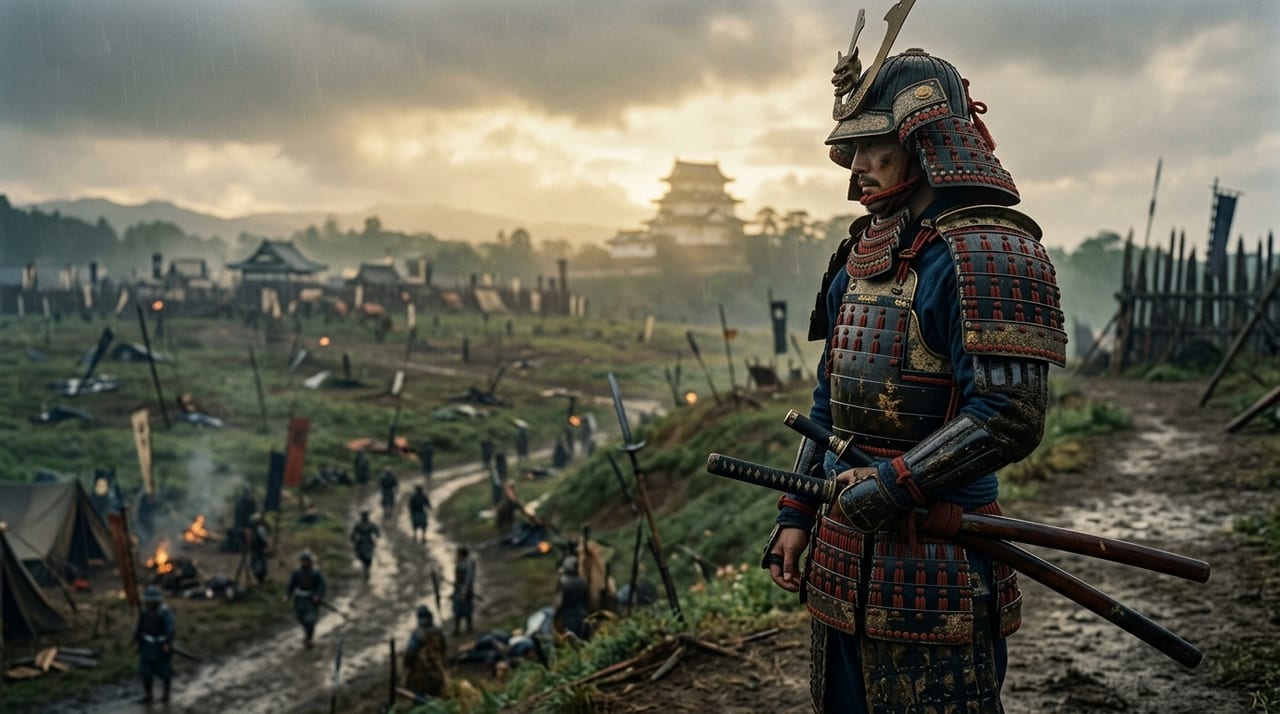
 * Image is for illustrative purposes only.
Hattori Hanzō
服部半蔵
Oni Hanzō—Spear Master Who Served Tokugawa Ieyasu and Led the Iga dōshin; His Name Still Signifies the Pinnacle of Swordsmen
Description
The Birth of Oni Hanzō
Hattori Hanzō Masanari was born in Mikawa Province (present-day Okazaki, Aichi Prefecture) in Tenbun 11 (1542). He served Tokugawa Ieyasu and later led the Iga dōshin, so later generations have remembered him chiefly as the head of the Iga ninja. Hanzō himself, known by the nickname 'Oni Hanzō,' was a vanguard bannerman of the Tokugawa house, and he earned first-spear distinction at the Battle of Anegawa and the Battle of Mikatagahara.
The Iga Crossing
In the 6th month of Tenshō 10 (1582), news of Oda Nobunaga's death in the Honnō-ji Incident reached Tokugawa Ieyasu, who was staying in Sakai, and it shocked him. Fearing that Akechi Mitsuhide's forces would reach him, Ieyasu's party tried to return from Sakai to Okazaki Castle with only a small retinue. During this 'Iga Crossing,' Hattori Hanzō negotiated with the Iga and Kōka local strongmen together with Chaya Shirōjirō Kiyonobu to secure protection for Ieyasu's party. Had it not been for Hanzō's resourcefulness and the network of Iga men, Tokugawa Ieyasu might have been cut down by Akechi's pursuers. This achievement has been handed down as Hanzō's greatest accomplishment.
A Master of the Spear
Hanzō's signature was the spear. He was exceptionally skilled with the long spear, and Ieyasu is said to have praised his feats as 'oni-yari' ('demon spear'). Temple tradition holds that the ōmi-yari he received from Ieyasu as a reward for his service at the Battle of Mikatagahara is preserved at Sainen-ji in Shinjuku, Tokyo, where it is still known as 'Hattori Hanzō's spear.'
The Warrior and the Iga Men
Hanzō's own fighting style was that of a samurai who prized being first into battle and first to take the spear, relying on the spear and unarmed combat. At the same time, the records show that as a commander he led Iga men and Kōka men and sent out shinobi to carry out reconnaissance and covert operations. It is this position, bridging both warrior and shinobi, that gave rise to the later image of 'Ninja Hattori Hanzō.'
The Origin of Hanzōmon
The Hanzōmon gate, built on the west side of Edo Castle (present-day Imperial Palace), takes its name from the fact that Hattori Hanzō's residence was located there. Hanzō led two hundred Iga men in guarding Edo Castle and was expected to serve as the final bulwark of the shogunal house. The name survives today as a place name in Tokyo and also gives its name to the Tokyo Metro Hanzōmon Line. More than four hundred years after Hattori Hanzō's death, his name remains inscribed in the city of Tokyo.
Legend and Reality
In literature, theater, and film, Hattori Hanzō has repeatedly been portrayed as the 'strongest ninja swordsman.' In Quentin Tarantino's film Kill Bill, the name 'Hattori Hanzo' is given to the maker of 'the finest sword in the world' that the protagonist seeks, and this link between Hanzō and swords has carried into contemporary popular culture. The real Hanzō is said to have been less a schemer skilled in ninjutsu than an able organizer and intelligence officer, yet his legendary fame continues to be told together with the mystique of the Japanese sword.
Final Years and Successors
In January 1597 (the 11th month of Keichō 1), Hanzō died at the age of fifty-five. His son Masanari succeeded his father as head of the Iga men, but he was later dismissed (kaieki) owing to friction with the Iga dōshin and other factors. The name 'Hattori Hanzō' was taken up by Masanari's younger brother Masashige, but Masashige was relieved of the role of leading the Iga dōshin. He later became chief retainer (karō) of the Kuwana Domain, and his house continued to hold the post of karō until the late Edo period.
Notable Swords
- Long spear, Hanzō's spear (an ōmi-yari which temple tradition holds was bestowed on him by Ieyasu for his service at the Battle of Mikatagahara; transmitted at Sainen-ji in Shinjuku, Tokyo)