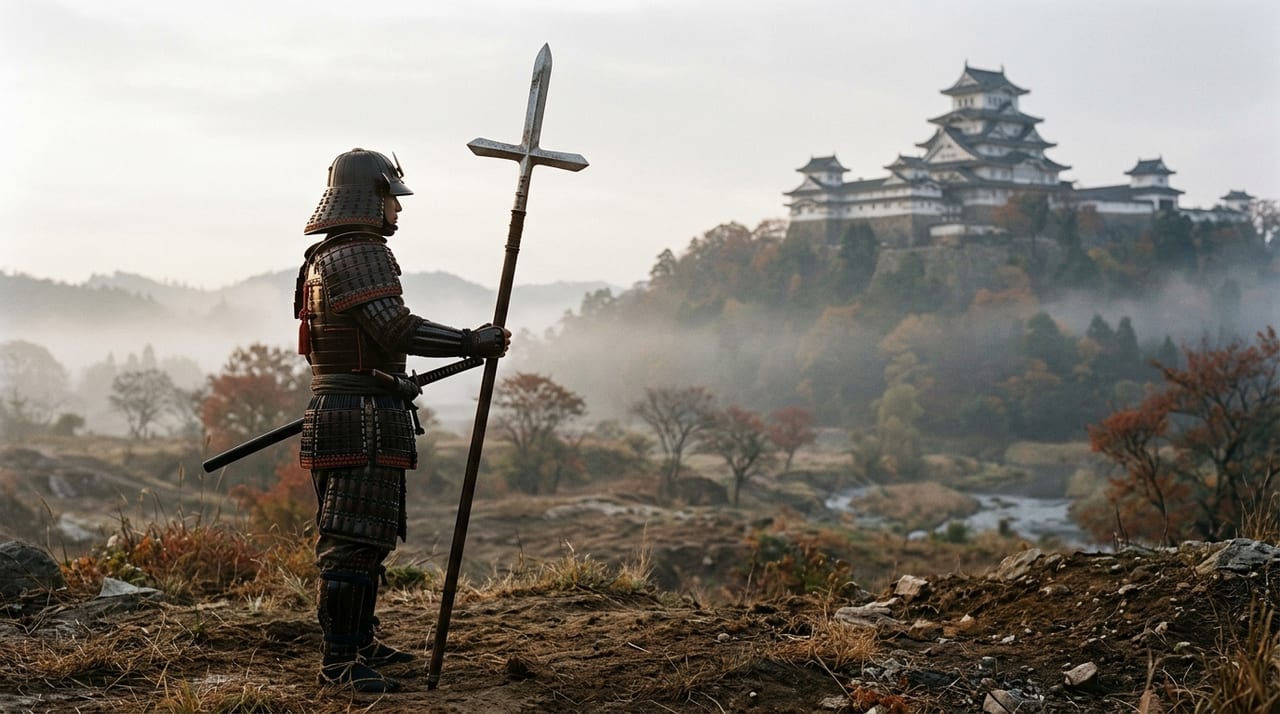
 * Image is for illustrative purposes only.
Harada Sanosuke
原田左之助
Captain of the 10th Unit of the Shinsengumi — A Spear Master and Valiant Warrior, the Shinsengumi's Spearman Remembered More for the Spear Than the Sword
Description
An Unusual Figure: A Master of the Spear
Harada Sanosuke, said to have been born around Tenpō 11 (1840) in Iyo Province (present-day Ehime Prefecture), was an exceptionally unusual figure within the Shinsengumi. Within the Shinsengumi, a band of swordsmen centered on swordsmanship, the weapon in which Harada excelled most was the spear. Harada is said to have entered the dojo of the Tani brothers, Tani Sanjūrō and Tani Mantarō, in Osaka, where he studied the Taneda-ryū spear art.
Pride in a Sword Wound to the Belly
It is said that Harada bore scars on his belly from an attempt at seppuku. A well-known anecdote tells that, while serving as a wakatō (young retainer) in Matsuyama, he was berated by a superior as "a lowborn wretch who does not even know how to cut his belly," and that he then actually cut his own belly to show him. The authenticity of this anecdote is debated, but it is certain that Harada was known within the Shinsengumi as a man who took pride in his martial valor.
Connection to Swords
Writing faithfully as a site about swords, Harada's principal weapon was the spear, and concrete records of the sword he wore are scarce. As a samurai of the late Edo period he naturally wore a sword, but in actual combat he is said to have mostly used the spear. While the Shinsengumi swordsmen are recorded as having favored blades such as Yamato no Kami Yasusada and Kashū Kiyomitsu, no reliable record of the sword Harada wore survives. Though a spear is a bladed weapon, he is remembered as a warrior who walked a different "path of the blade" from that of the Japanese sword.
The Ikedaya Incident and the Boshin War
He also took part in the Ikedaya Incident in Genji 1 (1864) and was constantly engaged in the Shinsengumi's activities. After fighting in the Battle of Toba–Fushimi and the Battle of Kōshū-Katsunuma, he parted ways with Kondō Isami and others in Edo and, together with Nagakura Shinpachi, formed the Seiheitai. His later whereabouts are subject to various theories: it is said that he left the Seiheitai to join the Shōgitai and died of wounds sustained in the Battle of Ueno in Keiō 4 (1868), while other accounts say he crossed over to the continent. The truth of his death remains unclear even today, and the enigmatic end of the man Harada Sanosuke is also one of the elements that color the romance of the late Edo period.
The Diversity of Martial Arts in the Shinsengumi
Harada's existence enriches the image of "the Shinsengumi as a band of swordsmen." Carrying a spear and finding his pride in the spear rather than the sword, Harada Sanosuke was a warrior who embodied the breadth of the martial world of bladed weapons.
Notable Swords
- Spear (Sanosuke's principal weapon; said to have studied the Taneda-ryū spear art at the dojo of the Tani brothers, Tani Sanjūrō and Tani Mantarō, in Osaka)
- Katana (details unknown; as a samurai he would have carried a sword, but no reliable historical records document his specific blade)