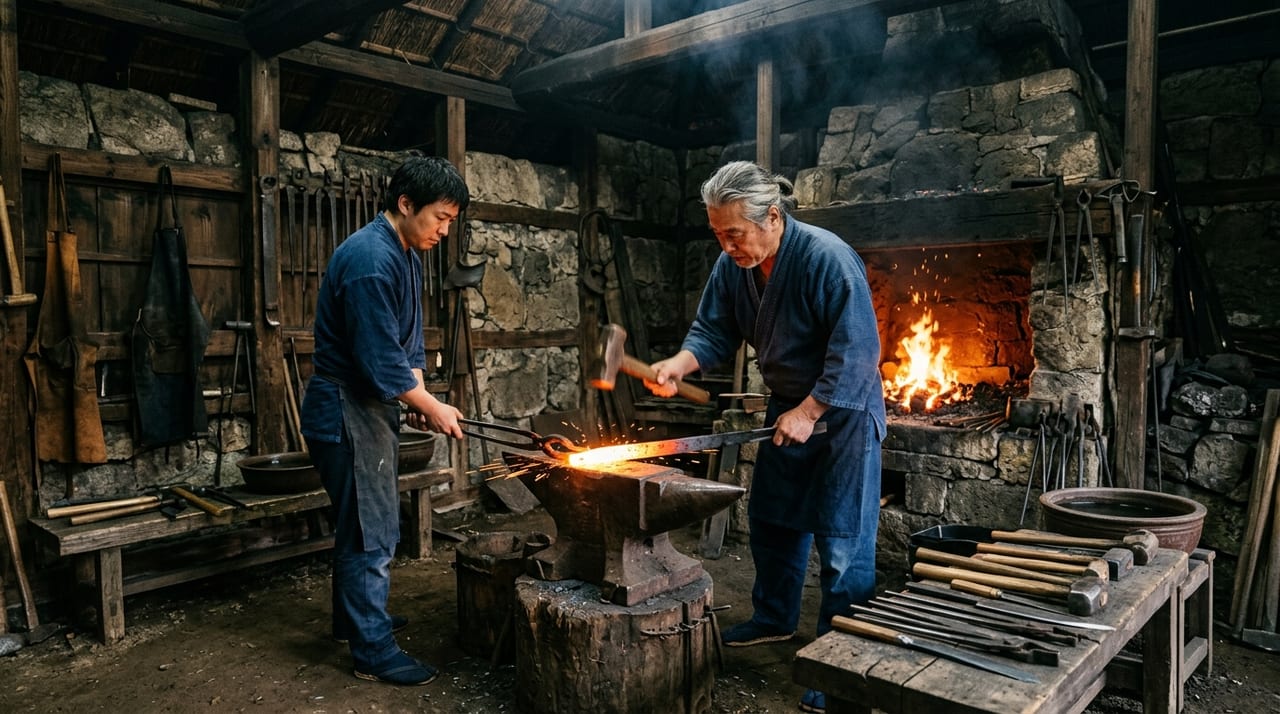
 * Image is for illustrative purposes only.
Senjuin
千手院
Description
Senjuin was a school of swordsmiths that arose in Yamato Province (present-day Nara Prefecture) and was active from the late Heian period through the Kamakura period into the Nanboku-chō period. Together with Tegai, Taima, Shikkake, and Hōshō, it is collectively called the five Yamato schools (Yamato Goha), though it is considered the oldest of them. The school takes its name from its sword forging in Senju Valley at the foot of Mount Wakakusa in Nara, and it is also tied to the fact that Senju-dō (Senjuin-dō), with Senju Kannon as its principal image, stood in that same place. Yamato swordsmiths developed as a group subordinate to the great temples of Nanto (Nara), beginning with Kōfuku-ji and Tōdai-ji, and grew in response to demand for the weapons carried by the warrior monks (sōhei) of those temples. Senjuin is also traditionally said to descend from smiths subordinate to Tōdai-ji. Yukinobu is handed down as the founder of the school, but there is no evidence for his period of activity beyond placing it in the late Heian period, and only the names of a few smiths, including Shigehiro, have been known since ancient times.
Its style clearly shows the characteristics of the Yamato tradition. The construction (tsukurikomi) is koshi-zori with fumbari, and the basic form is a tachi with a high shinogi and a broad shinogi-haba. The jigane shows itame-hada flowing into masame-gakari, with thick ji-nie, and chikei appearing, giving a clear and refined quality. The hamon is based on suguha, mixed with ko-midare and ko-gunome, and abundant workings characteristic of Yamato-mono appear, such as nijūba, kuichigai, kinsuji, sunagashi, and yubashiri. The point that most distinguishes it from other schools is that its style is elegant and plain, and because it is the oldest of the five schools, it possesses the dignity of kochō and kosaku.
Because Senjuin works differ in style by period, works from the early Kamakura period or earlier are distinguished as Ko-Senjuin, and works from that time through the Nanboku-chō period are simply called Senjuin. Ko-Senjuin especially shows kochō, but very few of its works have been transmitted, and almost no signed works with certain dates are seen. In fact, most of the extant works of the Senjuin school are unsigned, and their kiwame relies not on an inscription but on judgment of the style itself. The scarcity of reliably signed works, and by extension the difficulty of tracing the achievements of individual smiths from their works, speaks to the antiquity of this school and its character as a group of craftsmen attached to a temple.
In terms of evaluation, it is placed among the superior works (jōsaku) of kotō, and it is valued in sword history as the oldest source among the five Yamato schools. One of its certain surviving examples is the tachi, mumei, Senjuin, held by the Touken World Foundation, which has been certified as Tokubetsu Jūyō Tōken. This work is known as an excellent piece that well displays the stylistic range of the Senjuin school's traditional works: the kitae shows itame flowing into masame with ji-nie well developed; the hamon is suguha-style with shallow notare, with kinsuji and sunagashi; and the nioiguchi is bright and clear. That it has been firmly attributed to Senjuin from its style despite being unsigned clearly shows how this school is appreciated.
Famous Works
- Tachi (Important Cultural Property)