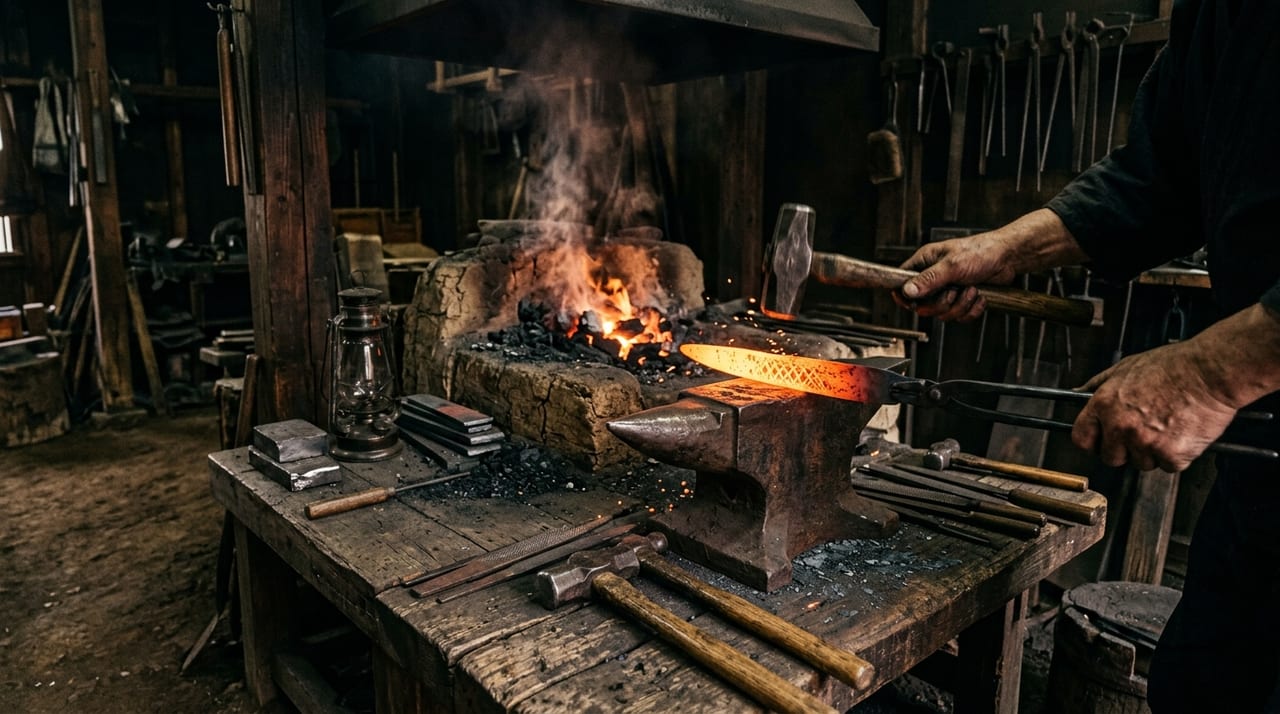
 * Image is for illustrative purposes only.
Sōshū Sadamune
相州貞宗
Description
Sōshū Sadamune was a swordsmith active in Kamakura, Sagami Province, from the late Kamakura period into the Nanboku-chō period. His common name was Hikoshirō, and although he is said to have been either a son or adopted son of Masamune, who brought the Sōshū-den (Sōshū tradition) to completion, this has not been confirmed; he is nonetheless regarded as the legitimate successor of Masamune's workshop. The Kanchi-in manuscript of the Meizukushi, regarded as the oldest sword book, also records “Masamune Gorō nyūdō, Sadamune, Hikoshirō Saemon-no-jō”, and his name was known early on.
His style strongly inherits that of his teacher Masamune. The jigane is ko-itame hada, tightly packed; ji-nie is well developed, and chikei appear frequently. The hamon is mainly notare mixed with gunome, and within the hanaka (inside the hamon) workings such as kinsuji and sunagashi are vigorous; the nioiguchi shows a bright, clear quality with deep nie. However, overall, unlike Masamune, chikei and kinsuji are not as prominent, and the work is more moderate and elegant, which is where Sadamune's individuality lies. He also excelled at horimono on the blade, and works with bonji and rendai carvings are known.
There are no extant works by Sadamune with a securely confirmed signature (mei), and most transmitted works are mumei attributions by the Hon'ami family. The shumei (red-lacquer attribution) inscribed in red lacquer on the tang is not the maker's own signature but an attribution inscription of the Hon'ami family, and it is through these attributions and origami certificates that the works have been transmitted as Sadamune's.
Many of his representative works survive as National Treasures and Important Cultural Properties. Among the National Treasures are the “Kikkō Sadamune” (katana, Tokyo National Museum), named after the hanabishi-kikkō pattern engraved (kebori) on the tip of the tang on the sashi-ura side; the “Tokuzen'in Sadamune” (tantō, Mitsui Memorial Museum); the “Fushimi Sadamune” (tantō, Kurokawa Institute of Ancient Cultures); and the “Terasawa Sadamune” (tantō, Agency for Cultural Affairs). Among the Important Cultural Properties, the “Monoyoshi Sadamune” (tantō, Tokugawa Art Museum) is well known; it is named after an anecdote that Tokugawa Ieyasu, who favored it, would always win whenever he drew it, and it was later passed down to the Owari Tokugawa family.
In terms of lineage, the line running from Masamune to Sadamune is regarded as the orthodox line (chakuryū) of the Sōshū-den. Sadamune is also counted among the Masamune Juttetsu (the ten great disciples of Masamune), a grouping formed in the late Edo period, although there is also a view that Sekishū Naotsuna should be included in place of Sadamune, Masamune's adopted son. The Kyōhō Meibutsuchō, compiled by the Hon'ami family at the command of the eighth shōgun Tokugawa Yoshimune, also lists many works by Sadamune, and of the extant works, four are designated National Treasures and twelve Important Cultural Properties. As Masamune's legitimate successor, Sadamune is regarded as a swordsmith who represents the Sōshū-den.
Famous Works
- Kikkō Sadamune (meibutsu)