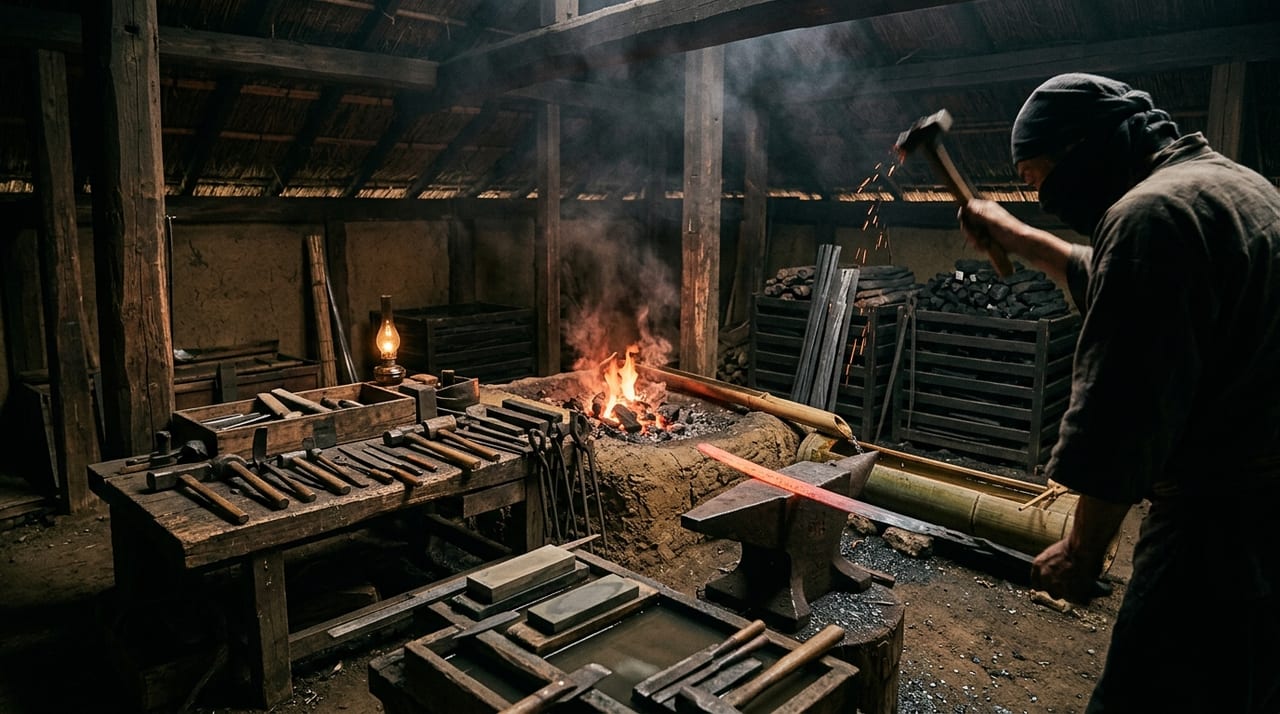
 * Image is for illustrative purposes only.
Rai Kunimitsu
来国光
Description
The Supreme Rai School: Historical Position of Rai Kunimitsu
Rai Kunimitsu was the foremost smith of the Rai school, active in Yamashiro Province from the late Kamakura period into the early Nanboku-chō period. He is traditionally said to be a child of Rai Kunitoshi, who continued the line of Rai Kuniyuki, the school's founding figure, and he is regarded as one of the school's leading smiths alongside Rai Kunitoshi and Rai Kunitsugu. In Japanese sword scholarship, Rai Kunitoshi is often seen as representing the dignity of the Rai school, while Rai Kunimitsu is often valued as the expression of its technical peak.
Rai Kunimitsu's period of activity coincided with the time when the Sōshū-den was beginning to expand its influence centered on Kamakura. While Yukimitsu, the teacher of Masamune, was developing innovative blades toward the establishment of the Sōshū-den, Rai Kunimitsu maintained the refined traditions of the Yamashiro-den at a high level while absorbing the new currents of the age, and he achieved a unique height of his own. His work preserves the clarity inherent in the Yamashiro-den while adding the grandeur characteristic of the late Kamakura period, and in it classical elegance and the vigor of the warrior age are masterfully combined.
Kunimitsu's Position in the Rai Lineage
The Rai school consists of a lineage that runs from Rai Kuniyuki, its de facto founder, through Kuniyuki, Kunitoshi, Kunimitsu, and Kunitsugu, together with a number of smiths who were active alongside this line. Rai Kunimitsu is considered to have been a child or disciple of Rai Kunitoshi in this lineage, and he represents the second and third generations of the Rai school.
Disciples and grand-disciples of Rai Kunimitsu carried on the sword culture of Kyoto and continued to influence the smiths of Yamashiro after the Muromachi period. Rai Kunimitsu's style also became a model for later Kyoto-school smiths, and through the practice of making blades in the manner known as Rai-utsushi, it continued to be highly respected by many later smiths into the Edo period and beyond.
Characteristics of His Work: The Crystallization of Rai School Aesthetics
The greatest feature of Rai Kunimitsu's blades is that they embody the aesthetics of the Yamashiro-den and the Rai school at their highest level. The jigane is a refined forging built mainly on ko-itame, and its ji-nie is especially elegant and its surface transparently clear, expressing the particular beauty of the Rai school. Some works also show the distinctive reflection of the Rai school known as nie-utsuri (Rai-utsuri), a scenery produced by the combination of a finely forged jigane and the technique of hardening.
The hamon is based on suguha, and it shows a varied composition that gracefully includes ko-midare and ko-chōji. The nie-tsuki is fine and uniform, giving the habuchi a tightened and beautiful impression. The work of the ashi and yō is also delicate, and the scenery within the hamon is rich without asserting itself too strongly, achieving a balanced beauty. Following the trends of the late Kamakura period, some works show strong hardening reminiscent of the Sōshū-den, and this, too, reveals the breadth of Rai Kunimitsu's craft.
Many masterful short blades (tantō) also survive, and he is sometimes considered, together with Awataguchi Yoshimitsu, one of the two great masters of Yamashiro-den tantō. Even in short blades, his elegant shapes and refined hamon embody the dignity of the Rai school, and museums and galleries across the country treasure them as exhibits of the highest quality.
Extant Works and Cultural Property Designations
A considerable number of Rai Kunimitsu's signed extant works are known, both tachi and tantō, and he is one of the smiths of the Rai school with the largest number of surviving works. The tachi inscribed "Rai Kunimitsu" held at the Tokyo National Museum is designated a National Treasure and is widely known as a cultural property that embodies the highest peak of the Rai school. Several works have also been designated Important Cultural Properties, and they are held by major museums and galleries in Japan and abroad.
Since the Edo period, Rai Kunimitsu's works have been especially prized as rai-mono, and among daimyō families and court nobles they were treated as swords of the highest rank. Many works received the highest evaluation in the origami (appraisal certificates) issued by the Hon'ami family, and their value has been officially recognized since ancient times.
TOUKENZA and Rai Kunimitsu
TOUKENZA presents Rai Kunimitsu as a master who represents the technical peak of the Yamashiro-den and the Rai school. His blades, which polished the clear aesthetic sensibility of the Rai school to its utmost limit, have secured the name of Rai Kunimitsu in the history of Japanese swords as the supreme figure of the Yamashiro-den, shining eternally. In an age when the innovations of the Sōshū-den swept the world of Japanese swords, Rai Kunimitsu defended the aesthetic values unique to the Yamashiro-den and faithfully passed them down to later generations. His achievement should be highly regarded not merely as technical brilliance but as the fulfillment of the cultural mission of preserving and carrying on the aesthetic diversity of Japanese swords.
Famous Works
- Tachi signed Rai Kunimitsu (National Treasure, Tokyo National Museum)
- Tanto signed Rai Kunimitsu (Important Cultural Property, multiple examples)
- Tanto signed Rai Kunimitsu (named Uraku Rai Kunimitsu, National Treasure)