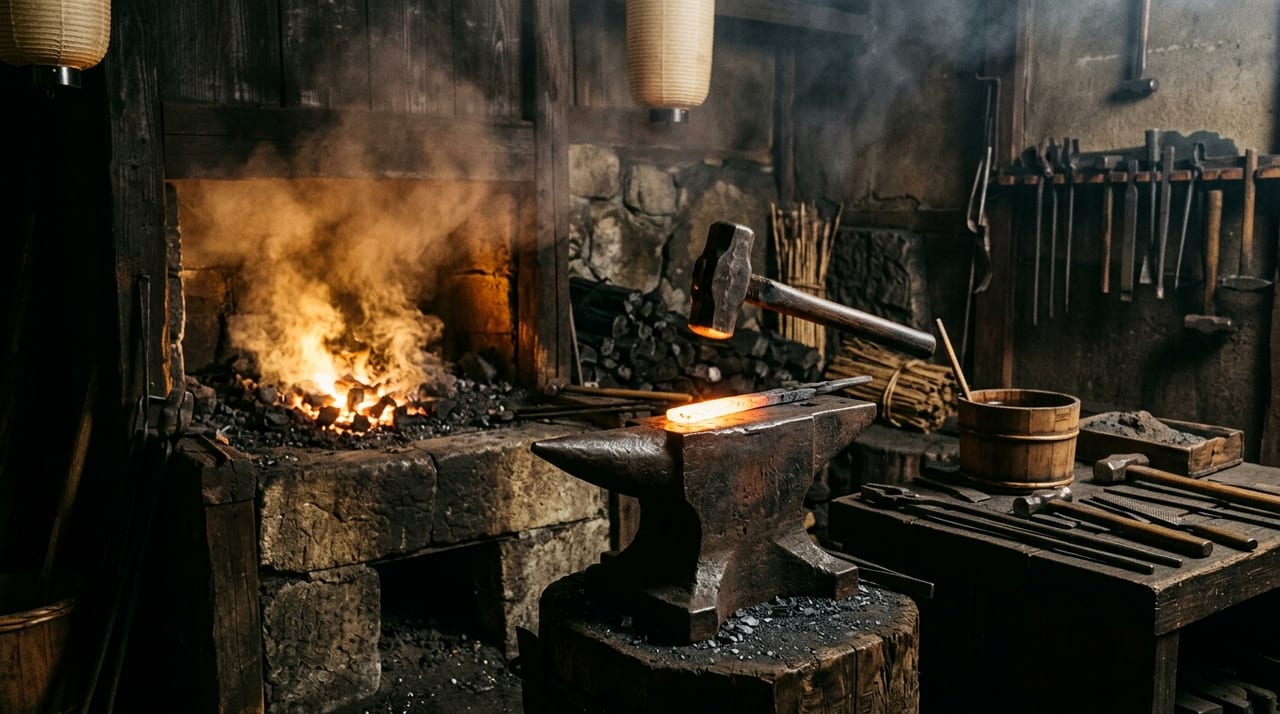
 * Image is for illustrative purposes only.
Ōsumi Toshihira
大隅俊平
Description
Ōsumi Toshihira (1932–2009) was the leading figure of Japanese swordsmithing and the foremost of contemporary swordsmiths, based in Ōta City, Gunma Prefecture. In 1997 (Heisei 9) he was certified as a holder of Important Intangible Cultural Property (Living National Treasure). In 1952 (Shōwa 27), he became a student of Miyairi Akihira, who led the postwar revival of Japanese swordsmithing and later took the name Yukihira and became a Living National Treasure. Through this training, he carried the traditional forging techniques using tamahagane into the modern era.
The greatest feature of Toshihira's swords lies in his thorough use of tamahagane and in the beauty of a jigane that rivals that of old swords (kotō). He personally selects tamahagane produced by tatara smelting, an ancient method that had nearly disappeared in the modern era, and by folding and forging the steel repeatedly, he achieves a lustrous jigane rarely seen in modern swords. The jigane is primarily ko-itame-hada, with itame and masame grain blending naturally into a complex pattern. For the hamon, he studied the suguha of the Bitchū Aoe school and, apart from his very earliest period, continued to produce suguha throughout his career. The nioiguchi is tight, and the nie is fine and evenly distributed, resulting in a refined finish reminiscent of masterpieces of kotō.
He won the Masamune Prize three times at the New Work Sword Exhibition (Shinsaku Meitō-ten), in 1974, 1976, and 1978. He also presented swords for the Shikinen Sengū at Ise Grand Shrine.
His designation as a Living National Treasure attests to his having reached the highest level of technical skill among contemporary swordsmiths, and he continues to receive high acclaim posthumously as one of the foremost contemporary swordsmiths. He died in 2009 (Heisei 21) at the age of 77, and the Ōsumi Toshihira Art Museum is located in Ōta City, his hometown.
Famous Works
- Votive swords for the Ise Jingū Shikinen Sengū
- Winner of the Masamune Prize at the Shinsaku Meitōten (1974, 1976, 1978)