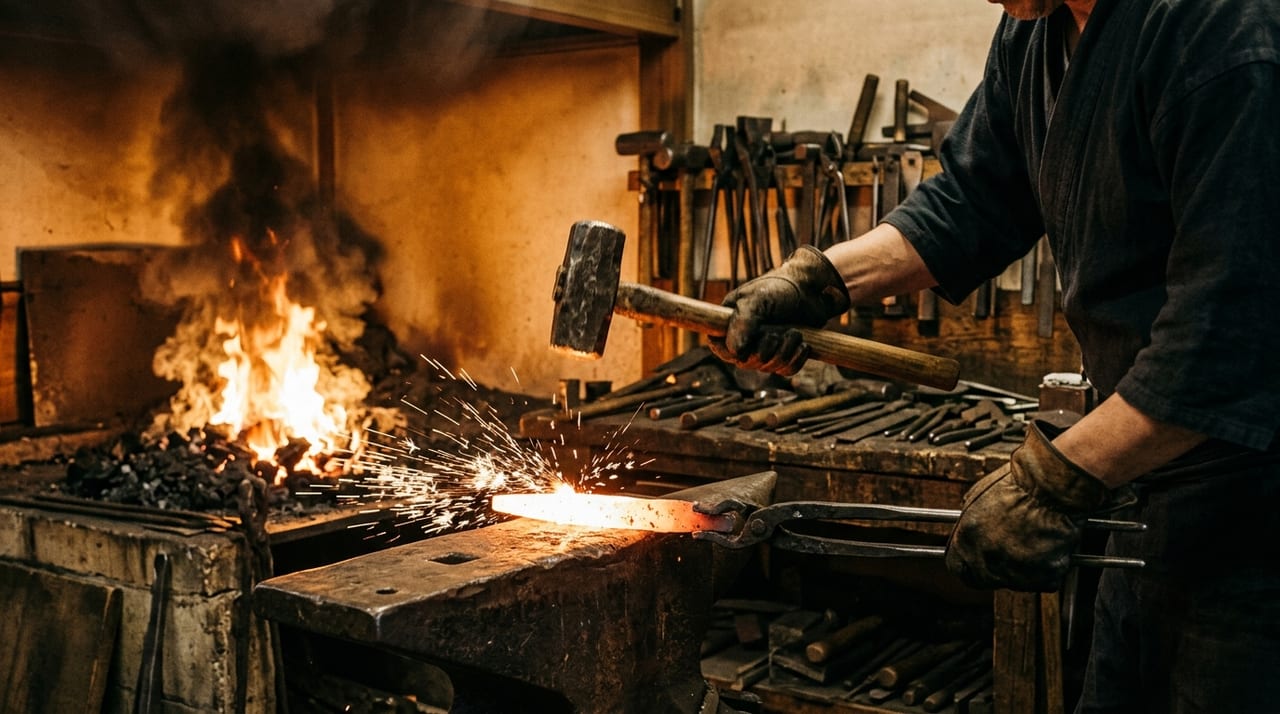
 * Image is for illustrative purposes only.
Kawachi Kunihira
河内國平
Description
Yamato-den's Modern Exponent: Kawachi Kunihira
Kawachi Kunihira is a contemporary swordsmith active across the Shōwa, Heisei, and Reiwa eras. Based in Nara Prefecture, he embodies the Yamato-den tradition in the present day and receives the highest evaluation from both Japan and abroad. In 1988 the NBTHK (Nihon Bijutsu Tōken Hozon Kyōkai) granted him Mukansa status, the mark of the highest rank for a swordsmith. His record of winning top honors in the sword world, including the Takamatsu-no-miya Prize (1979) and the Masamune Prize at the Shinsaku Meitō Exhibition (2014), shows that he has the most advanced skill among contemporary smiths.
The Yamato-den is one of the Gokaden, alongside the Yamashiro-den, Bizen-den, Sōshū-den, and Mino-den, and it developed in the religious and cultural setting centered on Nara's temples and shrines. Its style is marked by masame-based jigane, suguha-centered hamon, and nie activity such as hakikake, nijū-ba, and uchinoke. This gives it a distinct aesthetic that is clearly separate from the other four traditions. Kawachi Kunihira holds a special place in the Japanese sword world as a smith who embodies this Yamato-den beauty at the highest standard today.
Yamato-den's Historical Weight in Nara and Kunihira's Role
Nara is one of the oldest sword-culture regions, linked to the origins of Japanese swordmaking, and it is the historic land where masters of the Yamato-den were active over a thousand years. The swordmaking traditions left by the kotō masters, including Tegai Kanenaga, Shikkake Norinaga, Senjuin, and Hōshō, still live on in Nara. Kawachi Kunihira continues to forge Yamato-den blades from his base in Nara, and this carries special significance as a way of passing that historical weight on to the present.
Kawachi Kunihira was born in Osaka as the second son of Kawachi no Kami Kunisuke, the 14th-generation swordsmith. He studied Sōshū-den under Living National Treasure Miyairi Yukihira (Akihira) and Bizen-den under Living National Treasure Sumitani Masamine, and he mastered Yamato-den in 1995. In 2014 he won the Masamune Prize for a work that recreates midare-utsuri, a feature of kotō blades. His research-minded approach, which seeks to recover the beauty of kotō using modern materials and techniques, stands out even among contemporary smiths.
Characteristics of His Blades — The Essence of Yamato-den
The greatest feature of Kawachi Kunihira's blades is that he embodies the forms unique to Yamato-den at the highest standard in the present day: a refined jigane that mixes masame and itame, and a clear hamon centered on suguha, ko-midare, and nijū-ba. He forges the jigane with a strong focus on masame. In works where the nie activity unique to Yamato-den, such as hakikake, nijū-ba, and uchinoke, unfolds richly, the dignity of the kotō-period masterpieces comes through.
The hamon is centered on suguha, with neatly formed ko-midare and ko-chōji included with restraint, and fine Yamato-den-specific activity decorates the edge. The nie is fine and uniform, giving an impression of a clear, tightened hamon edge. Overall, he achieves at a high level the Yamato-den's "pure beauty," an aesthetic that values religious and spiritual clarity over the bold grandeur of the warrior house.
In form, he basically aims for the graceful shape of the kotō style. He keeps a length and curvature suited to modern demand, and he still achieves an overall beauty that does not lose the dignity of Yamato-den.
Scholarly and Cultural Activities
Kawachi Kunihira plays an important role not only in sword-making but also in the scholarly study and popularization of Japanese sword culture. His activities include writing and lecturing, training young smiths, and producing the tachi and hoko for the 61st and 62nd periodic rebuilding (Shikinen Sengū) of Ise Grand Shrine. Together they make up a broad cultural contribution that goes beyond sword-making technique.
TOUKENZA and Kawachi Kunihira
TOUKENZA introduces Kawachi Kunihira as a master who embodies one of the oldest traditions of the Japanese sword, the Yamato-den, at the highest standard in the present day. The high technical level that his Mukansa rank and numerous awards officially certify, his continued sword-making in the historic land of Nara, and his dedication to the cultural mission of conveying the Yamato-den aesthetic to the present day come together to set Kawachi Kunihira apart as an exceptional figure even among contemporary smiths. His works, which bring the clear beauty of Yamato-den to modern viewers, show that the Japanese sword remains a living art today.
Famous Works
- Kunihira Kawachi no Kami Kunisuke (Masamune Prize, New Masterpiece Sword Exhibition 2014)
- katana, signed Kunihira (New Masterpiece Sword Exhibition prize-winning works; multiple)
- tantō, signed Kunihira (various fine examples)