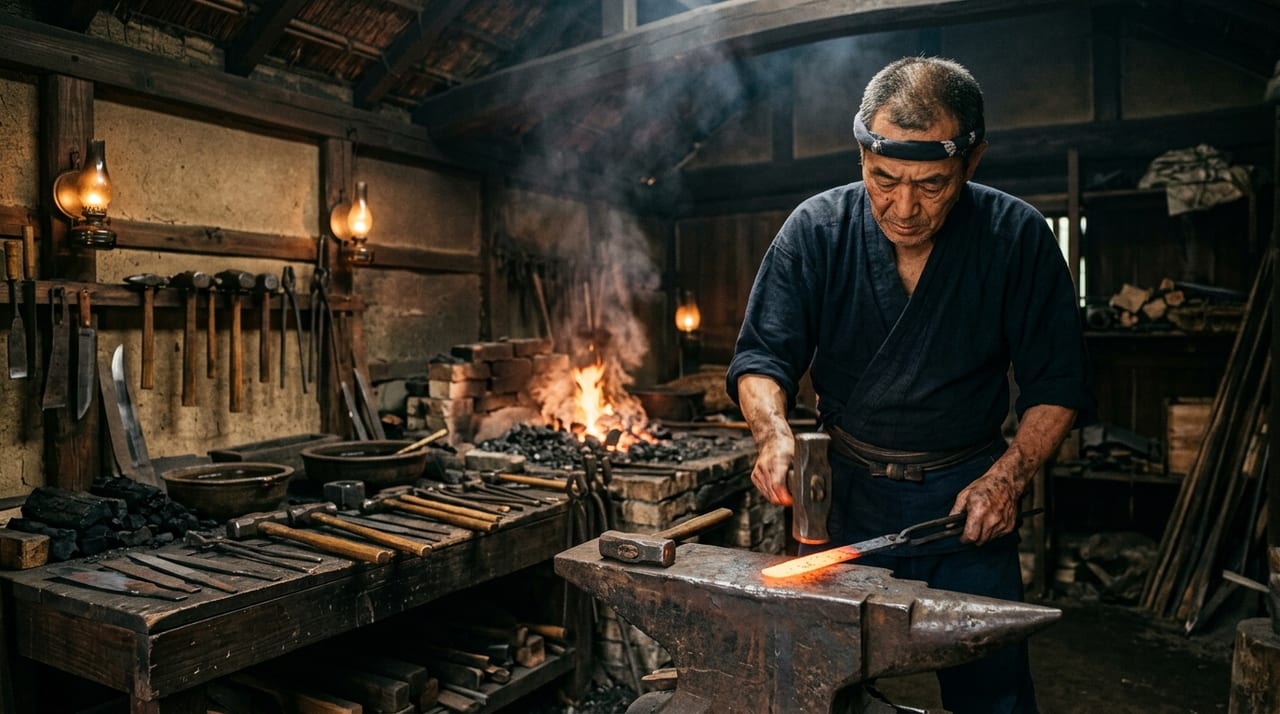
 * Image is for illustrative purposes only.
Norishige
則重
Description
Norishige was a swordsmith active in Etchū Province during the late Kamakura period. Because he lived in Gofuku-gō, Nei District, Etchū Province (present-day Gofuku, Toyama City, Toyama Prefecture), he is also called Gofuku-gō Norishige. He took the family name Saeki and signed his works "Norishige," "Saeki Norishige," or "Etchū-no-kuni Saeki Norishige," among other inscriptions. A date inscription of Enkyō 3 (1310) and a tantō inscribed Shōwa 3 (1314) are known, and these corroborate the period of his activity. Theories about his lineage have been put forward since ancient times. Since early times he has been counted among the Masamune Juttetsu (Ten Great Disciples of Masamune) and widely proclaimed as a disciple of Sōshū Masamune. In recent years, however, the view that he was a fellow disciple who studied under Shintōgo Kunimitsu (or Tōzaburō Yukimitsu) in Kamakura, Sagami Province, that is, an older fellow disciple of Masamune, has also gained strong support. Furthermore, he is said to have had a close connection with Gō Yoshihiro (Matsukura-gō Yoshihiro), another renowned smith of Etchū who lived in Matsukura-gō, and the theory that Norishige was Yoshihiro's teacher is widely transmitted. In any case, he is positioned as the central figure who transmitted the Sōshū-den to the land of Etchū.
What most characterizes Norishige's style is his jigane (ground steel). As a result of forging hard and soft steel together, the surface rises in swirling patterns, producing a distinctive forged texture resembling layers of gnarled pine bark. This is called "Norishige's matsukawa-hada" (pine-bark skin), and in later appraisal it has become the greatest point for identifying Norishige. Within the steel, thick chikei appear, ji-nie is densely deposited, and yubashiri, kinsuji, and sunagashi appear abundantly, forming a scene rich in variation. The hamon is basically a straight hamon mixed with ko-notare, though some are disordered in a gunome style. In the manner of the Sōshū-den, ko-nie is strongly deposited and ashi enter well. Overall, the raised forging of the surface and the subdued tone of the jigane and hamon combine to present a powerful and weighty character.
Signed tachi are few in number, and the surviving examples are somewhat more often tantō. Tantō are slender with thick kasane, and many fine examples are those with conspicuous uchi-zori. Among his representative works, the most renowned is the National Treasure "Tantō, inscribed Norishige." It is well known as a piece collected and cherished by Hosokawa Moritatsu, and because of its outstanding quality it is called by the appellation "Nihon-ichi Norishige." It is a superb hira-zukuri, outstanding in soundness, with ji-nie well deposited on a jigane in which the matsukawa-hada is not conspicuous, ko-nie strong in a gunome-style hamon, and kinsuji and sunagashi appearing frequently. It is designated a National Treasure and is currently held by the Eisei Bunko. This is the only National Treasure by Norishige. Several other pieces, including tachi, katana, and tantō, are designated Important Cultural Properties.
His rank is evaluated as saijō-saku among Kotō smiths, and he is counted among the master smiths who excelled in the Sōshū-den. Above all, as a representative smith of the Sōshū-den in Etchū, he is ranked alongside Gō Yoshihiro. In the exquisite workings of nie and the individuality of matsukawa-hada, he is unrivaled, and he is highly regarded as a master smith representing Etchū-mono.
Famous Works
- Tantō signed Norishige (National Treasure, named Nihonichi, held by Eisei Bunko)