Tsuchioki Technique: How to Apply Clay Before Yaki-ire to Create the Hamon, and the Craftsman's Empirical Rules
 * Image is for illustrative purposes only.
Table of Contents
What Is Tsuchioki — the "Blueprint" That Creates the Hamon
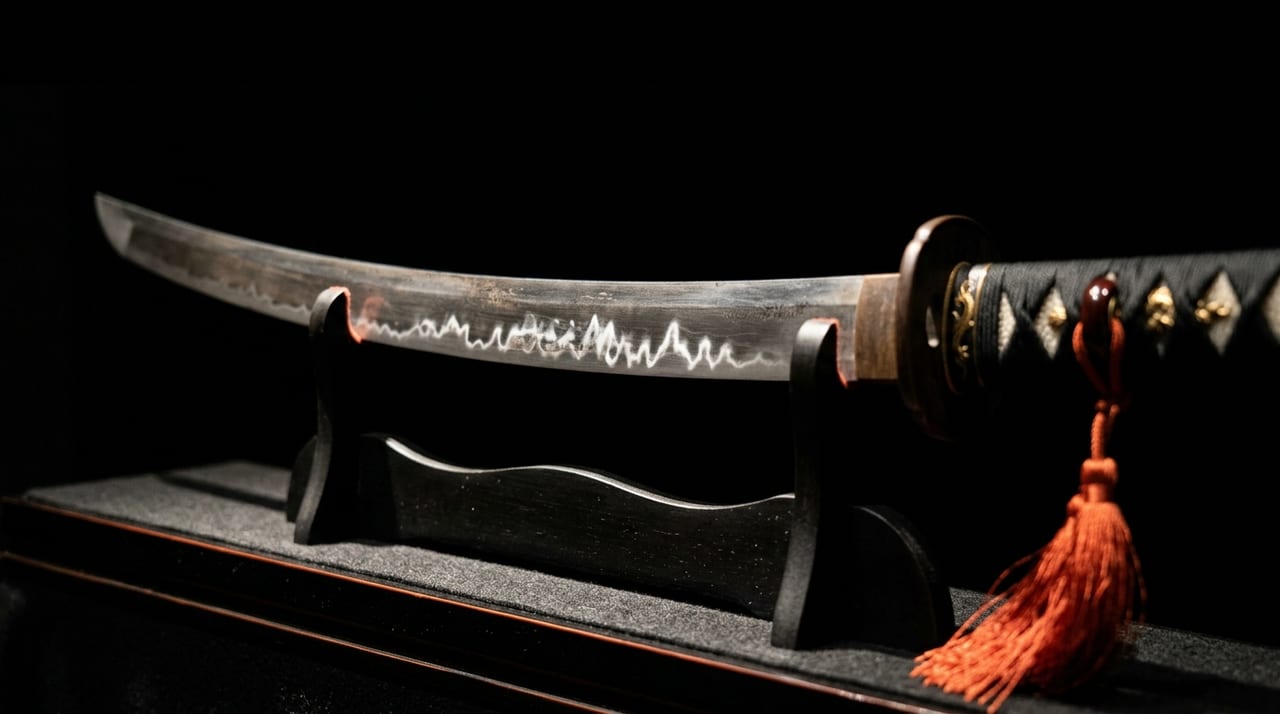
"Tsuchioki" refers to the process of applying "yakiba-tsuchi" to the blade of a Japanese sword before yaki-ire. This yakiba-tsuchi decisively determines the shape of the hamon.
Yaki-ire is the process of rapidly cooling a blade that has been heated to a high temperature in water (or oil). The rapidly cooled portion of the edge hardens into a martensite structure, forming the hamon. At this point, the area coated thickly with yakiba-tsuchi is less susceptible to rapid cooling (insulating effect), while the thinly coated or uncoated areas are rapidly cooled and harden.
Tsuchioki is therefore a process of designing in advance "where to place the hamon," and is one of the most important steps in determining the artistic completion of a sword.
Composition of Yakiba-tsuchi — Traditional Secret Formulas
The specific ingredients of yakiba-tsuchi are a "secret" passed down within each tōkō's tradition, and few tōkō disclose the details to outsiders. However, the following are generally known as commonly used ingredients:
Main Ingredients
- Clay: The primary material that provides insulation and adhesion. Its properties vary by origin. Finer-grained clay tends to achieve a more uniform application.
- Whetstone powder: Whetstone ground into powder. It adjusts the viscosity of the clay and helps prevent "cracking" during yaki-ire.
- Charcoal powder or wood charcoal powder: Influences temperature control during yaki-ire. May also function as a source of carbon.
- Water: The medium for mixing the above ingredients. The amount of water determines the firmness and ease of application of the clay.
Mixing Ratios and Formulation
The mixing ratios of each ingredient are a secret of the tōkō. It is said that "more clay → stronger insulating effect, milder hamon" and "more whetstone powder → thin clay, sharp hamon with a wider yakiba."
What is important is that "even with the same materials, it is impossible to produce perfectly identical clay every time." Since the properties change depending on the origin of the clay, its dryness, and seasonal humidity, each formulation requires the craftsman's intuitive judgment.
Tsuchioki in Practice — Principles of Application
Tsuchioki is carried out in the following steps:
Step 1: Cleaning the Blade
The blade is cleaned before applying the clay. If oil or dirt remains, the clay will adhere unevenly.
Step 2: Applying the Hazakai-tsuchi
A thin layer of clay called "hazakai-tsuchi" or "tsuchidome" is first applied along the area that will become the boundary line of the hamon. This thin line determines the outline of the hamon.
When creating a chōji-midare, the chōji shapes are drawn one by one with care at this stage. When creating a suguha, the clay is applied in a straight line. This step is the most delicate and demands the most skill.
Step 3: Applying Clay to the Edge Area (Thinly)
Clay is applied thinly to the area intended to become the hamon (the edge side). In some cases, no clay is applied at all. This becomes the area that is rapidly cooled during yaki-ire.
Step 4: Applying Clay to the Ji and the Mune (Thickly)
Clay is applied thickly to the ji (body of the blade) and the mune for insulation. This area is less susceptible to rapid cooling during yaki-ire and does not harden.
Step 5: Drying
After applying the clay, it is dried uniformly. Uneven drying can cause the clay to peel off during yaki-ire or cause unexpected areas to be hardened.
Differences in Tsuchioki by Hamon Pattern
The method of tsuchioki differs depending on the type of hamon:
Tsuchioki for Suguha
Suguha appears to be the simplest, but since the precision of tsuchioki directly affects the beauty of the hamon, the difficulty is by no means low. The hazakai-tsuchi must be applied uniformly as a straight line parallel to the edge. Even the slightest wave or wavering appears as "midare," requiring a high degree of concentration and skill.
Tsuchioki for Chōji-midare
Chōji-midare is one of the most difficult tsuchioki. The "head," "foot," and "joint" of each chōji are drawn one by one in clay. Since dozens to more than a hundred chōji must be arranged evenly on a single sword, the work is carried out with constant attention to the balance between adjacent chōji.
Since the shape of a single chōji affects the overall impression, it is said that "tsuchioki for chōji-midare is calligraphy of the hamon."
Tsuchioki for Gunome-midare
Gunome, the rounded, wavelike hamon, is somewhat more regular than chōji. The tsuchioki also draws a relatively even wavelike pattern. Adjusting the degree of "irregularity" is an expression of the craftsman's skill.
Tsuchioki for Hitatsura
Hitatsura, which appears as though the entire blade up to the mune has been hardened, requires a special tsuchioki that uses clay minimally (or applies it only partially). Restrained tsuchioki creates a condition in which the entire blade is quenched. This was a specialty of the great masters of Sōshū-den.
The Five Traditions and Tsuchioki Style — the Aesthetic Sensibility of Each School
The five traditions (Yamashiro, Yamato, Bizen, Sōshū, Mino) each have their own distinct tsuchioki approach.
| Tradition | Tsuchioki Characteristics |
|---|---|
| Bizen-den | Excels at chōji-midare, producing a delicate hamon dominated by nioi |
| Sōshū-den | Uses clay sparingly to produce prominent nie, and hitatsura also originated from this tradition |
| Yamato-den | Centers on suguha and emphasizes drawing the hazakai-tsuchi as a uniform straight line |
The differences among the five traditions show that variations in the quantity and shape of tsuchioki are directly linked to the individuality of the hamon.
The Craftsman's Empirical Rules — How "Climate" Changes Tsuchioki
One of the difficulties of tsuchioki is that even with the same materials and methods, results change when conditions change.
- Season and humidity: During the rainy season through summer, air humidity is high and the clay dries slowly. In winter, drying is faster. This difference changes the drying state of the clay and affects the results of yaki-ire.
- Furnace temperature control: The heating temperature immediately before yaki-ire, through its interaction with the tsuchioki, determines the final hamon. Subtle judgments such as "today's furnace is running a little hot" can change how the hamon develops.
- Water temperature: The temperature of the water used for yaki-ire (which differs between summer and winter) changes the rate of rapid cooling and affects the "clarity" of the hamon.
Veteran tōkō observe these conditions daily and make adjustments to "today's tsuchioki and yaki-ire" from experience. This "accumulation of tacit knowledge" is one of the elements that distinguishes master craftsmen from ordinary tōkō.
Comparison with Modern Technology — Can Tsuchioki Be Reproduced?
When tsuchioki is analyzed from the perspective of modern materials science and metallurgy, it becomes clear that it is an extremely advanced thermal management technique. However, even if "an effect equivalent to tsuchioki" is reproduced using modern industrial manufacturing methods capable of precise numerical control, the complex beauty of a Japanese sword's hamon cannot be achieved.
One reason is the "beauty of chance." The subtle fluctuations in tsuchioki, the uneven drying, and the temperature gradients within the furnace combine to produce a "living hamon" that does not turn out exactly as expected. This is a beauty unique to handcraftsmanship that cannot be reproduced in a fully controlled industrial process.
Metallurgically, the brilliance of the hamon is broadly divided into nie and nioi. Nie is a brilliance in which martensite grains are coarse and identifiable as individual points with the naked eye; nioi is a state in which the grains are extremely fine and the boundary appears hazy. The more intense the rapid cooling, the more nie develops; the more gradual the cooling, the deeper the nioi in the hamon. Since the thickness of the tsuchioki directly controls the rate of rapid cooling, whether a hamon shows nie or nioi also depends on the tsuchioki craftsman's skill.
Conclusion — Tsuchioki Is the Tōkō's "Brushwork"
Just as a calligrapher runs a brush across the page, the tōkō "writes" the hamon with yakiba-tsuchi. Tsuchioki is both a technique and a "creative process" in which the tōkō's aesthetic sensibility and experience are most directly expressed.
When appreciating a hamon, try to imagine that behind its beautiful waves, chōji, and the brilliance of nie lies an accumulation of countless experiences and judgments.