The History and Present of Female Tōkō: Women Who Forged Swords from Ancient Times to the Reiwa Era
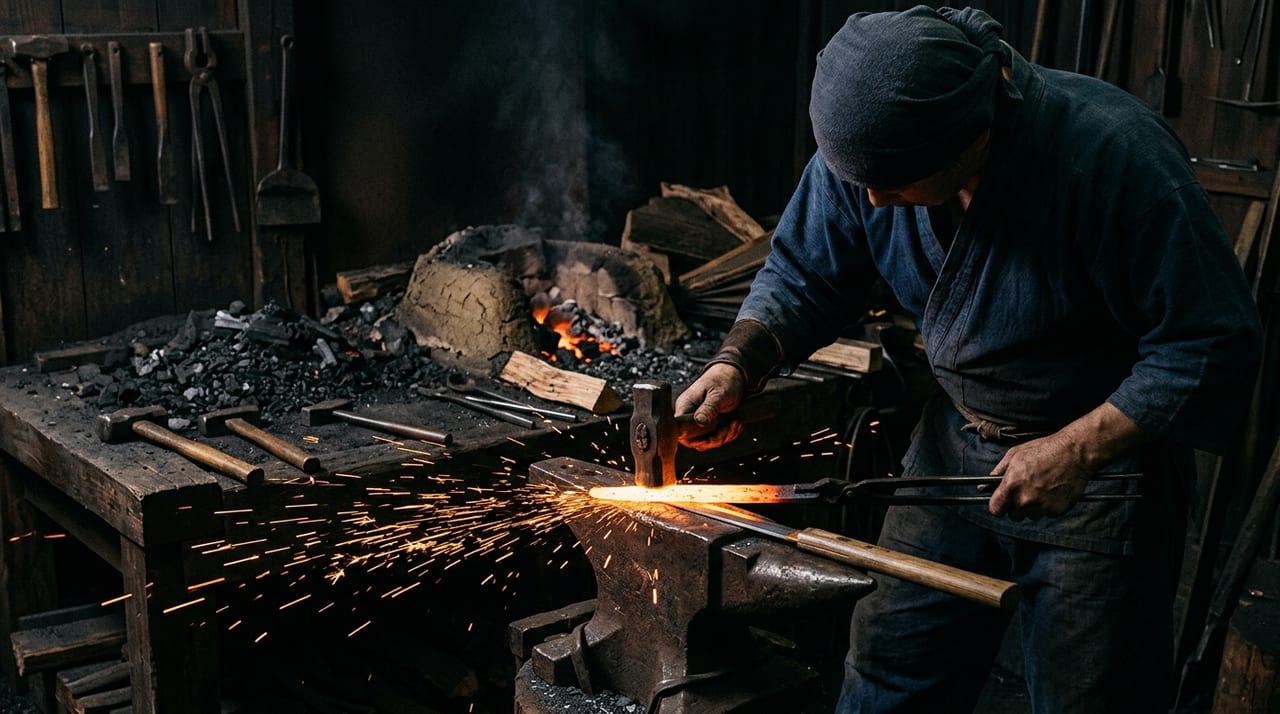 * Image is for illustrative purposes only.
Table of Contents
Dispelling the Assumption That Tōkō Are Male
Nihontō have long been described as a "world of men." While it is true that the overwhelming majority of tōkō throughout history have been men, this does not mean that female tōkō never existed. Women who continued to forge swords have certainly existed from ancient times to the present.
This article surveys the little-known history of female tōkō and provides a detailed account of the activities of contemporary female tōkō living in the Reiwa era.
Ancient and Medieval Periods——Legends and Records of Female Tōkō
The World of Myth and Legend
In Japanese myths of sword origins, swords are positioned as sacred symbols. Myths linking swords with female deities, such as Yasakatome no Kami, have also been passed down, and a spiritual connection between swords and women has existed since ancient times.
Fragmentary Records from the Medieval Period
In tōkō mei records (rosters and genealogies of tōkō) from the Kamakura and Muromachi periods, mei that appear to be female names or that contain the character "onna" (woman) can be fragmentarily confirmed. In many cases, however, it is difficult to determine whether these swords were actually forged by women or whether male tōkō used female names as their mei.
A relatively certain example is the "nyoseshu" found in records of swords dedicated to shrines and temples. This represents not a woman who directly performed kaji work but rather involvement as a patron or financier, yet it is a valuable record showing the point of contact between women and sword production.
Institutional Barriers That Prevented Women's Participation
From before the Edo period, deeply entrenched customs prevented women from participating in the world of tōkō.
- Fire deity worship: The tatara and sword kaji site was considered a sacred place enshrining the fire deity, and women were restricted from entering as "impure" (influenced by menstrual taboos).
- Master-apprentice system: A system of technical transmission from master to apprentice that assumed male participants.
- Family trade succession: In tōkō families, transmission of "family technique" from father to son was the norm, and transmission to daughters or wives was extremely exceptional.
The Modern Period——Changes in the Legal System and the Emergence of Female Tōkō
Tōkō and the System After the Meiji Era
After the Meiji Restoration (1868), sword kaji was placed under modern legal systems as a "craft manufacturing industry." Although there were no regulations explicitly excluding women from sword production or business operations, practical barriers to entry remained high.
The Shōwa Period——The Beginning of Formal Entry
Entering the Shōwa period, the Act on Protection of Cultural Properties (enacted in 1950) and the designation of nihontō tanren techniques as "Intangible Cultural Properties" advanced, and sword production came to be conducted under a system requiring approval for each sword produced (Article 18-2 of the current Act for Controlling the Possession of Firearms or Swords and Other Such Weapons (Jūtōhō) (e-Gov Law Search)). In this context, cases of women formally becoming apprentices began to appear little by little.
The Contemporary Period——Female Tōkō of the Reiwa Era
Changes in the Heisei and Reiwa Periods
In the contemporary era, the number of female tōkō has been steadily increasing. The following environmental changes lie behind this.
- Expansion of apprenticeship opportunities: Even workshops of Living National Treasures and holders of Important Intangible Cultural Properties have seen an increase in cases of accepting female apprentices.
- No gender requirements in the approval criteria for sword production: The requirements include dedicating oneself to honing skills for five or more years under a tōshō who has received approval, and completing training conducted by the Commissioner of the Agency for Cultural Affairs, with no distinction by gender (Ordinance for Approval of Production of Artistic Swords (e-Gov Law Search), Article 2).
- Spread of SNS and media: The activities of female tōkō have been featured on SNS and television, raising their social recognition.
The Reality of Contemporary Female Tōkō Activities
Female tōkō who are currently active, though few in number, certainly exist and present their works at auctions, exhibitions, and sword markets.
Characteristics of their activities:
- Many have a solid style that faithfully inherits the school and regional tradition of their master.
- Active outreach activities at exhibitions.
- Initiatives for nurturing the next generation, such as holding experiential sword-forging workshops.
Female Tōkō Abroad
Outside Japan as well, there are female tōkō who have mastered nihontō techniques. In particular, the number of women learning nihontō tanren in the United States and Europe has been increasing, and a new genre called "Western Female Japanese Swordsmith" is beginning to take shape.
The Practice of Sword Kaji and Women——Physical and Environmental Challenges
The Actual Work Involved
Sword kaji is a job that involves grueling physical labor.
- Forging work: Striking steel heated to 1,000–1,300°C with a hammer. Hundreds to thousands of blows are repeated in a single day's work.
- Extended work while standing: A single forging session involves continuous work lasting two to four hours or more.
- Fire management: Work conducted amid flames, heat, and smoke, with intense physical exhaustion.
Challenges Specific to Women and How They Are Addressed
The main challenges faced by contemporary female tōkō are the following three.
Physical strength: In the modern era, assistance from electric hammers has become standard, and barriers due to pure differences in physical strength have been greatly reduced.
The barrier of becoming an apprentice: In traditional master-apprentice relationships, the practice of residing at the workshop long-term as a "live-in apprentice" is deeply entrenched, placing a heavy burden on women in terms of daily living. A practical response is to choose a master who permits commuting apprenticeships or balancing work with family life.
Customary resistance: Resistance from veteran tōkō who believe in superstitions such as "the wrath of the fire deity" may still remain in some cases, but among younger generations of masters, such prejudices are gradually being resolved.
The Impact of Female Tōkō on Sword Culture
The increase in contemporary female tōkō is bringing various impacts to nihontō culture itself.
- Alleviation of the succession problem: In the tōkō industry, where the declining birthrate and shortage of successors are serious concerns, the entry of women reliably increases the number of those who can carry on the technical tradition.
- Diversification of viewers and buyers: The active roles of female tōkō shake the stereotype that "nihontō are for men" and encourage an increase in female collectors and viewers.
- The possibility of new aesthetics: The styles produced by female tōkō have the potential to expand the aesthetic diversity of nihontō.
Conclusion——Gender Is Irrelevant Before the Sword
The world of nihontō, which has historically been dominated by men, is also steadily changing in shape in the contemporary Reiwa era. Female tōkō who continue to forge swords by overcoming the barriers of systems and customs are new bearers of a tradition that has continued for more than 700 years.
The stereotype that "being a woman makes it impossible to be a tōkō" is, at least in contemporary Japan, becoming a thing of the past. For those who love swords, gender is irrelevant.