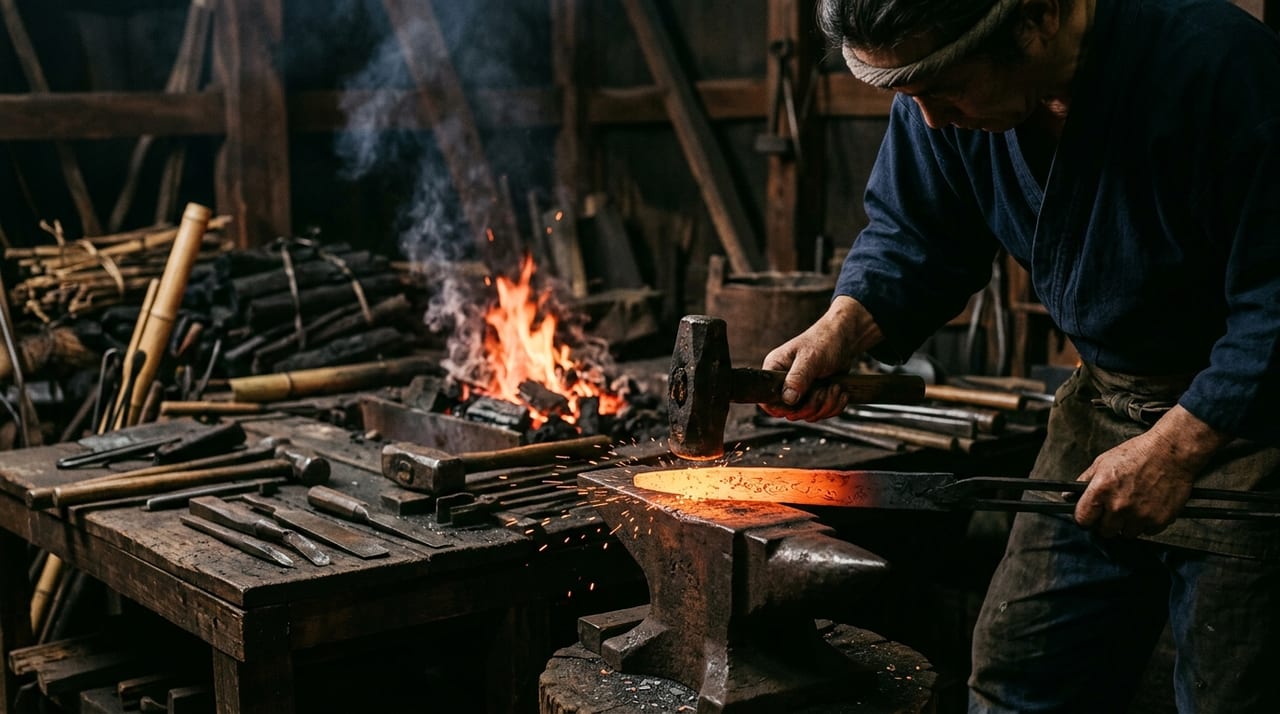
 * Image is for illustrative purposes only.
Kunikane
国包
Description
Kunikane and the Founding of Sendai's Sword Tradition
Kunikane (first generation) was a swordsmith active in Sendai, Mutsu province (present-day Sendai City, Miyagi Prefecture) during the early Edo period, and the founding master of the Sendai Kunikane school. Working under the patronage of the Sendai domain, Kunikane became the center of swordmaking in the Tōhoku region, forming a distinctive style through dialogue with the local environment while building on the Yamato Hōshō tradition. The Date family lords' high regard for his work spread his reputation throughout Tōhoku, making him the defining sword name of the region throughout the Edo period.
The first generation Kunikane is said to have gone to Kyoto in Keichō 19 (1614) on the orders of domain lord Date Masamune, where he studied under Echchu-no-kami Masatoshi (first generation), giving him a technical foundation in the orthodox line of the Yamato Hōshō tradition. In the wave of "technology transfer from the center" that swept across Japan as the Shinzō period began, Kunikane is positioned as the swordsmith who brought this wave to the Tōhoku region.
The Yamato Hōshō Tradition in the Tōhoku Context
Kunikane's hamon is based on suguha, interspersed with ko-gunome and ko-midare, forming a composed, dignified style. Inheriting the masame-kitae of the Yamato Hōshō tradition strongly, with fine ji-nie appearing on the masame surface, through dialogue with Tōhoku iron sand and charcoal, the jigane acquired its own particular quality. Itame runs through the masame, with fine ji-nie throughout. The overall cleanliness and clarity, along with the restrained style avoiding ornament that accords with the warrior aesthetic, resonated deeply with the samurai culture of the Sendai domain.
The blade form follows standard Shinzō period proportions, with a balanced relationship between moto-haba and saki-haba, creating a neat, unfussy shape. Avoiding excessive curvature and dramatic width expansion reflects the Tōhoku warrior preference for practical beauty in a blade.
Kunikane and the Sendai Domain
The Date family had long prized fine blades, and by establishing Kunikane as a domain swordsmith they sought to develop a distinctive regional sword culture. As the official domain swordsmith, Kunikane served the lord and his retainers, but also accepted commissions from warriors, merchants, and religious institutions across Tōhoku. This broad clientele gave his work a warmth that might be called "approachability within dignity."
He was also a devoted teacher. The succession of second and third generation Kunikane maintained the standard of swordmaking in Tōhoku. The regional sword culture of the northeast, fondly called "Sendai-tō" even today, was nurtured from the seeds planted by the founding Kunikane.
Comparison with Other Regional Shinzō Masters
The Shinzō period (Edo period) saw regional swordsmiths rise throughout Japan, each forming a local sword culture. Kunikane stands among the most distinguished of these, praised for maintaining the Yamato Hōshō tradition at high quality within the geographic and cultural particularity of Tōhoku. Alongside contemporaries such as Echizen Yasutsugi, Hizen Tadayoshi, and Inaba Masanori, he is positioned in Japanese sword history as a representative master of regional Shinzō.
TOUKENZA and Kunikane
TOUKENZA presents Kunikane to convey the richness and diversity of regional sword culture in the Edo period. Kunikane's composed suguha with masame-kitae is evidence that the Yamato Hōshō spirit took root and flourished in Tōhoku soil — an ideal synthesis of metropolitan technique and regional character. The grounded dignity nurtured by Sendai samurai culture continues to appeal as a universally valid aesthetic value in the present day.
Famous Works
- 刀(仙台市博物館蔵)
- 太刀(重要美術品)