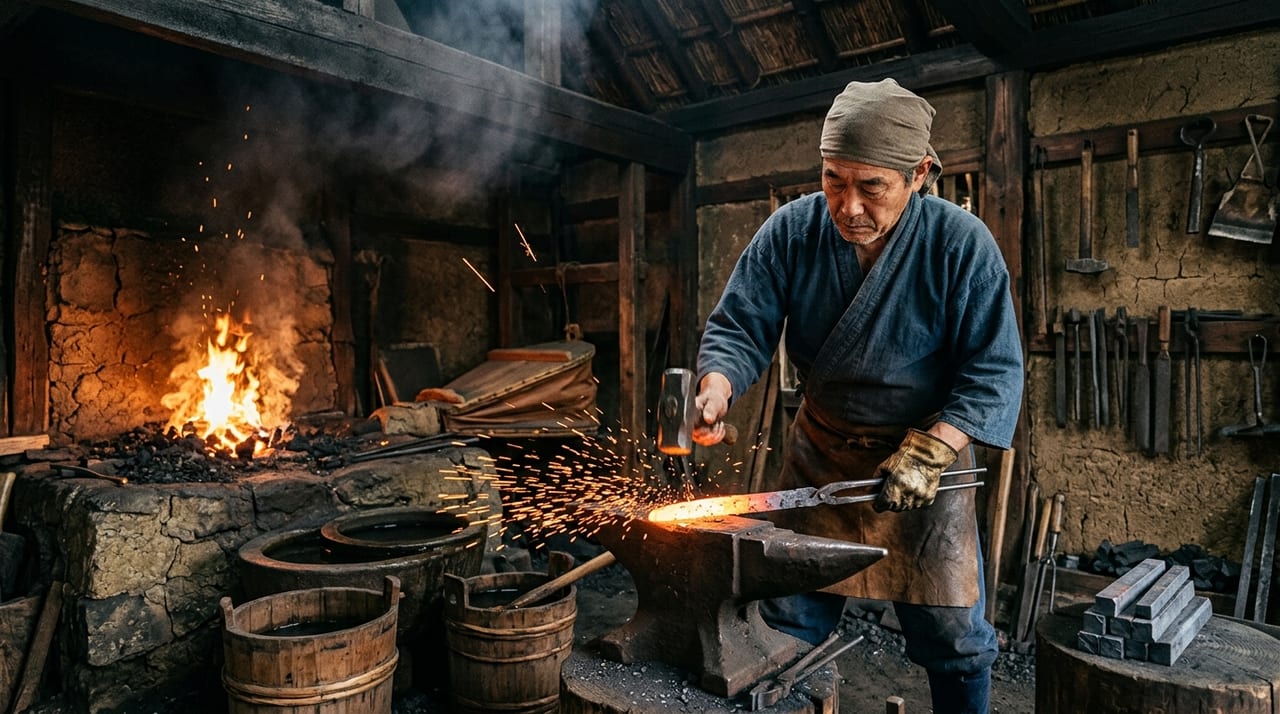
 * Image is for illustrative purposes only.
Shizu Kaneuji
志津兼氏
Description
Shizu Kaneuji was a swordsmith active from the late Kamakura period into the early Nanboku-chō period. He is the founder of the Mino Shizu school and is counted among the Masamune Jittetsu, the ten eminent disciples of Sōshū Masamune. His common name was Saburō, and he is called "Shizu Saburō Kaneuji." Originally he belonged to the Tegai school of Yamato Province, and he is said to have studied the Yamato tradition under the name "Kaneuji," written with the character "包." Eventually he went to Sagami Province, studied under Masamune, and is said to have mastered the Sōshū tradition. He later moved to Shizu in Mino Province (present-day vicinity of Nanō-chō, Kaizu City, Gifu Prefecture). He took the name "Shizu" from the place name and changed his signature character from "包" to "兼," making his name "Kaneuji." Thus Kaneuji fused in himself the solidity of the Yamato tradition and the refinement of the Sōshū tradition, laying the foundation of Mino smithing. Regarding the Masamune Jittetsu, there is also a view that not all of them were direct disciples of Masamune, given chronological consistency. For Kaneuji too, there are various theories about the master-disciple relationship. In fact, the designation "Masamune Jittetsu" itself is considered a retrospective grouping that took shape later (around the late Edo period), and the details of the actual master-disciple relationships are not clear.
His style is characterized by works centered on nie, based primarily on the Sōshū tradition. The hamon is based on notare, mixed with gunome and pointed blades, with thick nie, and kinsuji and sunagashi appear abundantly within the blade. The jigane is itame mixed with a masame-like texture derived from the Yamato tradition, with good jinie, and some works display jikei and shirake utsuri. On the other hand, before entering Masamune's tutelage, he is also said to have produced midare with gunome as the main element and somewhat small patterns, and works from this period are called "Yamato Shizu" in later times. His range of works is broad, and there are works said to closely resemble his teacher Masamune in both jigane and hamon, which reflects his high level of skill.
Confirmed signed works are few. Many bear the two-character signature "Kaneuji," and occasionally longer signatures such as "Kaneuji, resident of Mino Province" are seen. Works dated Kōei 2 (1343) are also known. Representative works include the tanto "Inaba Shizu," recorded in the Kyōhō Meibutsuchō and designated an Important Cultural Property (named after its former ownership by the Inaba family, samurai of western Mino), and the famous blade "Togawa Shizu" (unsigned, held by the Tokugawa Art Museum). Many are unsigned and have been attributed in later times as "Shizu" or "den-Shizu," and they have been valued with certificates of authenticity (origami) attached.
After Kaneuji's death, his lineage, including Kanetoshi, Kanetomo, and Kanetsugu, moved to Naoe in Mino Province (present-day vicinity of Yōrō-chō, Yōrō District, Gifu Prefecture) and flourished under the name "Naoe Shizu." It is customary to distinguish the first Kaneuji and his direct disciples as "Shizu," and the later branch as "Naoe Shizu." Shizu Kaneuji is highly regarded as an extremely important figure in the history of Japanese swordmaking. He took root the Sōshū tradition in Mino and became the source of the Mino tradition that led to the later Seki kaji (Seki smiths).
Famous Works
- Tantō, named Inaba Shizu (Important Cultural Property)