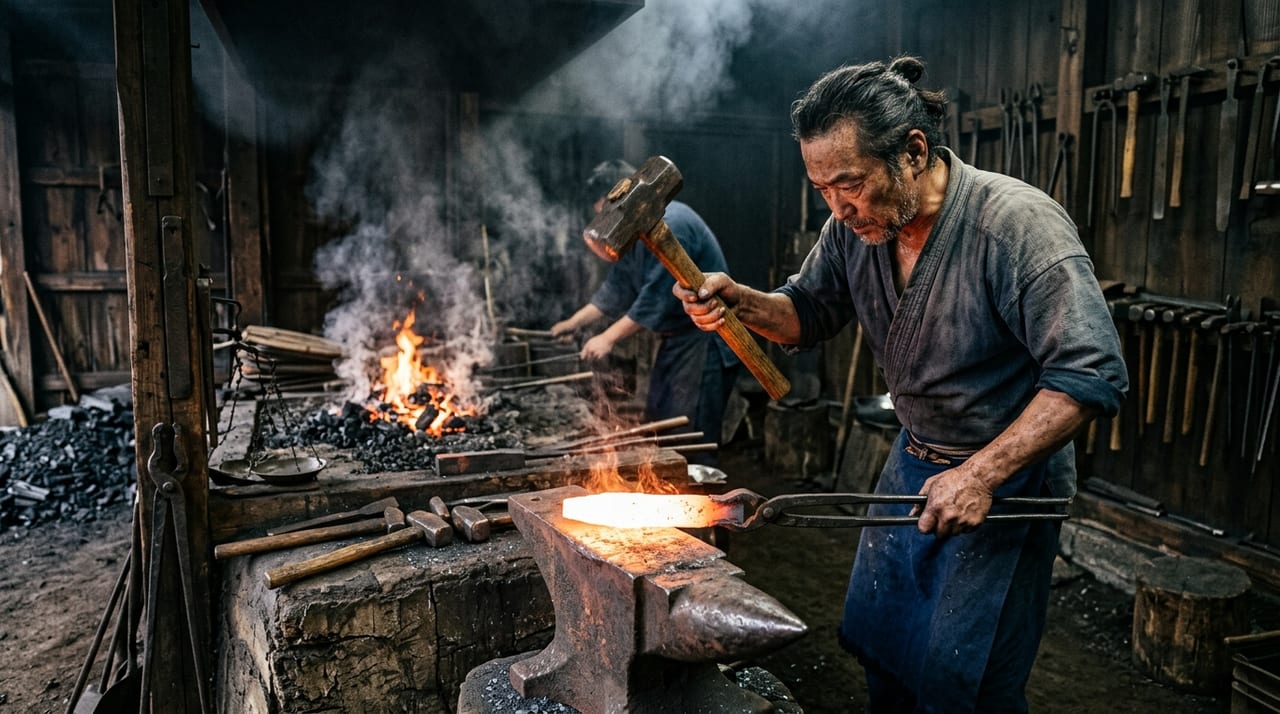
 * Image is for illustrative purposes only.
Awataguchi Kunitsuna
粟田口国綱
Description
The Six Awataguchi Brothers: The Golden Age of the Yamashiro Tradition
Awataguchi Kunitsuna was a master smith who was active in Awataguchi, Kyoto, from the early to middle Kamakura period. His name is recorded in the history of the Japanese sword as one of the Six Awataguchi Brothers. The Six Awataguchi Brothers refers to the six smiths Kunitomo, Hisakuni, Kuniyasu, Kunikiyo, Arikuni and Kunitsuna. They were children of their father, Awataguchi Kuniie, and were active in the same era.
All six were outstanding smiths, and they were the principal figures who led the Awataguchi school of the Yamashiro tradition to its peak. Among them, Kunitsuna is said to have moved to Kamakura at the invitation of Hōjō Tokiyori and to have forged "Onimaru," one of the Tenka Goken (Five Great Swords under Heaven), which is held in the Imperial Household collection (gyobutsu). Through his child, said to be Shintōgo Kunimitsu, he is regarded as a particularly important smith who laid the foundations of the Sōshū smiths.
The Sword-Making Environment of the Awataguchi School: From Heian Elegance to Kamakura Vigor
Awataguchi is located at the foot of Higashiyama in Kyoto, and it is an area long known as a concentration of sword smiths. From the late Heian period through the Kamakura period, the smiths active in this area inherited the graceful style of the Heian period. At the same time, they met the practical demands of the Kamakura warrior government and established a distinctive style of their own.
The early to middle Kamakura period, when Kunitsuna was active, corresponds to the peak of the Awataguchi school. During this period, orders came in from across the country to meet the demands of the shogunate. Demand from the imperial court and the nobility also remained strong. The Awataguchi smiths were producing works that combined the dignity and practicality needed to meet the expectations of both.
Characteristics of the Sword-Making: A Refined Example of the Yamashiro Tradition
Kunitsuna's works display, at a high level, the refined Yamashiro tradition style that is a hallmark of the Awataguchi school. The jigane is a refined forging of ko-itame and ko-mokume, with ji-nie, and it shows a rich, moist appearance. The beauty of the jigane, characteristic of the Awataguchi school, is refined yet also conveys a sense of strength. This quality is especially well expressed in Kunitsuna's works.
The hamon is mainly ko-midare and ko-gunome. The activity of ashi and yō is finely ordered, giving an elegant impression. The nie are small, uniform and crisp, showing the clear, pure hamon world typical of the Awataguchi school. A tachi designated as an Important Cultural Property is highly regarded by sword researchers as a masterpiece showing the highest standard of the Yamashiro tradition. It plays an important role as a benchmark for the style of the Awataguchi school as a whole.
Move to Kamakura: The Origins of the Sōshū Smiths
Kunitsuna is said to have moved to Kamakura and made swords there around the Kenchō era (1249–1256), at the invitation of Hōjō Tokiyori, regent of the Kamakura shogunate. He is known as the maker of the tachi "Onimaru," which is held in the Imperial Household collection (gyobutsu). According to legend, it cut down an oni that had troubled Tokiyori. Shintōgo Kunimitsu, who later founded the Sōshū tradition, is said to have been Kunitsuna's child. The history of swords in Kamakura is said to have effectively begun with the move of Kunitsuna and others to Kamakura.
Kunitsuna is a smith who brought the techniques of the Awataguchi school from Kyoto to Kamakura. He stands at the starting point of the current that led to the establishment of the Sōshū tradition.
TOUKENZA and Awataguchi Kunitsuna
TOUKENZA presents Awataguchi Kunitsuna as a master smith representing the peak of the Awataguchi school of the Yamashiro tradition. Kunitsuna's works showed a distinctive presence in the era of collective creation by the Six Brothers. They embody the ideal of the Yamashiro tradition, in which Heian elegance and Kamakura practicality are fused at a high level. Also from the perspective of his move to Kamakura and the lineage leading to the Sōshū smiths, Kunitsuna is an indispensable figure in discussing the history of the Japanese sword.
Famous Works
- Tachi signed Kunitsuna (Onimaru, Imperial Collection)
- Tachi signed Kunitsuna (Important Cultural Property, Tokugawa Art Museum)