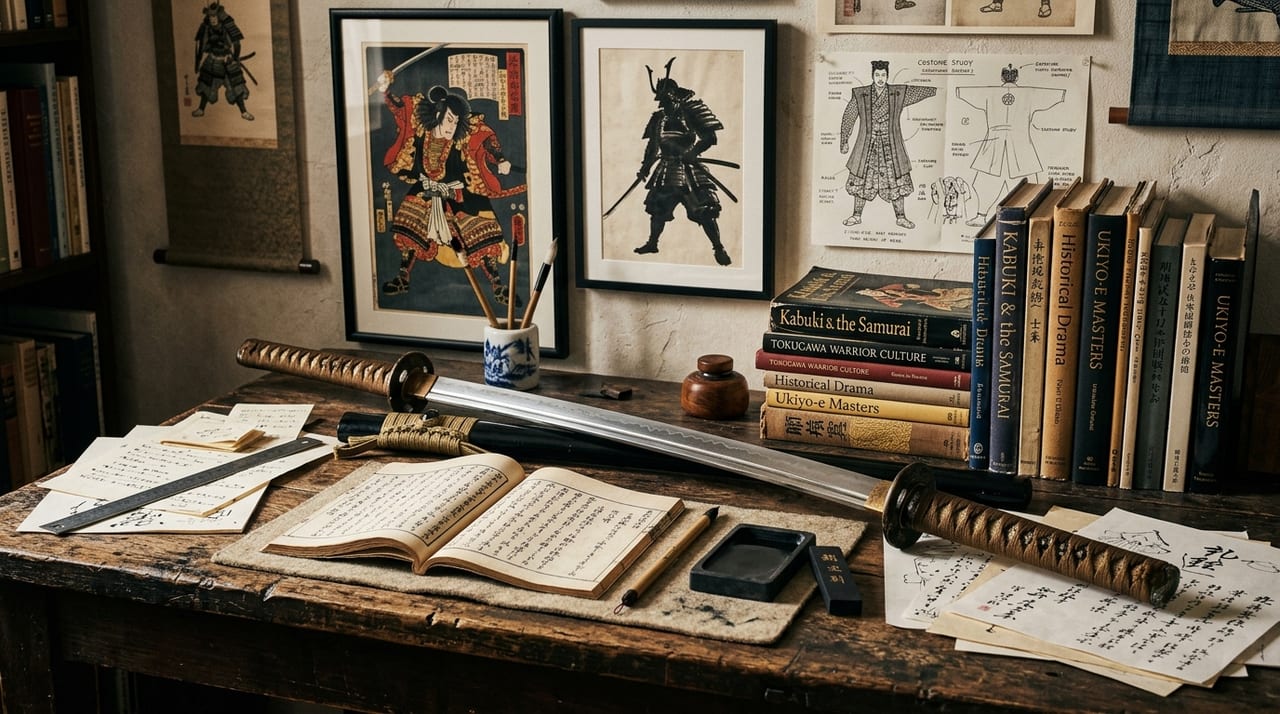
 * Image is for illustrative purposes only.
Chūshingura (The 47 Ronin)
忠臣蔵
Japan's greatest revenge epic, drawn from the Akō Incident (1703). After Lord Asano of Akō struck Kira Yoshinaka in Edo Castle's Matsu Corridor, forty-seven of his rōnin spent months planning revenge before raiding Kira's mansion under Ōishi Kuranosuke's command. From kabuki and jōruri to film and television, the Chūshingura tradition has established the Japanese sword as the supreme cultural symbol of loyalty, justice, and samurai spirit across three centuries of artistic interpretation.
Description
Chūshingura — Three Hundred Years of Cultural History in Which the Japanese Sword Became the Symbol of Justice
Chūshingura is the collective name for a body of narratives based on the raid by the forty-seven rōnin of Akō on the night of December 14, Genroku 15 (1702), and for over three hundred years has been repeatedly transmitted through Japanese art, culture, and popular entertainment — a "narrative of the Japanese spirit." Told continuously across all media — kabuki, jōruri puppet theater, kōdan narrative, film, television drama, anime, and manga — this body of stories stands at the center of the cultural establishment of the Japanese sword, transcending its identity as a "weapon" to become a "symbol of justice," "proof of loyalty," and "soul of the samurai."
### March 14, Genroku 14 — The Blade Clash at the Matsu Corridor
The narrative originates with the blade-clash incident that occurred at the "Matsu Corridor" of Edo Castle on March 14, Genroku 14 (1701). Asano Takuminokami Naganori, daimyo of Harima Akō, inflicted a blade wound (a sword slash) upon Kira Kōzukenosuke Yoshinaka, a senior hatamoto of the Tokugawa house. The shogunate immediately imposed the ultimate penalty upon Asano—"seppuku on the same day and abolition of the Akō domain"—while Kira, designated as the perpetrator, went unpunished.
This "unequal judgment" provided the forty-seven rōnin (masterless samurai who had lost their lord) with moral justification for revenge, leading to the raid on Kira's mansion on December 14 the following year. After the raid, the shogunate ordered all forty-seven to commit seppuku. In this episode, the sword appears three times: as the instrument of the blade clash, as the weapon of the raid, and as the ritual tool of seppuku.
### The Three Meanings of the Sword — Instrument of Crime, Weapon of Justice, Tool of the Spirit
The meaning of the sword in Chūshingura possesses a three-fold structure.
The first layer is "the sword as an instrument of crime." The blade that Asano Takuminokami drew at the Matsu Corridor became the instrument of an unprecedented grave crime — a "blade-clash incident" within Edo Castle, the residence of the shogun. This act was deemed capital precisely not because "a blade was drawn," but because "a blade was drawn within the residence of the shogun," revealing the social and political positioning of the sword within the Tokugawa system.
The second layer is "the sword as a weapon of justice." The blades carried by the forty-seven rōnin in the raid were sanctified as "tools for fulfilling loyalty to their lord." In modern Chūshingura exhibitions, swords said to have been used in the raid (surviving examples are preserved in Sengakuji temple, the Akō Municipal History Museum, and elsewhere) are displayed as "relics of justice," exemplifying the bond between sword and spirituality.
The third layer is "the sword as a tool of the spirit." The seppuku performed by all forty-seven at the end embodies the function of the Japanese sword as a "tool of the spirit" in its purest form. Seppuku is "the act of proving one's loyalty to one's lord, one's own purity, and one's pride as a samurai by opening one's abdomen with one's own blade," whereby the sword functions as a "tool of proof" before being a "tool of death."
### Kabuki "Kanadehon Chūshingura" and the Aesthetic Formalization of the Sword
The jōruri puppet theater "Kanadehon Chūshingura" (subsequently adapted for kabuki), which premiered in 1748, is the paramount work in establishing the aesthetic conventions of Chūshingura culture. Structured in eleven acts, this work remains today one of the most frequently performed pieces in the kabuki repertoire and is staged throughout Japan every December. The "sword aesthetic" in kabuki—the stylized forms in unsheathing, the choreographed combat (tate), the deportment of setting down the blade, and the manner of returning it to the scabbard—has been refined and codified through the extended performance history of Chūshingura and directly influences the contemporary practice of kenjutsu and iaidō.
### Film and Television — Chūshingura
Chūshingura is the most frequently adapted subject in Japanese film history, with over one hundred filmed versions produced from the silent era of the 1910s to the present day. Notable film versions include those directed by Inagaki Hiroshi (1958), Fukusaku Kinji (1994), and the Shōchiku production (1985). Internationally, the Hollywood adaptation "47 Ronin" starring Keanu Reeves (2013) introduced Chūshingura to a global audience, though with substantial departures from historical fact.
On television, the custom of broadcasting "Chūshingura dramas" every December in Shiwasu (December) has become established as a "seasonal fixture of the year-end." This cultural practice is intertwined with Japanese reflection during year-end upon "justice," "loyalty," and "moral reckoning," demonstrating that Chūshingura has transcended being merely a historical narrative to become part of "Japan's spiritual cultural calendar."
### Akō and Sengakuji Temple — Pilgrimage and Relic
As historical sites, Sengakuji temple (Tokyo, Minato ward), the ancestral temple of the Asano family, preserves the graves of all forty-seven and relics connected to the raid, drawing sword enthusiasts and history pilgrims throughout the year. Particularly on December 14, the "Festival of the Righteous Samurai" (Gishi-sai), memorial services and displays of historical weaponry are held. Akō City (Hyōgo Prefecture) preserves the ruins of Akō Castle and the Akō Municipal History Museum, housing swords said to have been used in the raid and weaponry associated with the Asano and Kira families.
### Perspective for Sword Collectors
Chūshingura is the preeminent narrative apparatus through which the Japanese sword became culturally established as an embodiment of justice, loyalty, and sincerity. The cultural disposition through which modern sword collectors value the sword as "a tool in which the spirit dwells," "a symbol of spirituality," has been formed through three hundred years of accumulated narratives of the samurai spirit, foremost among which stands Chūshingura. The perspective of viewing the sword not as a "tool of cutting" but as "proof of the spirit" could not have emerged without Chūshingura—in this respect, Chūshingura stands as one of the most crucial cultural apparatuses in the entire history of Japanese sword culture.
See authentic Japanese swords
See authentic Japanese swordsThis page is intended to introduce Japanese sword culture and is not affiliated with any of the works mentioned.