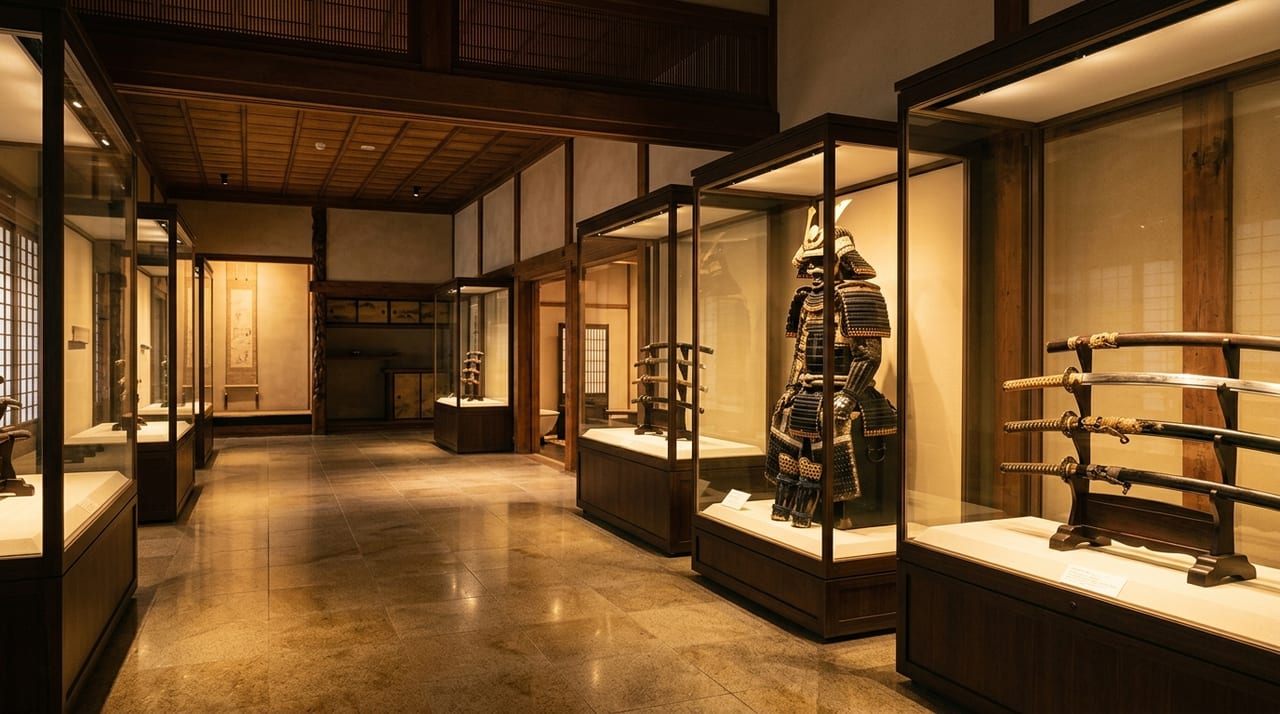
 * Image is for illustrative purposes only.
Marugame City Museum
丸亀市立資料館
Overview
The Marugame City Museum is a municipal history museum standing within the grounds of Marugame Castle, in Kameyama Park, beneath one of Japan's twelve surviving original castle keeps. Established in 1972, it holds more than thirty-nine thousand items, centered on historical materials, folk materials, and fine and applied arts associated with the Kyōgoku family, lords of the Marugame domain. Among sword enthusiasts it is known above all as the repository of the Important Art Object "Nikkari Aoe."
Nikkari Aoe — A Great Wakizashi of the Aoe School
Nikkari Aoe is a large wakizashi thought to date from the Nanbokuchō period, produced by the Aoe school of Bitchū Province. The Aoe smiths flourished in Bitchū from the late Heian through the Nanbokuchō era, and their output is conventionally divided into Ko-Aoe, Chū-Aoe, and Sue-Aoe phases; this blade is classed as Chū-Aoe and is attributed by tradition to Aoe Sadatsugu. It is designated an Important Art Object by the state.
The sobriquet "Nikkari" is said to derive from a legend in which an apparition smiled at its wielder and was cut down with this blade. Among the many celebrated named swords of Japan, it is notable as one whose very name carries a tale of the uncanny, making it of interest not only for its workmanship but for the history of how Japanese swords were received and storied.
Transmission to the Kyōgoku Family
A key point in its provenance is the tradition that Kyōgoku Tadataka received the blade from Toyotomi Hideyori at the time of the Osaka Campaign of 1614. Thereafter Nikkari Aoe descended within the Kyōgoku house, was preserved as a family treasure after the Kyōgoku entered Sanuki as lords of the Marugame domain, and remained in Marugame into the modern period. The line of transmission itself — from the Toyotomi to the Kyōgoku and thence to the Marugame domain — is a document of the political relationships spanning the close of the Sengoku era and the formation of early modern daimyo houses.
Kyōgoku Materials and Marugame Castle
The holdings extend well beyond swords. Arms, furnishings, archival documents, and decorative arts descending in the Kyōgoku house of Marugame are supplemented by a systematic body of folk material from Marugame and the wider Sanuki region, so that local history from the domain period through the modern era can be surveyed as a whole.
Marugame Castle itself is celebrated for its original keep and for the exceptional height of its stone ramparts. Because castle, keep, daimyo family collection, and regional folk collection are gathered on a single hill, the museum offers an unusually direct experience of the warrior culture of Sanuki Province in situ. Note that the actual blade of Nikkari Aoe is customarily shown only during limited special exhibitions; visitors are advised to confirm the display schedule on the official site before traveling.
Highlights
- Holds the Important Art Object "Nikkari Aoe," a large wakizashi of the Chū-Aoe phase of the Bitchū Aoe school, attributed to Aoe Sadatsugu
- Traditionally received by Kyōgoku Tadataka from Toyotomi Hideyori at the 1614 Osaka Campaign, thereafter descending in the Kyōgoku house of Marugame
- More than thirty-nine thousand items combining Kyōgoku family materials with folk collections of the Sanuki region
- Set within Marugame Castle, one of only twelve castles in Japan retaining an original keep, uniting fortress and daimyo collection in one place
- The actual Nikkari Aoe blade is normally shown only in limited special exhibitions — check the schedule before visiting
* Opening hours and exhibitions are subject to change. Please check the official website before visiting.