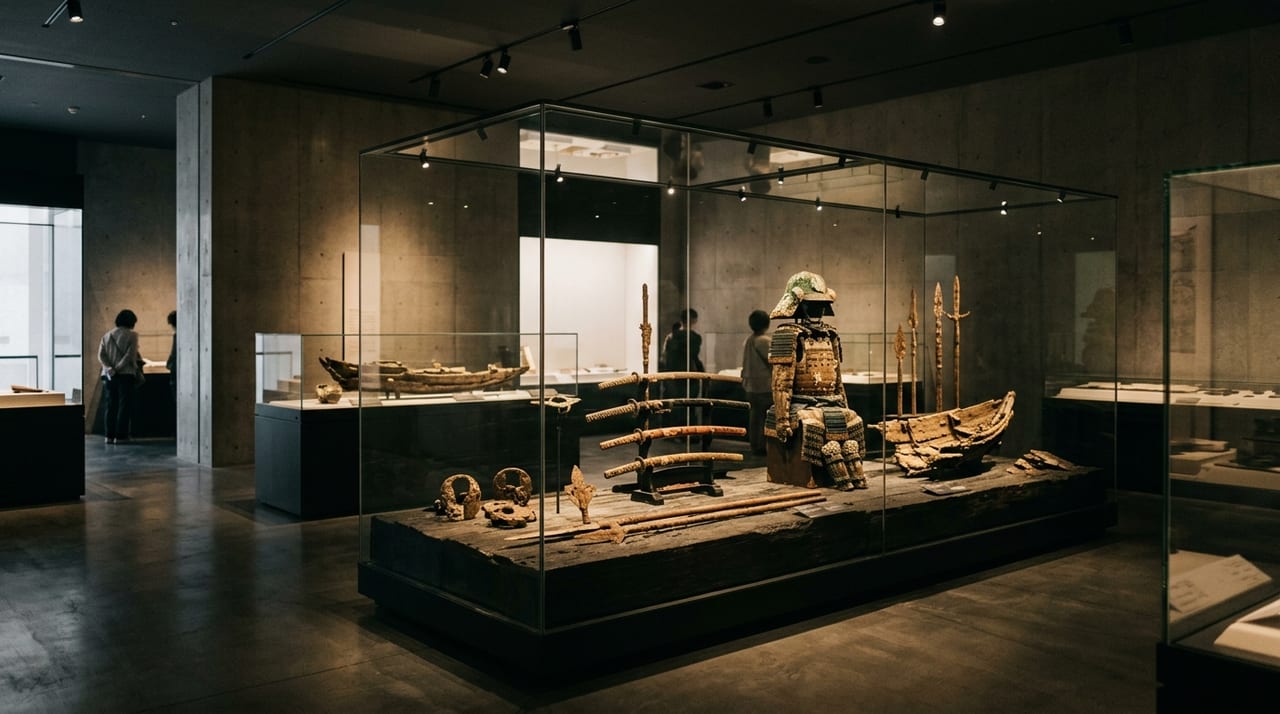
 * Image is for illustrative purposes only.
Imabari Murakami Kaizoku Museum
今治市村上海賊ミュージアム
Overview
The Imabari Murakami Kaizoku Museum is a museum facility located in Miyakubo-chō (Ōshima), Imabari City, Ehime Prefecture, and is known as a facility that specializes in exhibiting the history, culture, and maritime technology of the Murakami Kaizoku (Murakami Suigun), the sea pirates who dominated the Seto Inland Sea during the Sengoku period. The Murakami Kaizoku were divided into three branches, Nōshima, Kurushima, and Innoshima. They controlled maritime traffic in the Seto Inland Sea, and were the pirate bands that the missionary Luís Fróis called “the greatest pirates in Japan.” They were a maritime power representative of the Sengoku period, involved with Mōri Motonari, Ōtomo Sōrin, Oda Nobunaga, and others.
The collection includes the Kurokawa-odoshi Dōmaru, handed down in the Nōshima Murakami family and designated as an Imabari City Cultural Property; a jinbaori said to have been worn by Murakami Takeyoshi and his son Kagechika; a portrait of Murakami Kagechika; and joint letters by Murakami Takeyoshi, Motoyoshi, and others (designated as an Imabari City Cultural Property). In the “Murakami Family Memorial Room” on the second floor, restored armor and jinbaori are on display. The Murakami Kaizoku skillfully handled kobaya-bune and were adept at battles using gunpowder, such as hōroku hiya. Outdoors, a kobaya-bune is also on display, a reconstruction of the small vessels the Murakami Kaizoku used.
Inside the museum, it also introduces the daily life and trade of the pirates through remains and artifacts unearthed in archaeological excavations. Combined with the boat tour to the nearby Nōshima Castle Ruins (a national historic site), it offers a unique experience as historical tourism in the Seto Inland Sea island region.
Highlights
- History of the Murakami Kaizoku (Murakami Suigun) — the exploits of the Nōshima Murakami clan, which Luís Fróis called “the greatest pirates in Japan,” presented through old documents and reproductions
- Armor and jinbaori handed down in the Nōshima Murakami family — the Kurokawa-odoshi Dōmaru, designated as an Imabari City Cultural Property, and the jinbaori said to have been worn by Murakami Takeyoshi and his son Kagechika
- Excavation results from the Nōshima Castle Ruins (national historic site) — remains and artifacts unearthed in excavations shed light on pirate daily life and trade
- Boat tour to the Nōshima Castle Ruins — a distinctive historical tour experiencing a naval castle on a solitary island in the Seto Inland Sea from the water
- A sightseeing base along the Shimanami Kaidō — ideal when combined with the Kurushima Kaikyō strait and the Ōyamazumi Jinja Hōmotsukan (Treasure Hall) on Ōmishima
* Opening hours and exhibitions are subject to change. Please check the official website before visiting.