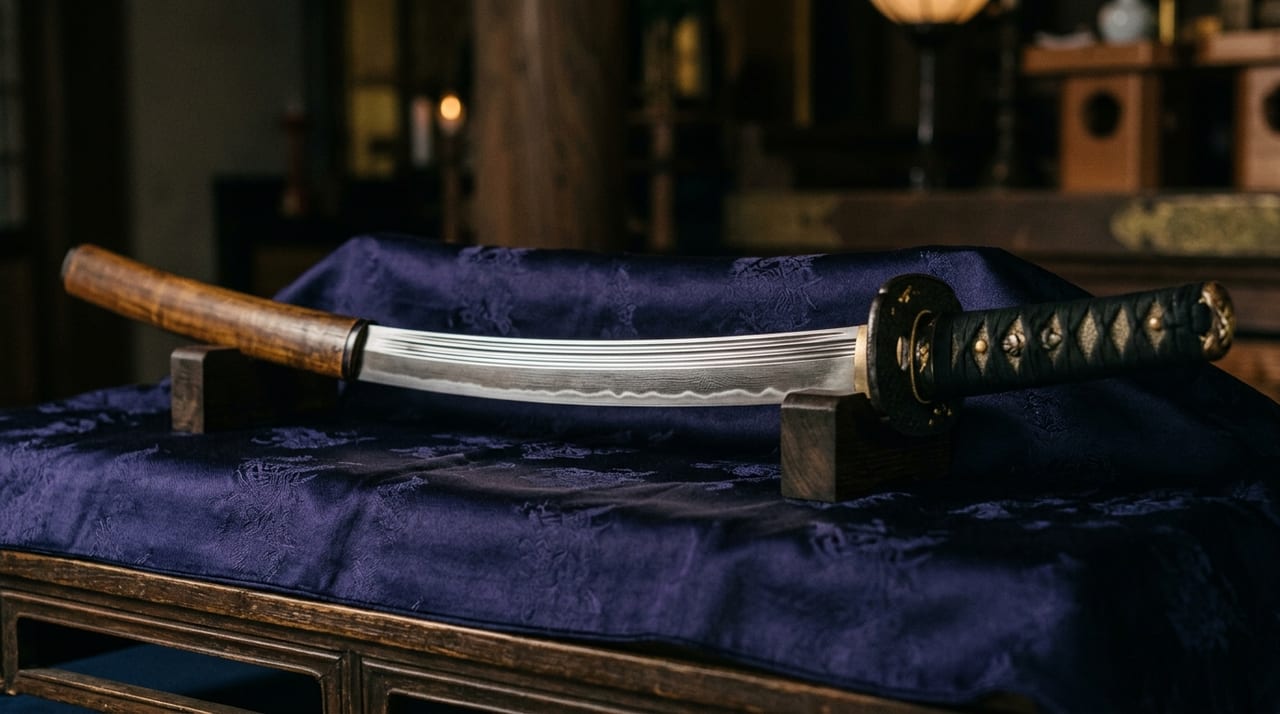
 * Image is for illustrative purposes only.
Tegai Kanenaga
手掻包永
Also known as: Founder of the Tegai School; Adamantine Blades of Yamato
- Smith
- Tegai Kanenaga
- Era
- Mid-Kamakura period (13th century)
- Type
- Tachi
- Designation
- National Treasure / Important Cultural Property (multiple works)
- Location
- Seikadō Bunko Art Museum (Chiyoda Ward, Tokyo) and others
Description
Overview of Tegai Kanenaga: One of the Five Yamato Schools
Tegai Kanenaga was a swordsmith active in Yamato Province (present-day Nara Prefecture) in the mid-Kamakura period (13th century). As the founder of the Tegai school, one of the five major schools of the Yamato tradition (Yamato-den), he holds a secure place in the history of the Japanese sword. "Tegai" is said to derive from the name of a locality near the Tegai Gate (Tegaimon) of Tōdai-ji, and Kanenaga established his forge in this area. The Yamato tradition is one of the Five Traditions of the Japanese sword (Gokaden), together with Yamashiro, Bizen, Sōshū and Mino, and it has played an important role since the early stages of the development of the Japanese sword. Kanenaga is regarded as a figure who established the distinctive Tegai school within the Yamato tradition, and he is placed among the foremost smiths of Yamato.
Technical Characteristics of Tegai Kanenaga's Swords
The greatest feature of Tegai Kanenaga's tachi is "the robustness of the Yamato tradition." As a general trait of the Yamato tradition, "strength and straightforwardness" stand in contrast to the elegance of the Bizen tradition and the precision of the Yamashiro Rai school, and Kanenaga's works embody this quality of Yamato most clearly. In the National Treasure tachi in the collection of the Seikadō Bunko Art Museum, the construction shows a high shinogi and a broad shinogi width typical of Yamato-style works. The jigane shows itame skin that flows and masame that is mixed in, with ji-nie appearing abundantly. The hamon has a nioiguchi that is somewhat subdued and strong nie, with shallow notare mixed with ko-midare and gunome. Features such as nijūba, hotsure, uchinoke and kinsuji can be seen. The bōshi is shallowly notare and turns back slightly. Overall, Kanenaga's tachi possess the powerful dignity characteristic of the Yamato tradition.
Connection with Tōdai-ji
The tradition that Tegai Kanenaga made tachi for warrior monks on the outskirts of Tōdai-ji's Tegai Gate provides an especially important context for understanding his works. In the Heian and Kamakura periods, the great temples and shrines of Nara were the de facto powers of Yamato Province, and they were also military entities that maintained armed warrior monks (sōhei) as the temple-shrine powers (jishaseiryoku). Given that the Tegai area was near Tōdai-ji, it is highly probable that Kanenaga forged swords for the leading temples of Nanto, such as Tōdai-ji and Kōfuku-ji. The need of Nara's temples and shrines for high-quality swords to maintain the armament of their warrior monks is considered to have been the social foundation that established a smith of the highest standard, such as Kanenaga, in Yamato.
The Aesthetics of Masame-hada
Masame, which also appears in Tegai Kanenaga's jigane, is a forging pattern in which the iron fibers align in one direction and show up as vertical striations. It is a feature of the Yamato tradition as a whole, but in Kanenaga's works it appears as a skin in which itame flows and masame is mixed. Masame-hada is produced as a result of highly controlled directionality in forging, and it shows a different iron texture from the itame of Bizen or the ko-itame of Yamashiro. Visually, vertical striations resembling the straight grain of lumber appear across the blade's surface, creating a distinctive aesthetic that gives the whole blade a sense of "discipline" and "toughness." This masame-hada can also be interpreted as a product of a forging technique that the Yamato smiths optimized to produce the sturdy swords of "neither breaking nor bending" that temple-shrine warrior forces required as practical weapons, and it is related to the blade's practical toughness.
Later Development of the Tegai School
The Tegai school founded by Tegai Kanenaga continued to produce swords in Yamato for several generations. While building on Kanenaga's style, it added changes to meet the demands of the times. In modern sword research, the Tegai school is evaluated as the school that left the largest number of fine works among the Five Yamato Schools, and Kanenaga is held in unwavering esteem as its founder.
Yamato's Iron Culture and Kanenaga's Position
Yamato Province has a history of large-scale metalworking, represented by the casting of the Great Buddha of Tōdai-ji (the Great Buddha of Nara). The accumulation and transmission of this ancient metalworking formed the foundation for the flourishing of Yamato smiths from the late Heian period into the Kamakura period. Kanenaga is evaluated as a master who, standing on this rich metal culture of Yamato, brought the technical potential of Yamato to its fullest in the specific form of the sword. Behind Bizen and Yamashiro, which are later remembered as the greatest centers of sword production, the high-quality group of tachi made by Yamato smiths, of which Kanenaga's works are the representative, is recorded in the history of the Japanese sword as a "hidden pillar" that supports the diversity and richness of Japanese swords. The robust aesthetics of Yamato that Kanenaga's tachi embody continue to shine today as valuable evidence of the diversity of beauty in Japanese swords.
Legends & Stories
Religious Power in Nara and Swordsmiths
The great temples and shrines of Nara (Tōdai-ji, Kōfuku-ji and Kasuga Taisha) were, from the Heian to the Kamakura periods, the centers of religious and political power known as the "Nanto." The "Nanto Hokurei," the temples of Nara together with Enryaku-ji on Mount Hiei, were the political pressure groups that the imperial court found hardest to handle. These temple-shrine powers carried out armed demonstrations called "gōso" (direct petitions), and they had the actual strength to force the court to accept their demands. Tegai Kanenaga is said to have made tachi for warrior monks (sōhei) on the outskirts of the Tōdai-ji's Tegaimon. It is thought that Kanenaga's tachi were not merely beautiful but were also practical tools that supported the armament of these religious forces. The duality of Kanenaga's tachi, which combine the sacred aspect of "the sword of gods and buddhas" with the worldly aspect of "a political weapon," is also a microcosm of medieval Japan's "world in which gods, buddhas and power were inseparably bound together."
Tōdai-ji's Tegai Gate and the Sacred Ground of Swordsmiths
Tōdai-ji's Tegai Gate (Tegaimon), which gave its name to the place Tegai, is an ancient gate founded in the Nara period, located northwest of Tōdai-ji. It is a historic structure that still survives today as an architectural work of the Nara period. The tradition that Kanenaga set up his place of sword-making near this Tegai Gate suggests that his workshop was under the protection of Tōdai-ji, the highest religious authority. The Tegai Gate is said to have been built in the Tenpyō-hōji era (757–765), and it is designated a National Treasure.
Decline and Reappraisal of the Yamato Tradition
From the Muromachi period onward, the Yamato smiths gradually lost their distinctiveness under the influence of other traditions such as Mino, Sōshū and Bizen, and in the Edo period fewer works could be clearly identified as those of "Yamato-tradition smiths." In one respect this decline was the "result of flexibility," as the Yamato smiths actively adopted techniques from other schools. From the standpoint of the pure succession of the Yamato tradition, however, it is also assessed as "a dilution of tradition." Against this background, Yamato works of the Kamakura and Nanbokuchō periods, Kanenaga's among them, were prized by sword enthusiasts in the Edo period as well. Even today, Yamato works of the Kamakura period are highly valued, and Kanenaga's tachi, as its representative example, enjoys undying reverence in the sword world.
Modern Discovery and Reconsideration
In modern sword research, the works of the Yamato tradition and Tegai Kanenaga have prompted a fundamental reexamination of the conventional evaluation standard of "Bizen and Sōshū superiority." Since the latter half of the twentieth century, Japanese sword studies have shifted their viewpoint from "smith-centrism" toward a comprehensive understanding of regional traditions, and in this process the distinctiveness of the Yamato tradition has been re-evaluated: the aesthetics of masame skin, the severity of suguha, and its deep ties to Nara's religious culture. The "beauty of Nara" shown by Kanenaga's tachi is the core of a fourth Japanese aesthetic sensibility, neither the splendor of Bizen, the refinement of Yamashiro, nor the grandeur of Sōshū. It is a value system that can also be expressed as "solemn stillness rooted in the earth." The fact that Kanenaga's tachi, born more than seven hundred years ago near the Tegai Gate, still demonstrates the diversity of Japanese sword beauty today is among the most moving proofs of the power of true masterpieces to keep speaking across the ages. The skill and spirit the Yamato smiths preserved were brought to completion by the master Kanenaga and blossomed as the Tegai school. Its legacy, together with the cultural layering of Nara that Tōdai-ji and Kōfuku-ji symbolize, is a golden chapter eternally carved into the depths of Japanese civilization. The sword-making spirit of Tegai Kanenaga embodies a particularly practical aesthetic among the five Yamato schools. The strict spirit of Nara Buddhism and the robust blade beauty born from the fire of the forge convey the most powerful aspect of the Japanese aesthetic sense to the present, and that spirit will not fade even a thousand years into the future.