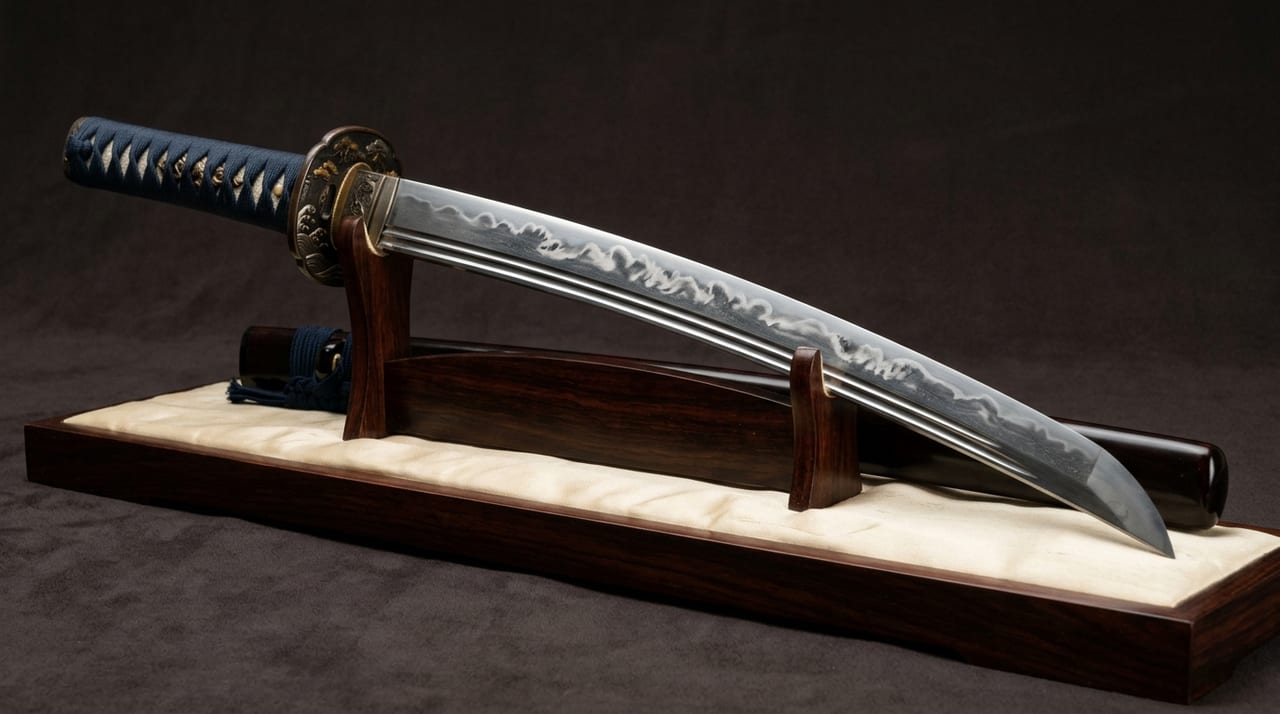
 * Image is for illustrative purposes only.
Soboro Sukehiro
ソボロ助広
Also known as: Sukehiro I; Yahei; Master of the Formative Period of Osaka Shintō
Description
Soboro Sukehiro — Another Name of Sukehiro I
Soboro Sukehiro is an alternative name for Sukehiro I, a swordsmith active in Osaka in the early Edo period. Because one of Sukehiro I's works is inscribed with 'Soboro', he is called "Soboro Sukehiro." Sukehiro I's common name was Yahei. He came from Tsuda Hosoe in Harima (Banshū). He was at first a mass-production smith in Tsuda, but he went to Osaka, became a disciple of Kawachi no Kami Kunisuke I, and founded his own school in Osaka. He died in the 11th month of Kanbun 3 (1663).
Incidentally, Tsuda Echizen no Kami Sukehiro (1637–1682), who later completed the tōran-ba and became a master representing Osaka shintō, was the second generation, an adopted son of Sukehiro I. He is a different person from Soboro Sukehiro (Sukehiro I).
Style of Sukehiro I
The style of Sukehiro I (Soboro Sukehiro) has shallow curvature (sori), and on a ko-mokume jigane it features chōji-ba and gunome midare hamon. In this way it inherits the style of his teacher, Kawachi no Kami Kunisuke I. Whereas the second-generation Tsuda Echizen no Kami Sukehiro created the splendid tōran-ba, which evokes the great waves of the open sea, Sukehiro I, as a smith who supported the early period of Osaka shintō, is classed as jōjō-saku (very superior grade) among shintō smiths and as saijō ō-wazamono (highest grade for cutting ability).
Lineage of Osaka Shintō
Kawachi no Kami Kunisuke I, under whom Sukehiro I studied, was a disciple of Horikawa Kunihiro, the Kyoto master regarded as the founder of shintō, and he is considered one of the founders of Osaka shintō. Sukehiro I continued this lineage and, together with Inoue Shinkai, Kawachi no Kami Kunisuke II, and others, supported the development of Osaka shintō. In the early Edo period, Osaka flourished as a center of commerce and culture, and wealthy townspeople and daimyō sought the finest swords. The Osaka shintō smiths who met this demand reflected the aesthetic sense of their age through the clarity of their jigane and new expressions of hamon, and built a distinctive genre of their own.
The First and Second Generations — The Sukehiro Name
The Sukehiro name passed from the first generation (Soboro Sukehiro) to the second (Tsuda Echizen no Kami Sukehiro). The second generation was born in Uchide village in Settsu Province, became an adopted son of Sukehiro I, learned sword-making from him, became independent in his twenties, and grew into one of the foremost masters of Osaka shintō. The tōran-ba completed by the second generation had a great influence on later Osaka shintō smiths and reshaped the mainstream of sword aesthetics from the middle Edo period onward. Soboro Sukehiro I, as a pioneering master who laid the foundations for that great second generation, holds an important place in the history of Osaka shintō.
Works and Evaluation
Among the signed works of Sukehiro I (Soboro Sukehiro), some carry the added inscription 'Soboro', and this became the source of the alternative name. The signatures are cut as 'Sesshū jū Fujiwara Sukehiro' and 'Sesshū Ōsaka jū Sukehiro saku', among others. The works of Sukehiro I have a flavor different from the splendid style of the second generation, and they are valued by sword enthusiasts and researchers as material showing the starting point of Osaka shintō.
Legends & Stories
The Riddle of the Name Soboro
The name "Soboro Sukehiro" derives from the fact that some blades by the first Sukehiro (Sukehiro I) bear the added inscription "Soboro." As for the meaning of "Soboro," various theories exist, including the view that Sukehiro I, indifferent to his appearance, always wore rags; however, the truth is uncertain.
The Birth of Tōran-ba — A Revolution in Edo-Period Sword History
The hamon of Japanese swords developed over time, from the suguha and ko-midare of the Heian period, to the chōji-midare of the Kamakura period, and the ō-midare of the Nanbokuchō period. Yet the tōran-ba perfected by Tsuda Echizen no Kami Sukehiro II (adoptive son of the first Soboro Sukehiro) is one of the most dramatic innovations in that history. Tōran-ba is a hamon style that depicts, along the edge, large wave forms resembling the great waves of the open sea crashing against the shore. Unlike conventional hamon, which change rhythmically along the blade line, the size, shape and force of the waves change freely depending on the location on the blade, so the blade presents entirely different scenes depending on the viewing angle and the way light falls on it. This conception can be interpreted as a translation into iron and fire of the dynamic aesthetic sensibility of Osaka during the Kanbun and Enpō eras, when townsman culture was blossoming. Sukehiro II, breathing the air of Osaka, a city where merchant culture flourished, was a rare artist who elevated his aesthetic judgment into the very special medium of expression that is hamon. The completion of tōran-ba was not merely a technical advance but a declaration that the sword should be elevated from a "weapon" to an "object of appreciative art," and it became a historic turning point that determined the direction of Osaka shintō thereafter.
Sukehiro at the Crossroads of Warrior and Townsman Culture
In the early Edo period, in Osaka during a long peace, warriors had begun to redefine the sword from a tool of actual combat into a cultural luxury and status symbol. Wealthy daimyō, hatamoto and rich merchants sought the finest swords as if competing with one another. Sukehiro's works were sought not merely for their cutting quality but as demonstrations of the owner's discernment, wealth and cultural refinement. The sword culture of this era was a special space in which the spirituality of the warrior ethos and the hedonism of townsman culture were intricately intertwined, and Sukehiro II's tōran-ba succeeded in integrating the values of both within a single blade. Pouring the pursuit of sensory beauty into the form of a sword that symbolizes spiritual discipline — this paradox is precisely the essence of Osaka shintō, and the Sukehiro lineage, continuing from the first to the second generation, is its representative bearer.
Influence on Later Generations
The tōran-ba of Sukehiro II had a great influence on later Osaka shintō smiths, and Ōmi no Kami Sukenao, Echigo no Kami Kanesada and Ikkanshi Tadatsuna each incorporated elements of tōran-ba in various forms. Smiths in the line of Sukehiro's disciples in particular inherited their master's techniques while adding their own interpretations, yet none emerged who fully transcended Sukehiro's attainment. The tōran-ba style, after Sukehiro's death, became formalized as a "legacy of the school"; however, the organic and vivid movement of the waves seen in the works of Sukehiro II himself possesses a vitality of an entirely different dimension from the stylized successor works. This is proof that Sukehiro was not merely a craftsman but a true artist who engraved his own inner sense of beauty directly into the steel.
Modern Evaluation
Today, Soboro Sukehiro (Sukehiro I) is positioned, as a smith of the early Osaka shintō period who laid the foundation of the Sukehiro lineage continuing to Tsuda Echizen no Kami Sukehiro II, among the "jōjō-saku" (very superior grade) and the "saijō ō-wazamono" (highest grade for cutting ability).