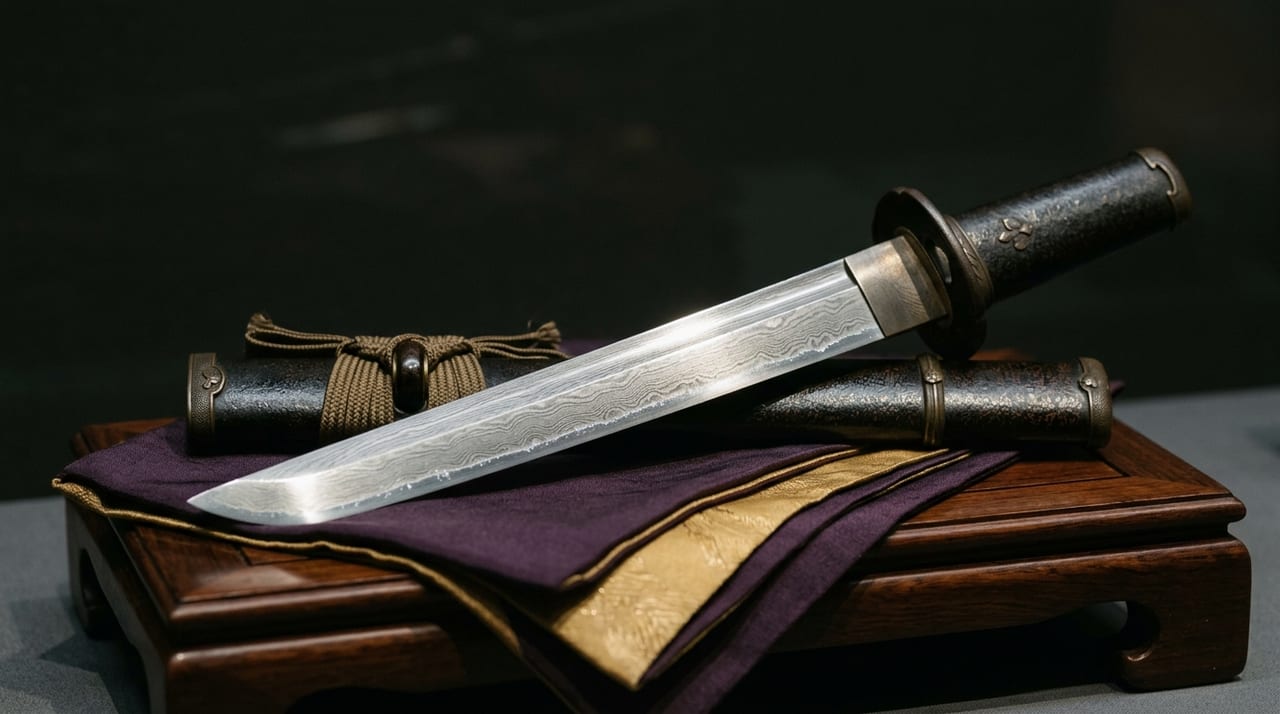
 * Image is for illustrative purposes only.
Shinano Tōshirō
信濃藤四郎
Also known as: Shinano Tōshirō · Short sword by Awataguchi Yoshimitsu · Precious treasure of the Tokugawa shogunate
Description
Overview of the Blade
Shinano Tōshirō is a masterpiece tanto forged by Awataguchi Yoshimitsu, a celebrated master of Yamashiro Province (present-day Kyoto) in the mid-Kamakura period, and stands as one of Yoshimitsu's most highly regarded tantos. "Tōshirō" was Yoshimitsu's common name; the tantos forged by Yoshimitsu are collectively called "Tōshirō blades," and most are designated as National Treasures or Important Cultural Properties. Shinano Tōshirō is a famed blade recorded in the Kyoho Meibutsu-chou, with the "Shinano" name derived from the court rank of its former owner, Nagai Shinano-no-kami (Nagai Shinano Governor). It is designated an Important Cultural Property (originally designated a National Treasure in 1935; reclassified as an Important Cultural Property following the enactment of the Cultural Properties Protection Law in 1950) and is currently housed at the Chidō Museum in Tsuruoka City, Yamagata Prefecture.
Yoshimitsu's Tantos—The Pinnacle of Kamakura Blade Artistry
Awataguchi Yoshimitsu was a swordsmith who lived in Awataguchi, Yamashiro Province during the mid-Kamakura period, and his tantos are esteemed as among the highest achievements in the history of Japanese sword craftsmanship. Yoshimitsu's tantos are characterized by their slender form, with blade lengths of roughly 6 to 9 sun (approximately 18–27 cm), combined with the Awataguchi tradition's finely-packed small kōzane ji-tetsu and fine nie that densely adheres to the edge, creating a straight or gently-undulating hamon of pristine, dignified beauty. So celebrated were Yoshimitsu's works that both samurai and court nobility praised them as "a single Yoshimitsu tanto is worth more than several tachi combined"; his pieces demonstrate the highest realm that Japanese swordcraft achieved, not only in cutting ability but in spiritual fulfillment as a craft. As one of Yoshimitsu's finest works, Shinano Tōshirō well conveys the beauty of the Awataguchi school through the brilliance of its ji-tetsu, the subtle radiance of its hamon, and the orderly balance of its overall form.
Provenance and the "Shinano" Name
Shinano Tōshirō is said to have acquired the "Shinano" name from its former owner, Nagai Shinano-no-kami (Nagai Shinano Governor). Subsequently, it entered the Tokugawa shogunate collection, passed through the Maeda family of Kaga domain, and was transmitted to the Sakai family, lords of Shōnai domain in Dewa. By being recorded in the Kyoho Meibutsu-chou, which compiled celebrated blades of the Edo shogunate, it was officially recognized as "a treasure renowned throughout the realm." Its provenance, carefully preserved through the hands of the shogunate and daimyo families, testifies that Yoshimitsu's tantos were treasured as the highest of possessions by the powers of the age.
From the Sakai Family to the Chidō Museum
Shinano Tōshirō was long transmitted through the Sakai family, lords of Shōnai domain in Dewa, but in 1986 (Showa 61) it was stolen. The thief was subsequently apprehended, and in 1999 (Heisei 11) the Chidō Museum reacquired it, making it part of their collection. The Chidō Museum, located in Tsuruoka City, houses numerous precious artifacts connected to the Sakai family, the lords of Shōnai domain. The journey of Shinano Tōshirō—born in Kyoto in the mid-Kamakura period, transmitted through the shogunate and daimyo families to Shōnai, surviving the hardship of theft, and preserved into the present age—speaks to the history of how Japanese swords, as cultural treasures, have been preserved through countless hands.
Shinano Tōshirō Among the Tōshirō Blades
Dozens of Awataguchi Yoshimitsu's tantos survive today, and an exceptionally high proportion of them are designated as National Treasures or Important Cultural Properties. Among the Tōshirō blades, which bear such poetic individual names as "Namazuo Tōshirō" (Catfish-Tail Tōshirō) and "Yagen Tōshirō" (Trident-Shaped Tōshirō), Shinano Tōshirō stands out for its dignified name anchored in a place and its documented provenance through the shogunate and daimyo families, making it a masterpiece of exceptional historical and cultural significance within the Tōshirō tradition.
Legends & Stories
The Mystery of Awataguchi Yoshimitsu—Life of the Greatest Swordsmith
No certain dates of birth and death have been transmitted regarding Awataguchi Yoshimitsu, and much of his life remains shrouded in mystery. He is believed to have been active in the mid-Kamakura period (late 13th century) with his base in Awataguchi, Yamashiro Province (present-day Higashiyama Ward, Kyoto), though contemporary records are scarce, and his legacy is transmitted largely through later blade treatises and oral tradition. The common name "Tōshirō" became widely known, and the tantos he forged are collectively called "Tōshirō blades," transmitted to daimyo families, temples and shrines, and samurai throughout Japan. The abundance of Yoshimitsu tantos that survive today may be attributed to his long career or continuous production by his school, but the sheer number of extant works also testifies that from his own time his creations enjoyed the highest esteem and were carefully preserved. Shinano Tōshirō is one of Yoshimitsu's masterpieces, which acquired its name from having been owned by Nagai Naomasa, a retainer of Tokugawa Ieyasu who was appointed Shinano Governor, and is today an Important Cultural Property housed at the Chidō Museum in Tsuruoka City, Yamagata Prefecture.
Registration in the Kyoho Meibutsu-chou—A Treasure Recognized by the Edo Shogunate
The "Kyoho Meibutsu-chou," compiled under the command of Tokugawa Yoshimune during the Kyoho era (1716–1736), is a comprehensive official catalog of celebrated blades throughout the realm and is regarded as the supreme authority on sword evaluation during the Edo period. The fact that Shinano Tōshirō appears in this catalog means the Tokugawa shogunate officially recognized it as "a treasure renowned throughout the realm," establishing its authority in sword history. Most blades recorded in the Kyoho Meibutsu-chou remain designated as National Treasures or Important Cultural Properties today; notably, this catalog continues to influence modern standards of sword evaluation, transcending its role as mere historical record.
The World of Tōshirō Blades—Connections Forged by Yoshimitsu's Tantos
The collection of Awataguchi Yoshimitsu's tantos—including Yagen Tōshirō, Namazuo Tōshirō, Maeda Tōshirō, Hakata Tōshirō, and Ichigo Hitofuri—exist as sibling creations born from a single talent named "Yoshimitsu," each possessing its own distinctive name and provenance. Among them, Shinano Tōshirō holds a special place of distinction as a masterpiece bound to the highest authority—the Tokugawa shogunate—within the world of Tōshirō blades. The richness of Japanese sword naming and transmission culture—wherein each Tōshirō blade bears a distinctive name and its provenance is passed down through the ages—is exemplified most fully in Yoshimitsu's collection of tantos, and the name "Shinano Tōshirō" itself is deeply rooted in this rich cultural heritage.
The Land of Shinano and the Poetry of the Blade
When a place name like "Shinano" is given to a blade, there overlays the image of a rich inland landscape of mountains, rivers, and forests. Shinano province (present-day Nagano Prefecture) is a mountainous region surrounded by the Japanese Alps, a land that nurtured its own distinctive culture within pristine waters and a severe natural landscape. The serene and dignified beauty of the world inhabited by Yoshimitsu's exquisitely introspective tantos sustains the stature of this famed blade. The combination of the memory of authority embodied by the Tokugawa shogunate and the poetic place name Shinano bestows upon "Shinano Tōshirō" its own distinctive stature and poetic resonance; it continues to shine across seven hundred years as a legendary blade that resonates vividly in the hearts of all who encounter it.