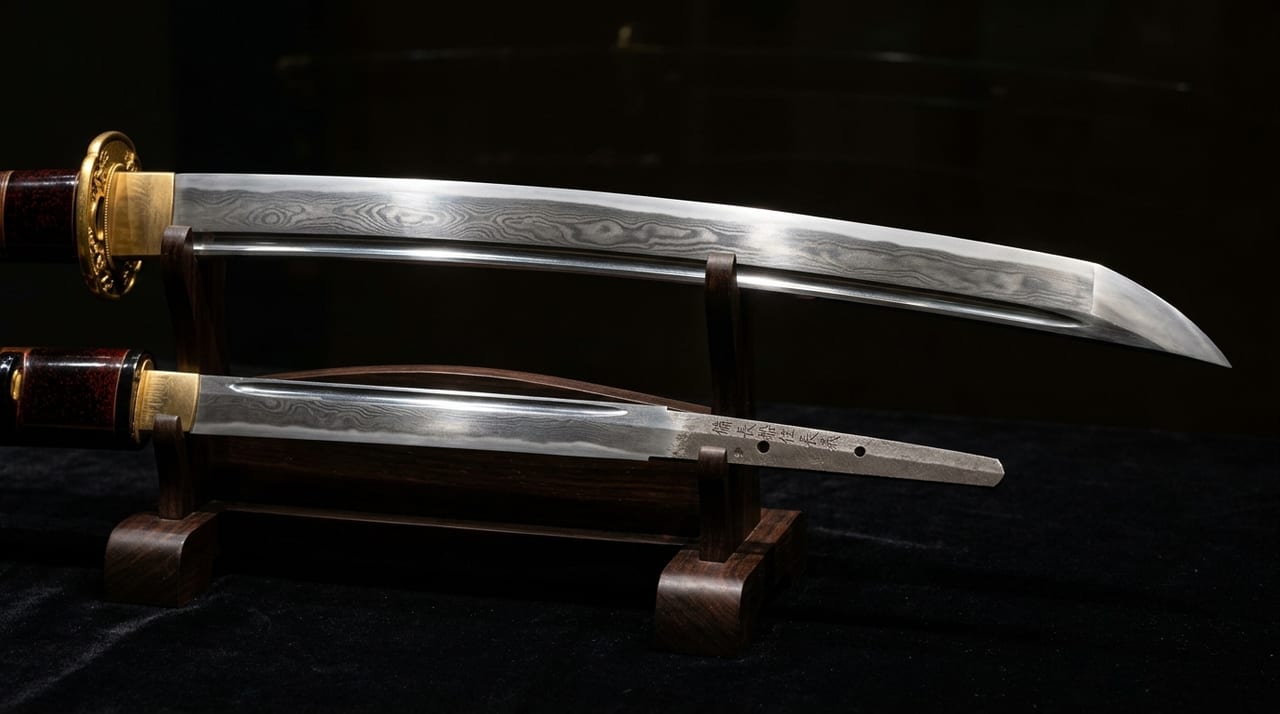
 * Image is for illustrative purposes only.
Osafune Chōgi
長船長義
Also known as: Pinnacle of Osafune in the Nanbokuchō Era; Perfecter of the Ōkissaki; Suguha Chōgi
Description
Osafune Chōgi Overview — The Peak of Bizen in the Nanbokuchō Period
Osafune Chōgi was a swordsmith who flourished in the latter half of the 14th century (Nanbokuchō period) based in Osafune in Bizen Province (present-day Okayama Prefecture), and is recorded in Japanese sword history as a master craftsman who embodied the highest standard of the Osafune school in his era. Chōgi's lineage is said to descend from the line of Sanenaga and Mitsunaga, who carried on the tradition of Mitsuada, and is transmitted to be a separate line from the main current represented by Kagemitsu and Kanemitsu. While Chōgi was influenced by the refined works of late Kamakura Kagemitsu and the grand Kanemitsu of the Nanbokuchō period at the same Osafune location, he opened his own unique artistic domain. Chōgi's greatest characteristic lies in the "ōkissaki (big point) suguha (straight) tachi" — a paradoxical aesthetic that combines the grand tachi with a large point, as demanded by the turbulent age of the Nanbokuchō, with a serene blade pattern of suguha — and the beauty of this combination became a subject of special appreciation in later generations.
The Technical Characteristics of Chōgi's Blades — The Paradox of Big Points and Straight Edge
The greatest technical and aesthetic characteristic of Osafune Chōgi's works lies in the rare combination of "ōkissaki (big point) suguha (straight hamon)." The vast majority of Osafune blades from the Nanbokuchō period possess violent hamon such as ōmidare (large waves) or notare (undulation), but in the midst of the age's turmoil, Chōgi instead chose suguha — the most tranquil of all hamon patterns. This "contrast between grand physical form (big point, large body tachi) and serene blade pattern (suguha)" imparts profound tension and emotion to the beholder — the paradoxical beauty of a gigantic weapon concealing extreme serenity within is Chōgi's greatest appeal. The steel surface displays typical Bizen characteristics with large itame mixed with prominent wood-grain patterns and bright, vivid utsuri, while the fine, uniformly distributed jini demonstrates a dignified finish. The hoshi (tip shape) sweeps out grandly before turning, displaying majestic form unified with the tachi's grand physical proportions.
The Nanbokuchō Period and Society
The Nanbokuchō period (1336–1392), when Chōgi was active, was the greatest internal conflict in Japanese medieval history, during which the Southern Court (continuing the line of Emperor Godaigo) and the Northern Court (the emperor placed by Ashikaga Takauji) fought for fifty-six years over the rightful imperial throne of Japan. This era was also a time when extremely long tachi known as "nodachi" and "ōdachi" were produced, and Chōgi left works of the highest standard from this period of increasing scale. The paradox that an age of turmoil generated the greatest swords embodies the universal historical pattern that "social crisis draws forth artistic challenge," and Chōgi's great tachi group stands as one of the most eloquent testimonies to this. At the same time, Chōgi's choice of suguha — "the most peaceful of all blade patterns" — can be interpreted as "the swordsmith's quiet resistance" in an age of upheaval, revealing the depth of Chōgi's aesthetic philosophy.
Works Bearing Long Inscriptions and Their Historical Documentary Value
Among Osafune Chōgi's works, several extant pieces bearing long inscriptions reading "Bizen-no-Kuni Osafune Chōgi" with dates of manufacture exist and hold high value as primary sources of the first rank in the study of Bizen swords of the Nanbokuchō period. Chōgi's dated long-inscribed works, inheriting the tradition of Kagemitsu's long inscriptions, make it possible to trace Chōgi's stylistic changes chronologically and provide a benchmark for understanding the overall transformation of Bizen swords in the Nanbokuchō period. In particular, the existence of works bearing era names such as "Shōhei" and "Enbun," used respectively by the Southern and Northern courts, raises the question of which political power patronized Chōgi, and holds special significance in the research theme of how medieval swordsmiths survived amid complex political circumstances.
Comparison with Kanemitsu and Chōgi's Individuality
Osafune Kanemitsu, a contemporary and member of the same school as Chōgi, holds overwhelming reputation as "the greatest master of the Nanbokuchō period," but Chōgi occupies a special position as an equally standing figure of the same era. If Kanemitsu expressed the turmoil of the Nanbokuchō through the grand, turbulent hamon of ōmidare on his blades, Chōgi expressed the same era from an entirely different angle through the serenity of suguha — this contrast between the two is passed down among sword researchers as the most fascinating parallel demonstrating the diversity and richness of Nanbokuchō Bizen swords. The two aesthetics born from the contrast of "Kanemitsu's intensity and Chōgi's serenity" are not a question of which is superior, but rather stand as the most dramatically demonstrative case showing the diversity of beauty that can emerge from the same era and the same technical foundation, possessing special educational and cultural value.
Contemporary Evaluation
In the modern sword-collecting world, Osafune Chōgi is held in unwavering high regard as one of "the peaks of the Osafune school in the Nanbokuchō period," and several excellent works designated as National Treasures or Important Cultural Properties survive today. In particular, Chōgi's distinctive style of "ōkissaki suguha" holds special appeal in the world of sword appreciation, and is highly valued as a work through which one can experience a unique aesthetic of "serenity within grandeur" in contrast to Kanemitsu's grand, turbulent ōmidare. The display of Chōgi's works at the Tokyo National Museum and the Kyoto National Museum is regularly introduced as one of the finest opportunities to experience "the diversity of Nanbokuchō sword aesthetics," and through the perspective of comparative appreciation with Kanemitsu, Chōgi's works continue to hold special appreciative value. The name of Chōgi shines eternally in the magnificent lineage of the Bizen tradition.
Legends & Stories
Osafune Chōgi worked during the Nanbokuchō civil war — 56 years of warfare between the Southern Court (legitimate descendants of Emperor Go-Daigo) and the Northern Court (backed by the Ashikaga shogunate) — a conflict that tore Japan apart and drove demand for the massive ōdachi (great swords) that characterize the era. In this context, Chōgi's consistent choice of suguha (straight hamon) was a remarkable act of aesthetic counter-statement: the most turbulent era of Japanese medieval history, embodied not in turbulent hamon but in the quietest possible line. This paradox — titanic blade with serene soul — has made Chōgi's work a perennial object of philosophical commentary among connoisseurs: the 'Zen empty-mind' interpretation of straight hamon on enormous bodies; the 'stillness within the storm' reading of a master's refusal to let the age's violence dictate his aesthetic. The later tradition of 'Chōgi-utsushi' (blades made in conscious homage to Chōgi's style) through the Muromachi, Momoyama, and Edo periods testifies to the lasting authority of his distinctive vision.