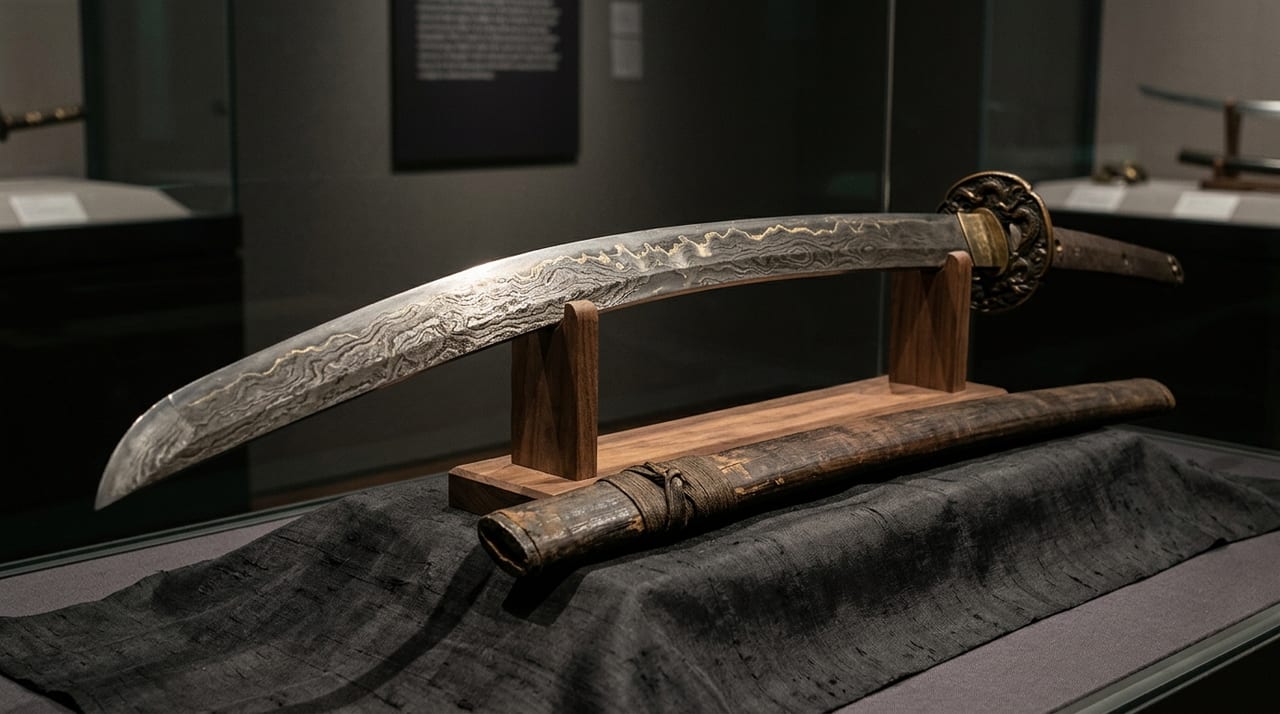
 * Image is for illustrative purposes only.
Etchū Norishige
越中則重
Also known as: Norishige; The Eccentric Genius of Matsukawa-hada; Maverick Among Masamune's Ten
Description
Overview of the Sword
Etchū Norishige (越中則重) was a master craftsman who flourished in Etchū Province (present-day Toyama Prefecture) in the early fourteenth century, during the late Kamakura period. He is counted among Masamune's Ten Disciples and represents the Sōshū tradition of sword-making. Norishige's greatest distinguishing feature lies in his unique jigane known as "matsukawa-hada" (pine-bark skin), a grain absolutely unparalleled in Japanese sword history. This unrivaled texture formed a world of beauty unique to Norishige alone, never seen in any other school. The matsukawa-hada is a distinctive surface characterized by the itame and mokume of the jigane flowing dramatically, displaying a rough and complex pattern much like the bark of an ancient pine tree—an aesthetic fundamentally opposed to the "uniform and refined jigane" that most Japanese swords pursued. This "intentional roughness" stands as proof of Norishige's genius, and his revolutionary style—which fundamentally questioned the very concept of sword beauty—has continued to captivate sword enthusiasts and researchers ever since.
The Mystery and Technical Significance of Matsukawa-hada
How the matsukawa-hada came to be remains incompletely understood even among modern sword researchers today. Various theories coexist: one holds that Norishige intentionally employed a special forging process to create this texture; another suggests that the unique quality of iron sand from Etchū naturally produced matsukawa-hada; yet another proposes that Norishige received a special technique from his master Masamune. Regardless of which theory one accepts, the indisputable fact remains that "only Norishige could achieve this," and posterity's sword-makers have never fully succeeded in reproducing true matsukawa-hada despite their attempts. In the modern era, matsukawa-hada is positioned as the most individualistic and daring expression among all jigane in Japanese swords, and sword enthusiasts who encounter Norishige's works experience a unique emotional response to the "beauty within roughness."
Norishige's Hamon and Overall Style
While matsukawa-hada is Norishige's foremost characteristic, he demonstrated equal genius in his hamon. His blade patterns combine notare and gunome in complex arrangements, with strong nie emerging in clusters. Kinsuji and inazuma are abundant, and the rough jigane resonates with the violent hamon to create a beauty of "controlled chaos." The bōshi typically displays riotous patterns, flowing long and deep, imparting an overall impression of "fierce energy unleashed within solidity." Norishige's tachi and tantō are better described as "existing intensely" rather than "quietly beautiful," possessing an active beauty that does not permit the viewer passive appreciation.
Norishige and Gō Yoshihiro—Etchū's Two Great Geniuses
Both Norishige and Gō Yoshihiro were Sōshū-tradition smiths based in Etchū Province, and being near-contemporaries, they are frequently discussed as paired figures—"Etchū's Two Great Geniuses"—in Japanese sword history. While Norishige is renowned for his late-Kamakura refinement and the uniqueness of his matsukawa-hada, Gō Yoshihiro is known for the fiercer intensity and rarity characteristic of the Northern and Southern Courts period. The fact that two master craftsmen of such caliber emerged from the same province of Etchū attests to the region's special place in sword-making culture, and one comes to understand that the natural environment—Toyama Bay, the Northern Alps, and rich iron-sand deposits—provided the foundation for nurturing the greatest of sword-makers.
Representative Surviving Works
The most celebrated example of Norishige's work is the National Treasure short sword (tantō) with mei "Norishige" (famously called "Nippon-ichi Norishige"—"Japan's Foremost Norishige") in the collection of the Eisei Bunko. This National Treasure tantō, in which the combination of matsukawa-hada and violent hamon is most magnificently realized, is regarded by sword researchers as Norishige's masterpiece and receives the highest assessment as "equal to the greatest peaks of the Sōshū tradition alongside Masamune and Go." Mei'd examples are relatively few in number, and numerous unsigned works have been authenticated as "Norishige" by the Hon'ami connoisseurs, though all the finest signed pieces receive the highest evaluation.
The Etchū Sword-Making Tradition and Its Transmission to the Modern Age
The tradition of sword-making in Etchū Province (present-day Toyama Prefecture), where Norishige flourished, continued long after the emergence of these two great geniuses, and Etchū sword-making retained significance into the Edo period. In the modern era, Toyama Prefecture maintains keen interest in sword culture, and the legacy of the great local craftsmen Norishige and Gō Yoshihiro is cherished as a source of regional cultural pride. Norishige's revolutionary discovery of matsukawa-hada beauty—a case of a single genius at once expanding the expressive possibilities of the Japanese sword—remains an inexhaustible wellspring of research for contemporary sword-makers.
Norishige's Aesthetics and Japanese Culture
The sense of "order and beauty within wild nature" evoked by Norishige's matsukawa-hada resonates profoundly with the core of Japanese aesthetics—wabi, sabi, and mono no aware. Beauty arising not from artificial uniformity, but from the contingency of nature—Norishige's swords embody precisely this. They crystallize in steel the paradoxical aesthetic sensibility that the Japanese people refined over centuries: "completeness within imperfection," "precision within roughness." The name Etchū Norishige stands in Japanese sword-culture history as a testament to the profound truth that sword beauty is born not from mere technical refinement but from the unity of natural force and human will. The fact that Norishige's swords are transmitted to the present day as National Treasures and Important Cultural Properties, attracting countless viewers each time they are exhibited, provides evidence that his matsukawa-hada possesses universal charm transcending time, eloquently demonstrating the magnitude of the legacy left to Japanese culture by the sword-making genius born in the remote land of Etchū.
Legends & Stories
The question of how Norishige created the matsukawa-hada has never been fully answered. Modern metallurgists and sword scholars have proposed theories involving the unique iron sand of Etchū, specialized folding techniques learned from Masamune, and even the specific charcoal and water of the region — but no modern smith has successfully reproduced it. The pine-bark skin remains one of the most studied mysteries in the history of Japanese craft. Norishige's relationship to Masamune is also debated: his technique differs so radically from his supposed teacher's that scholars argue he must have reinvented rather than inherited the Sōshū tradition. If so, the matsukawa-hada is not a variation on an existing aesthetic but a completely original creation — perhaps the most radical individual innovation in the entire history of the Japanese sword.