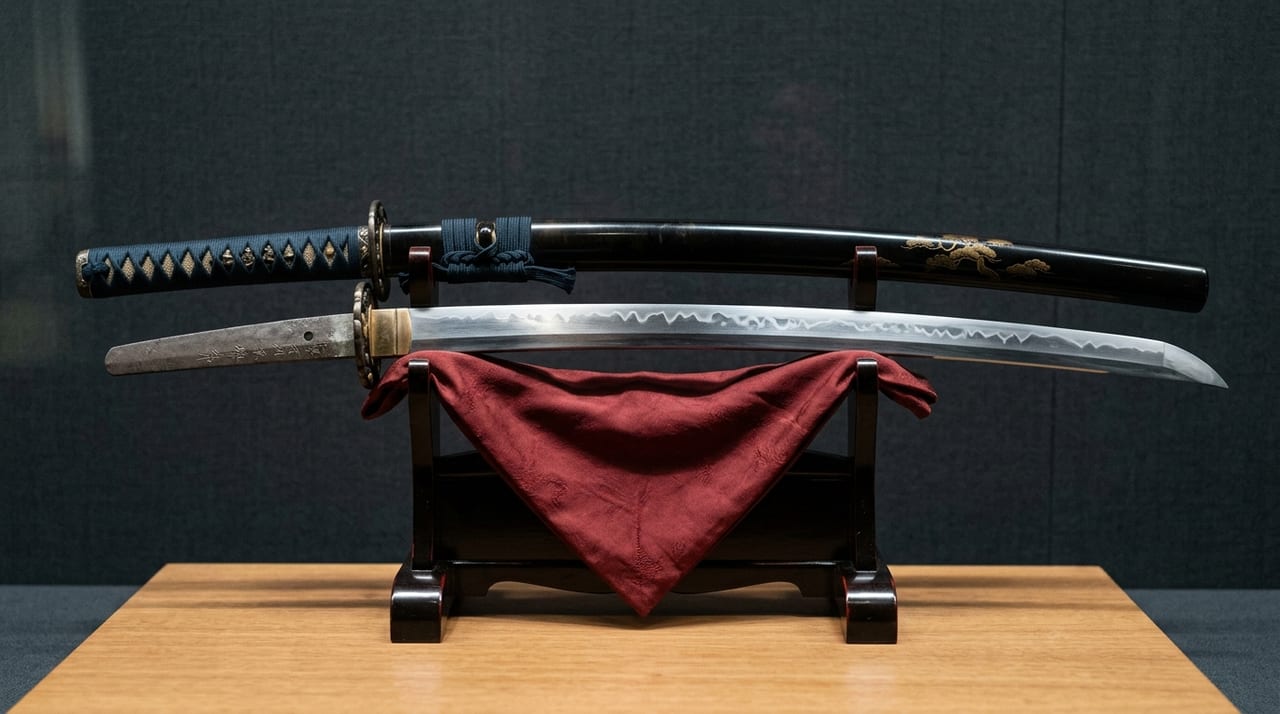
 * Image is for illustrative purposes only.
Nakigitsune
鳴狐
Also known as: Nakigitsune · Forged by Awataguchi Kuniyoshi · Passed Down Through the Akimoto Clan, Uchigatana
Description
Overview of the Sword
Nakigitsune (鳴狐, "Weeping Fox") is a sword forged by Awataguchi Kuniyoshi (粟田口国吉, also known as Saemonno-jō Fujiwara no Kuniyoshi), of Awataguchi, Kyoto, during the mid-Kamakura period. It is designated as an Important Cultural Property and is housed in the Tokyo National Museum. Among the Awataguchi school, renowned for mastery of short blade production, Nakigitsune is a distinctive work in the uchigatana (curved long sword) style, a form typically reserved for short blades, with a blade length of approximately 54 cm. This unique configuration—short blade aesthetics enlarged and given curvature—is rare among mid-Kamakura period works, and with few extant examples, it stands as a precious and exceptional surviving piece. The tang bears the signature "Saemonno-jō Fujiwara no Kuniyoshi." The poetic name "Nakigitsune" has no documented origin, though it is known to have passed through the Akimoto family of Yamamoto Domain, Dewa Province.
Awataguchi Kuniyoshi and the Awataguchi School
Awataguchi Kuniyoshi was a swordsmith active in mid-Kamakura period Kyoto, said to have been the son of Awataguchi Norikikuni. The Awataguchi school represents the pinnacle of the Yamashiro tradition, distinguished by refined steel and graceful blade patterns. Kuniyoshi gained high renown as a master of both short blades and swords. Nakigitsune is recognized as Kuniyoshi's masterwork, and alongside Yoshimitsu (Tōshirō), said to be a younger apprentice of the same school, it testifies to the excellence of the Awataguchi school into the modern day. Kuniyoshi's steel exhibits densely packed ko-itame with fine jinie that produces the characteristic lustrous and brilliant appearance known as "Awataguchi-hada." The blade pattern, based on a straight edge with small wavy elements woven throughout, exemplifies refined and dignified workmanship.
Form and Notable Features of Nakigitsune
Nakigitsune presents a curved long sword with blade length of approximately 54 cm, displaying pronounced curvature and a firmly anchored stance. This distinctive construction—short blade aesthetics realized in an enlarged curved sword form—stands as exceptionally uncommon among mid-Kamakura works, remarkable as an extraordinarily rare surviving example in the history of the Japanese sword. The steel exhibits uniform ko-itame grain densely packed with fine jinie, radiating bright white luminescence throughout. This is the hallmark of "Awataguchi-hada": microscopic jinie particles that shimmer snow-like in white brilliance, a visual effect unreproducible in swords of other schools. The blade pattern comprises an elegant composition of straight edges interspersed with small wavy elements, displaying a tightly drawn and lustrous edge, with refinement and dignity evident throughout. The tang is in its original state and bears the signature "Saemonno-jō Fujiwara no Kuniyoshi."
Transmission to the Akimoto Family and Preservation
Nakigitsune is documented to have been transmitted to the Akimoto family, daimyo of Yamamoto Domain in Dewa Province, and subsequently entered the Tokyo National Museum's collection in the modern period. Authenticated, signature-bearing works by Awataguchi Kuniyoshi are few in number, and among these, Nakigitsune is distinguished by excellent preservation and clarity of signature, rendering it an indispensable resource for research and authentication within Awataguchi school studies.
The Aesthetics of the Awataguchi School and Nakigitsune
The Awataguchi school epitomizes the Yamashiro tradition, refining three elements to their absolute zenith: precision of steel, refinement of blade pattern, and harmony of form. Its brilliantly white steel draws the viewer's spirit toward tranquility, opening access to a realm of crystalline beauty. Nakigitsune is a rare embodiment of the Awataguchi aesthetic expressed not through short blades but through the curved form of a sword, transmitting to the present day the mastery of Kuniyoshi and the legacy of the Awataguchi school. It has become widely known to younger generations through its appearance in the sword-themed video game "Touken Ranbu."
Legends & Stories
The Origin of the Name "Nakigitsune" — Multiple Traditions
The origin of the name "Nakigitsune" (鳴狐, crying fox — a fox giving voice, not a fox in tears) has been transmitted through various accounts since ancient times, and no definitive consensus has been established even in the modern era. The most poetic theory holds that the movement of the blade pattern (hamon) describes "a form resembling a crying fox" depending on the angle of polishing and the play of light, with portions of the hamon said to possess characteristic shapes evoking the contours of a fox's face or its tears. An alternative theory traces the name to a legend surrounding this sword—perhaps the person who possessed it experienced something mysterious connected to a fox, or the blade was discovered at a place where a fox was said to cry. Yet another account, using the character "鳴" (crying), interprets the name as a technical observation: the sound produced during polishing resembled the cry of a fox. The prolonged condition of multiple competing interpretations is itself regarded as desirable within Japanese naming culture, and it is precisely the polysemy of the name "Nakigitsune" that imparts a multidimensional character to this sword.
The Awataguchi School and Kyoto Sword Culture
The beauty created by the swordsmiths of Awataguchi is profoundly intertwined with the cultural character of Kyoto. Since the Heian period, Kyoto has been the complex cultural center where emperors, court nobility, Zen temples, and warriors mingled together, and the aesthetic sensibility nurtured in this city was distinguished not by simple strength or grandeur, but by refinement and elegance as its foundation. The bright white metal (jigane) and refined blade pattern of works by Awataguchi Kuniyoshi resonate deeply with the aesthetic of Kyoto—the lustrous shimmer of gold and silver in the Golden and Silver Pavilions, the purity of white sand in dry landscape gardens, the yugen quietude of the Noh stage. Awataguchi as a location stood at the foot of Higashiyama, along the path toward Kiyomizu Temple, and was known from ancient times as a craftsman's quarter where swordsmiths and forge workers gathered. The aesthetic sensibility cultivated in that place carried the distinctive refinement nurtured by Kyoto's mountains, rivers, and temples, and Kuniyoshi's works represent its crystallization. When we contemplate Nakigitsune, we may not be merely looking at a weapon, but directly confronting the very cultural essence that the Kamakura period's Kyoto had crystallized.
The Naming of Nakigitsune — Gaming and Contemporary Culture
Nakigitsune remains widely known in the modern era and appears in the sword-personification game "Tōken Ranbu" as "Nakigitsune" (鳴狐). While the game features multiple members of the "Tōshirō series"—personifications of short blades made by Awataguchi Yoshimitsu (including Hirano Tōshirō, Atsushi Tōshirō, Honebami Tōshirō, Gotō Tōshirō, and others)—Nakigitsune is a work by Awataguchi Kuniyoshi, not Yoshimitsu, and is not counted among the Tōshirō series. Such games have become a catalyst for introducing Nakigitsune to contemporary young generations. The phenomenon of traditional Japanese sword culture being transmitted to new generations through digital games is of paramount importance from the perspective of cultural property outreach, and it is also proof that the poetic beauty of the name "Nakigitsune" retains the power to capture people's hearts in the modern age. Young people who became interested in Nakigitsune through game characters and actually visit the Tokyo National Museum to encounter the authentic blade—in that moment, seven hundred years of time dissolves, and the Kamakura-era Kuniyoshi and the contemporary observer are connected through the sword. This is the true power that cultural property possesses, and Nakigitsune exemplifies that power most eloquently.
The Tokyo National Museum and the Present
Today, Nakigitsune is preserved and publicly displayed at the Tokyo National Museum as a Designated Important Cultural Property. It was transmitted to the Akimoto family of Dewa-Yamagata domain and subsequently donated to the museum by Watanabe Seiichirō, occupying an important position in Japanese sword history as a rare surviving example of a Kamakura-period uchi-gatana (tachi-form blade). Those who have actually viewed Nakigitsune often speak of the overwhelming presence and beauty that radiates from its small blade, and come to understand through direct experience the reason this uchi-gatana has been cherished across centuries. The radiance of its bright, clear metal and the landscape woven by its delicate blade pattern in the light carry a spiritual beauty that transcends mere metalwork, and evoke the sensation that the soul of the master craftsman Awataguchi Kuniyoshi yet lives on within this single blade. The poetic resonance of the name Nakigitsune and the cold, crystalline beauty emanating from the blade—these two aspects joined as one make this blade one of the most "narrative-rich" masterworks in the history of Japanese swords.
The Surviving Works of Awataguchi Kuniyoshi and Their Rarity
The surviving examples of Awataguchi Kuniyoshi's signed works are limited, and their rarity further elevates the value of these creations. Nakigitsune bears the signature "Sahyōe-no-jō Fujiwara no Kuniyoshi" on the tang and holds high authority as a Designated Important Cultural Property in Japanese sword history, embodying the weight that the name Kuniyoshi carries in Japanese sword-appreciation culture. The experience of encountering Nakigitsune in person at the Tokyo National Museum is a precious opportunity to directly experience the profundity of Japanese swords as an artistic form, and Nakigitsune shines as an eternal masterwork at the center of that experience.