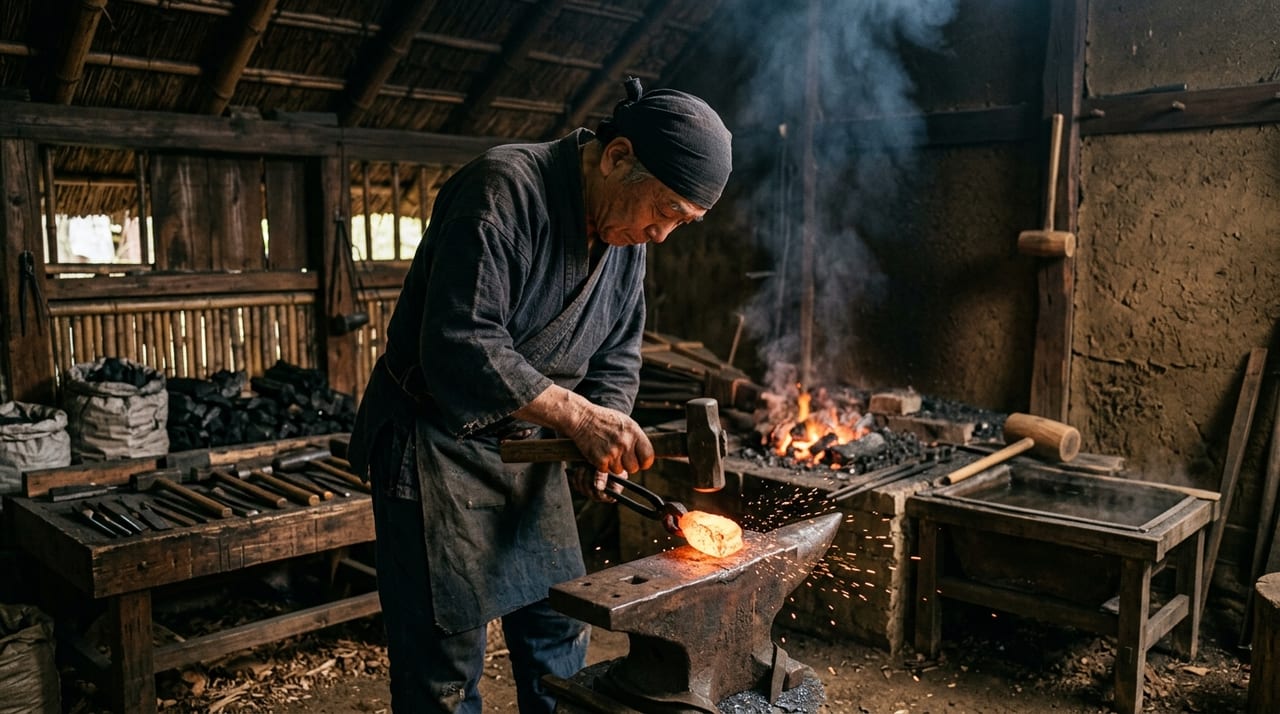
 * Image is for illustrative purposes only.
Awataguchi Kuniyoshi
粟田口国吉
Description
Awataguchi Kuniyoshi and His Era
Awataguchi Kuniyoshi was a swordsmith active in Awataguchi in Yamashiro Province (present-day area around Higashiyama Ward, Kyoto) during the mid-Kamakura period. The Awataguchi school was a major Yamashiro-den school that flourished from the late Heian period through the Kamakura period, based in Awataguchi in Kyoto. Centered on the "Six Awataguchi Brothers"—Kunitomo, Hisakuni, Kuniyasu, Kunikiyo, Arikuni, and Kunitsuna—it produced many outstanding swordsmiths.
The mid-Kamakura period was an age when the warrior government was established in Kamakura and the warrior ethos spread throughout the country. Demand for swords rose sharply, and sword-making groups in various regions, including Bizen, Yamashiro, and Yamato, competed to produce fine works. Within this setting, the Awataguchi school upheld the elegant tradition of the Heian-period Yamashiro-den while also producing swords of practical quality that met the demands of the age.
The exact birth and death years of Awataguchi Kuniyoshi are unknown, but based on extant dated works, he is presumed to have been active in the mid-Kamakura period. Because Awataguchi Yoshimitsu (said to have been Kuniyoshi's child or disciple) is regarded as the supreme master, Kuniyoshi is often positioned as a renowned smith of the stage preceding him. However, a detailed study of Kuniyoshi's works reveals his distinctive technique and high dignity, showing that he was an outstanding figure even within the Awataguchi school.
Kuniyoshi's Sword-Making Techniques and Style
The most notable features of Awataguchi Kuniyoshi's works are the refinement of their jigane and the dignity of their hamon. The jigane shows a well-packed ko-itame-hada, with a nashiji-like texture in places. This is a feature common to the Awataguchi school, but in Kuniyoshi's case the packing is especially uniform and beautiful, with a clear, lustrous moisture across the entire surface. Fine ji-nie is evenly distributed throughout the jigane, and its bluish iron tone adds depth.
The hamon is based on suguha, with many calm patterns that mix ko-midare and ko-gunome. The nie is deep and evenly distributed, and the hamon edge is moist and composed. The nie particles are fine and uniform, and thin kinsuji or sunagashi may appear within the blade. This serene and refined hamon can truly be said to embody the essence of the Yamashiro-den.
The bōshi is basically ko-maru-gaeri, but in Kuniyoshi's case the tip is arranged with particular dignity, the length of the return is moderately restrained, and the overall impression is neat. The nakago is mostly ubu, and the yasurime is often kiri. The signature "Kuniyoshi" is carved in a neat character style, and though simple, it has dignity.
Outstanding Skill in Tantō
Kuniyoshi's reputation rests especially on his tantō. The mid-Kamakura period was when tantō first came to occupy a central place in sword history, a transitional era from the age of tachi to the age of tantō. The Awataguchi smiths sensed this shift early and left many excellent tantō.
Kuniyoshi's tantō are based primarily on hira-zukuri or kanmuri-otoshi-zukuri. Blade lengths are mostly around 7 to 8 sun, the width of the blade is moderate, and the kasane is sturdy and neatly built without excessive thickness. The sori tends toward uchizori, which is also a characteristic of Awataguchi tantō.
From jigane to hamon, the work is as precise as in his tachi, and one senses the craftsman's pride in never cutting corners, even on tantō. Some works with horimono also survive, in which bonji and suken are carved with a neat hand.
Kuniyoshi's Position within the Awataguchi School
The Awataguchi school reached its peak with Yoshimitsu (Tōshirō), but in the preceding stage, Kuniyoshi, Arikuni, Kunikiyo, and others produced many works of high standard, playing a very important role in establishing the technical foundation of the entire school.
Kuniyoshi's works, as swords of dignified quality without exaggeration in technique, have been highly regarded by later appraisers.
Furthermore, among the Yamashiro-den, the Awataguchi school strongly reflects the refinement of capital culture, and it has a record of supplying swords to the court and to kuge. Kuniyoshi is also positioned as one of the smiths who left works of high dignity capable of meeting such noble demand.
Extant Works and Designation as Cultural Properties
Few of Awataguchi Kuniyoshi's works survive, but a tantō designated as an Important Cultural Property has been transmitted and is referenced as a standard work in Awataguchi school research. A tachi designated as an Important Cultural Property is also known, confirming that he displayed outstanding skill in both tachi and tantō.
The condition of his works is generally good, and the existence of several works with ubu nakago supports the authenticity of his signed works. Through exhibitions at sword museums and art museums across the country, his works are gradually becoming known to modern sword enthusiasts.
Kuniyoshi's Spirit and TOUKENZA
What Awataguchi Kuniyoshi's swords embody is a beauty that avoids ostentation and is upright and sincere. As the foundation of the Yamashiro-den, Kuniyoshi, who passed on technique and spirit to his successors, can be called a pillar of Japanese sword history, unseen but essential.
TOUKENZA values bringing light not only to renowned smiths such as Yoshimitsu and Masamune, but also to such "unsung masters." The dignity and sincerity shown in Awataguchi Kuniyoshi's works are rooted in the very essence of the culture of the Japanese sword, and they will surely resonate deeply with today's sword enthusiasts. Please sense the radiance of the spirit that Kamakura craftsmen poured into the clear jigane and the serene hamon.
Famous Works
- Tantō (Important Cultural Property)
- Tachi signed Kuniyoshi (Important Cultural Property, Kyoto National Museum collection)