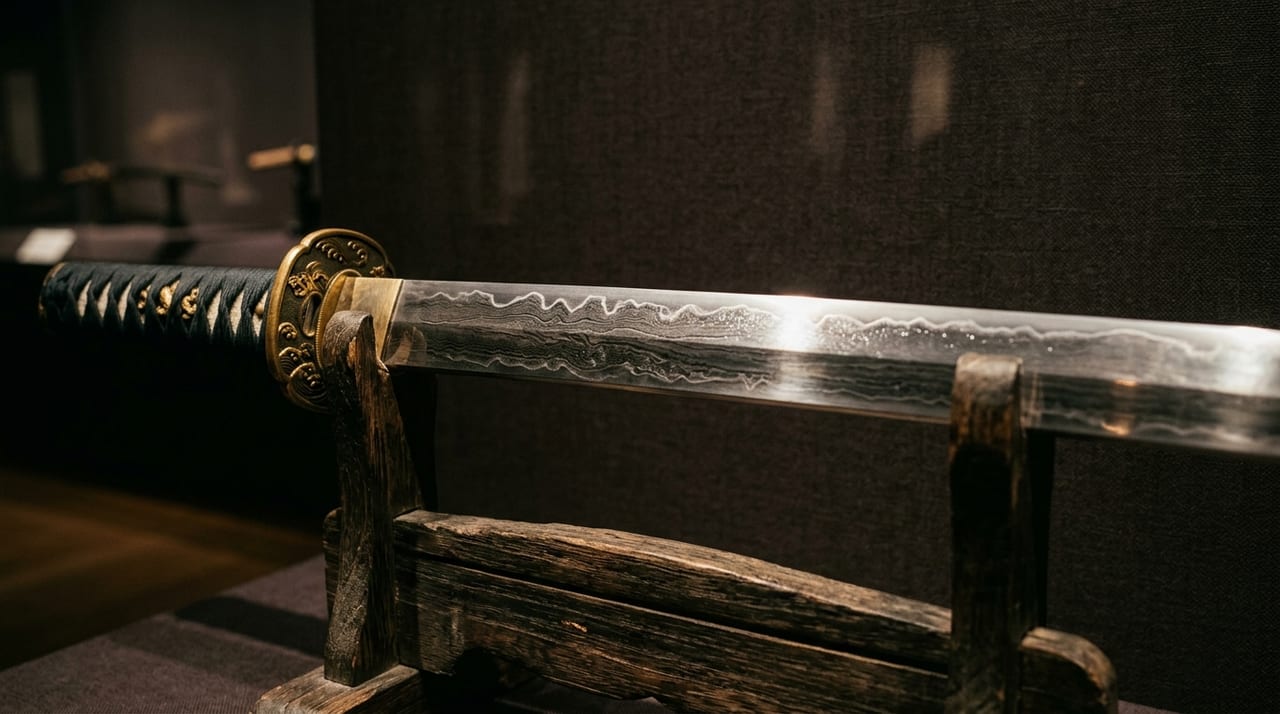
 * Image is for illustrative purposes only.
Katana by Minamoto Kiyomaro
源清麿の刀
Also known as: Kiyomaro Katana
Description
Minamoto Kiyomaro is celebrated as the last great genius of the Bakumatsu era's swordsmith tradition, so extraordinary in his craft that he is called the 'Masamune of the Bakumatsu era.' Born in Shinano Province (present-day Nagano Prefecture), he largely taught himself the rudiments of sword forging before moving to Edo at a young age for formal study under a master, and ultimately establishing his own forge. Kiyomaro's swords are grounded in the Sōshū tradition, featuring dynamic ō-midare hamon alive with abundant nie, kinsuji, and sunagashi weaving in all directions—a vibrant, intensely personal aesthetic. This katana, approximately 70.5 centimeters long, is considered to date from Kiyomaro's mature period, when his Sōshū-style hamon was at its most fully realized; kinsuji and sunagashi interlock in complex patterns throughout the blade, and the tempered edge is enveloped in mist-like nie. The jigane features a coarse ō-itame grain with areas of mokume and deep, dense ji-nie—a texture of overwhelming presence. Kiyomaro was a free-spirited man who loved wine and wandering, yet his blades were the product of an uncompromising perfectionism. He died at the young age of 42, leaving relatively few surviving works, each of which is treasured as representing the pinnacle of Bakumatsu sword artistry. Housed in the Yūshūkan Museum of Yasukuni Shrine, the sword also carries symbolic significance as an embodiment of the samurai spirit that gave way to the Meiji Restoration.
Legends & Stories
Numerous legends cluster around Kiyomaro's name. The most famous holds that he once forged a blade in a state of heavy intoxication, yet when the sword was complete the next morning, it proved to be his greatest masterwork. 'Sake summons divine inspiration,' Kiyomaro is said to have explained—a peculiar forging ritual that astonished his students and companions alike. His blades were also reputed to emit a pale blue light when sheathed at night, revered by warriors as prophetic divine weapons that warned of enemy approach. During the turmoil of the Bakumatsu era, many loyalists sought out Kiyomaro's swords, and the saying spread among them that 'the one who bears a Kiyomaro blade will cut open the age.' His early death at 43 has come to embody the tragic aesthetic of Japanese culture—'genius dies young'—and his memory is kept alive with undiminished fervor among sword connoisseurs to this day.