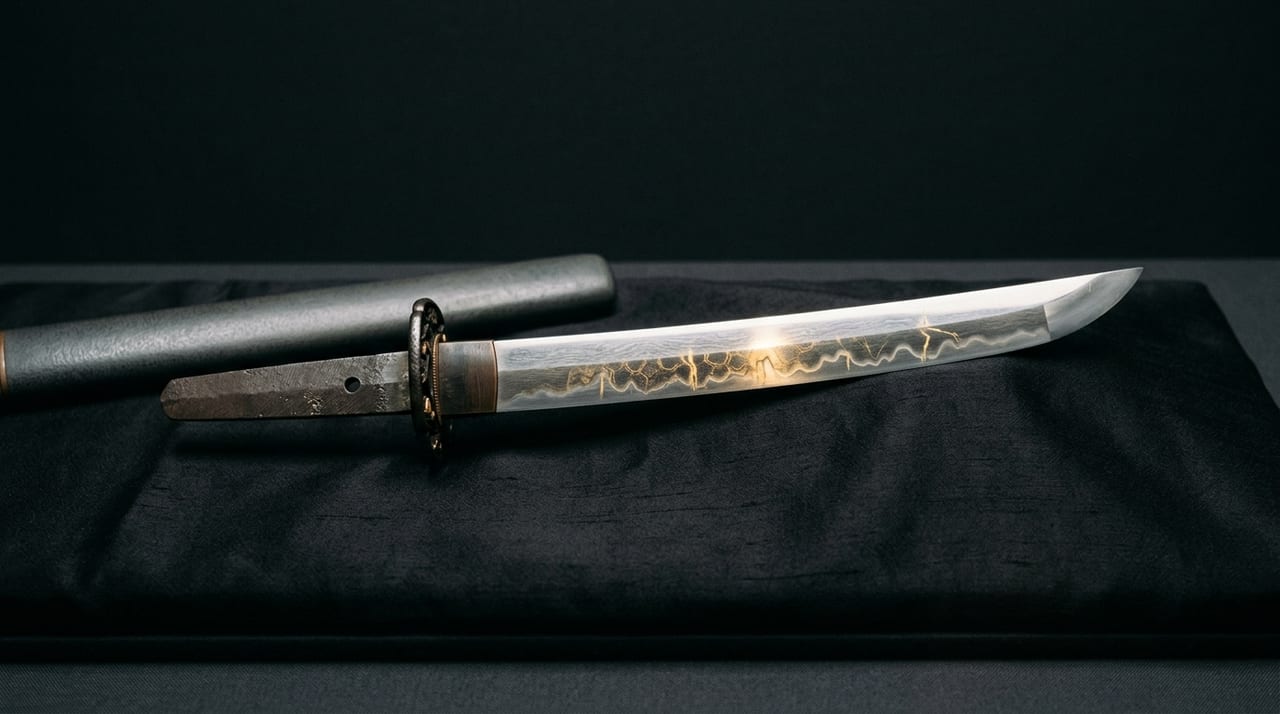
 * Image is for illustrative purposes only.
Kikkō Sadamune
亀甲貞宗
Also known as: Tortoiseshell Sadamune
Description
Overview of the Sword
Kikkō Sadamune is a long sword (tachi) authenticated as the work of Sadamune of Sagami Province and designated a National Treasure of Japan. It is a large, heavily polished and unsigned blade with a blade length of approximately 70.9 cm and curvature of 2.4 cm. The hamon features a complex irregular pattern based on gunkome (alternating crests) in nie-deki style, with kinsuji (gold lines) and inazuma (lightning) running vertically and horizontally throughout the blade. The nie (crystalline particles) at the edge is large-grained and shines brightly.
The name "Kikko" (tortoiseshell) derives from the engraving of a flower-diamond tortoiseshell pattern (tortoiseshell-chrysanthemum motif) hair-engraved on the back of the tang. The tortoiseshell pattern has long symbolized longevity and auspiciousness. That such natural patterns arise on the steel surface during the forging process was regarded by the samurai class as an auspicious sign reflecting both the smith's technical skill and heaven's blessing.
Sadamune stands alongside Masamune as one of the twin pillars of the Sagami school's greatest masters and reigns supreme in authentication circles. His extant works are held in such high regard that nearly all are designated as either National Treasures or Important Cultural Properties. As a work standing at the pinnacle of his achievement, Kikkō Sadamune has received the highest protection from the Tokugawa shoguns to the modern Tokyo National Museum.
Sadamune's Technique and "The Deepening of the Sagami Tradition"
Sadamune, trained under Masamune's guidance, was a swordsmith who further refined the techniques of the Sagami school. While Masamune's works are characterized by intense and turbulent nie-scenery, Sadamune's pieces exhibit a calmer distribution of nie and opened new ground in expressing delicate ji-scenery and ji-nie in the ground steel.
In Kikkō Sadamune's ground steel, itame (wood-grain) patterns flow abundantly with ji-nie and ji-scenery; the beauty of tortoiseshell-like reflections floating on the steel surface is unmatched. The hamon intermixes fine and coarse nie within the gunkome pattern, richly displaying feet, leaves, and gold lines; its varied scenery brings fresh discovery with each viewing.
It is the finest extant work representing the Sagami school and occupies an unshakeable position among sword scholars as Sadamune's masterpiece. Sadamune, said to have lived longer than Masamune, also left a distinguished legacy in cultivating disciples and successors, serving as a bridge to later masters such as Renköo, Akihiro, and Shizu Saburō Kaneuji.
The Tokugawa Shogunal Treasure
Kikkō Sadamune is one of the most important treasures passed down through generations as a personal sword of the Tokugawa shoguns. It is recorded in the Kyōhō Meibutsucho, compiled during the Kyōhō era, and was officially recognized as a treasure of the shogunal house.
The Tokugawa shoguns treasured Kikkō Sadamune not only for Sadamune's technical mastery but also because the tortoiseshell pattern, as an auspicious motif, held special significance in symbolizing the authority and longevity of the shogunal house. The Tokugawa regarded swords not merely as weapons but as offerings to Shinto and Buddhist institutions, as ceremonial implements, and as diplomatic gifts; Kikkō Sadamune was treated among these as a treasure of the highest ritual value.
It is said to have been one of the treasures specially transmitted at each shogunal succession, receiving treatment not as a private personal treasure but as an institutionalized "family heirloom" of the Tokugawa.
The Tortoiseshell Pattern as a Named Treasure
The tortoiseshell scenery in the ground steel that gives Kikkō Sadamune its name is said to arise from unequal carbon distribution produced during the folding and forging process of the steel. The appearance of hexagonal or irregular tortoiseshell-shaped skin patterns on the ground steel is an unintentional product of chance that cannot be deliberately produced and has been treasured since ancient times as "scenery bestowed by heaven."
Since the Nara period, the tortoiseshell pattern has been the highest rank of auspicious motif favored in imperial and aristocratic garments and furnishings. Its natural appearance in the blade's ground steel was one of the foundations for the samurai elite, beginning with the shoguns, to regard this blade as "a sword displaying heavenly auspiciousness."
This blade, bearing heaven's pattern on its surface, crystallizes Japan's unique conception of the sword as a divine receptacle—not merely a weapon, but a sacred spiritual object. That "kikko" means "turtle shell" also connects to East Asian beliefs in the turtle's thousand-year lifespan, making it the ideal name for a blade in prayers for the shogun's longevity and the Tokugawa house's perpetuity.
The Aesthetics of Kikkō Sadamune
The beauty in Sadamune's works lies in a "beauty of compression"—condensing the aesthetics of the Sagami school in perfect form within the dense forging and hamon. To realize simultaneously on a blade of approximately nine sun the rich expression of ground steel, tortoiseshell reflections, gunkome hamon, and the lively scenery of kinsuji and inazuma requires the swordsmith's highest synthetic technical skill.
While Masamune established his reputation principally in the long sword (tachi), Sadamune is evaluated as a swordsmith who demonstrated the highest standard in all categories—tachi, wakizashi, and tantō. His achievement in the tantō particularly became the standard for later generations as "the definitive model of Sagami school tantō."
As a work displaying the apex of "the aesthetic of Sadamune's creations," Kikkō Sadamune continues brilliantly to demonstrate the technical and artistic achievement that became the foundation for its National Treasure designation.
Modern Evaluation and Display at the Tokyo National Museum
Passing through private hands after the war, Kikkō Sadamune was donated to the Tokyo National Museum in 1991 (Heisei 3). Designated a National Treasure in the Showa era, it remains a centerpiece of the museum's sword collection and is displayed to the public at special exhibition opportunities.
The Tokyo National Museum, housing numerous National Treasure and Important Cultural Property swords, is one of Japan's premier institutions of cultural heritage; Kikkō Sadamune greets visitors as one of its supreme treasures. Among signed and authenticated National Treasure works by Sadamune, extant examples are exceedingly few; this blade is received with high acclaim from sword enthusiasts worldwide as the masterpiece of the Sagami school.
Legends & Stories
The Mystery of Sadamune's Origins — Biological Son or Student of Masamune?
The question of Sadamune's origins has been debated since ancient times, with three theories existing in parallel: that he was the biological son of Masamune, the adopted son, or the student (disciple) of Masamune. Regardless of which theory one accepts, there is no doubt that Sadamune, as Masamune's closest successor, inherited and developed the techniques of the Soshu tradition. Many experts evaluate that swords made by Sadamune display a refined and perfected expression of the steel surface that is even more delicate than Masamune's work. Kikkō Sadamune, positioned at the apex of this technical lineage between master and student (or father and son), demonstrates the pinnacle of the Soshu tradition's aesthetics for sword-making. In the world of swords, there exists a proverbial saying that "nothing compares to the Soshu Masamune and Sadamune," and Kikkō Sadamune is precisely the blade that most directly embodies those words.
Shogun Family Ceremony and the Spiritual Nature of the Short Sword
In the Tokugawa shogun family, the tantō (short sword) held a special ceremonial significance distinct from the katana and daisho. There was a custom whereby, at important milestones such as a shogun's enthronement, coming of age, and sankin-kotai, specific renowned swords would be offered before the kami or used as gifts for imperial envoys and the court. The tortoiseshell pattern on Kikkō Sadamune, as a symbol of longevity and prosperity, qualified it as the supreme gift and ceremonial implement for demonstrating the Tokugawa shogun family's authority. Kikkō Sadamune, said to have been placed at the highest rank among the shogun family's "go-koshimono" (personal ornamental swords), embodied the ceremonial and symbolic function of blades in samurai society at the highest level.
What the Greatest Swords Tell Us About Smithing Lineages
Viewing Kikkō Sadamune alongside other celebrated swords listed in the Kyōhō Meibutsu-chō such as Ishida Masamune and Taiko-gane Sadamune constitutes the highest appreciation experience for tracing the lineage of Soshu tradition smiths, with Masamune and Sadamune at the pinnacle. The fact that each smith expressed distinct aesthetics and individuality demonstrates that the Japanese sword is not merely a mass-produced item but the ultimate crystallization of an individual smith's spirit and technique. The tortoiseshell pattern on Kikkō Sadamune is a unique surface appearance that has never been replicated once in the history of Japanese swordcraft spanning over a thousand years, and it is precisely this uniqueness that makes it a "tenshin no meibutsu" (greatest treasure of the realm).