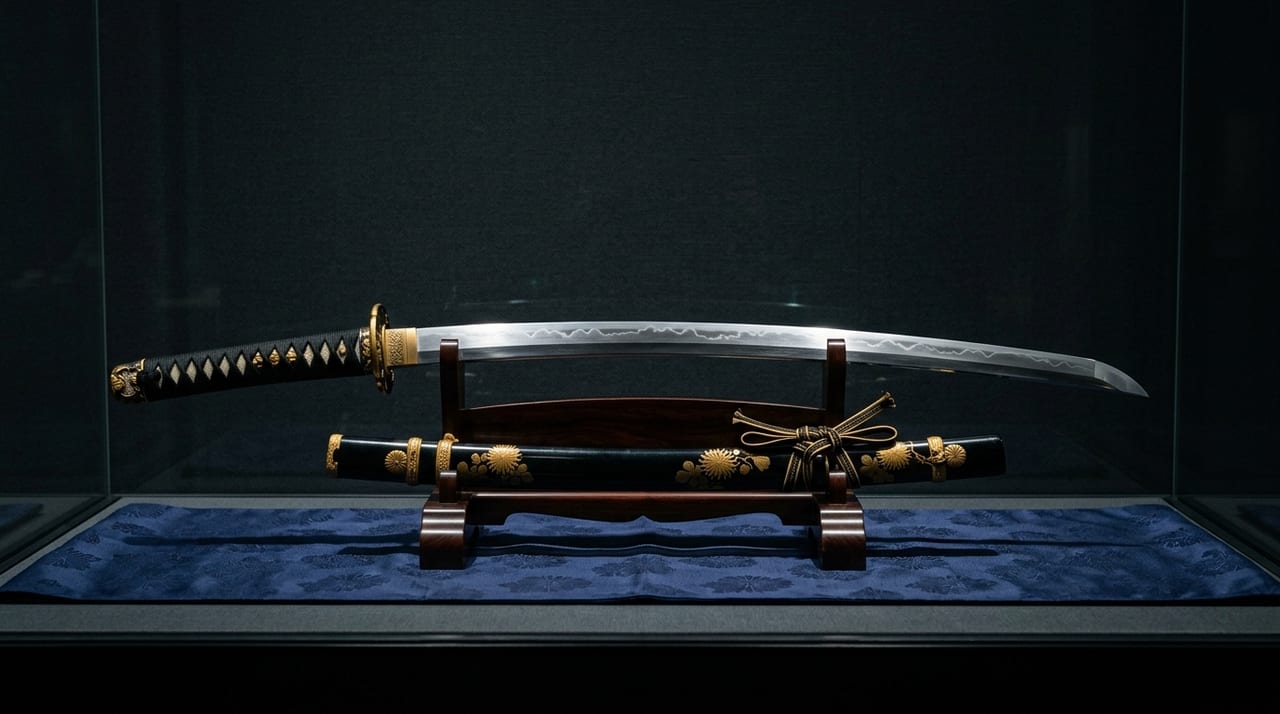
 * Image is for illustrative purposes only.
Kijinmaru Kunishige
鬼神丸国重
Also known as: Ikeda Kijinmaru Kunishige
Description
Kijinmaru Kunishige is a sword made by the smith Ikeda Kijinmaru Kunishige, who settled in Settsu Province (northern Osaka Prefecture), Toshima District, Ikeda (present-day Ikeda City, Osaka Prefecture), during the Edo period. It is the work of a celebrated smith in the history of Edo-period swords, graded shintō chū-jōsaku and rated wazamono.
The smith's home province was Bitchū Province, and he was born the son of a smith of the Mizuta school. He became a disciple of the second-generation Kawachi no Kami Kunisuke and, living in Toshima District, Ikeda, in Settsu Province, inscribed signatures such as "Sesshū-jū Kunishige" and "Sesshū-jū Ikeda Kijinmaru Kunishige." He is said to have also made swords in Edo, Akita and Satsuma, and works from the Kanbun to the Tenna era (1661–1684) survive.
His style was marked by a specialty in ō-midare hamon, with strong nie and a hamon rich in activity in both the jigane and the blade. The jigane is itame mixed with mokume, with abundant ji-nie, showing refined forging. His common name is traditionally given as Chōbei.
One of the greatest factors in making the name Kijinmaru Kunishige widely known in modern times is that it is said to have been the favorite sword of Saitō Hajime, captain of the Shinsengumi's third unit.
Legends & Stories
Kijinmaru Kunishige's swords are known as a sword carried by Katsu Kokichi, father of Katsu Kaishū, and are also depicted as Kokichi's favorite sword in the novel Oyako-daka by Shimozawa Kan. In addition, the favorite sword of Saitō Hajime, captain of the Shinsengumi's third unit, is also said to be a work of this smith.