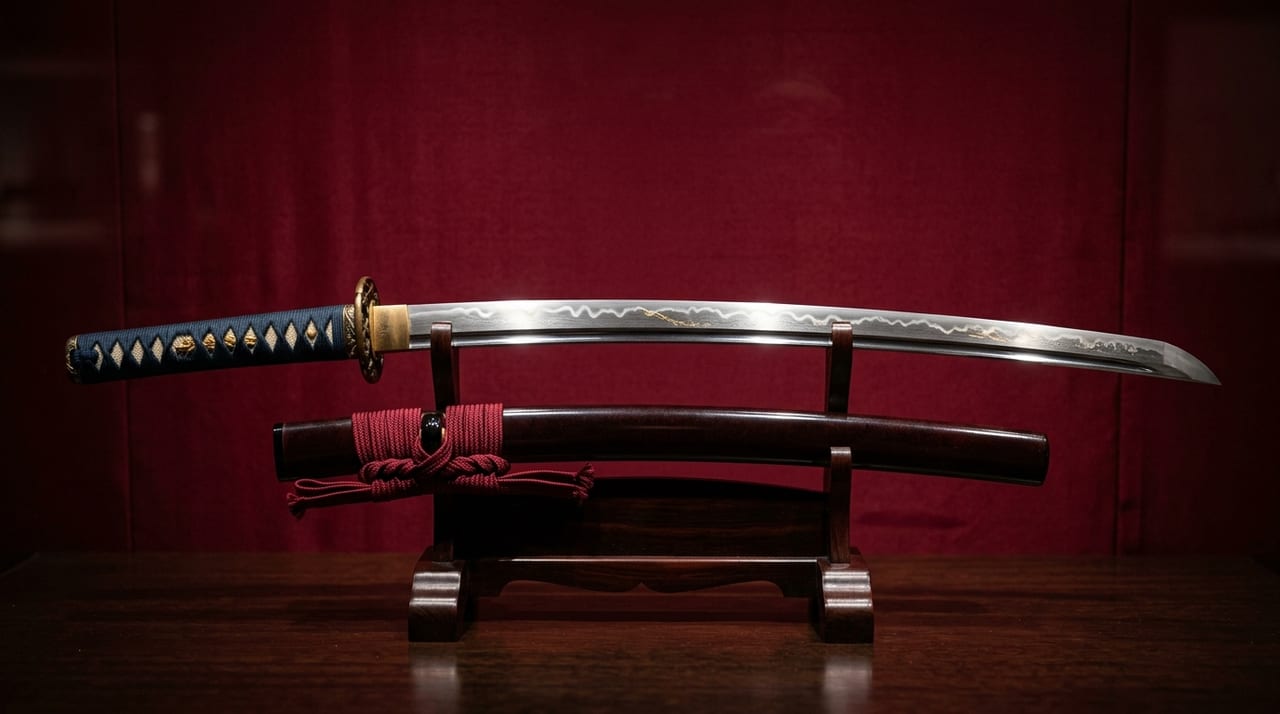
 * Image is for illustrative purposes only.
Katana by Inoue Shinkai
井上真改の刀
Also known as: Shinkai Katana
- Smith
- Inoue Shinkai
- Era
- Early Edo period (late 17th century)
- Type
- Katana
- Designation
- Important Cultural Property
- Location
- Private collection (Osaka Prefecture)
Description
Inoue Shinkai was an early Edo-period smith based in Settsu (Osaka) who represents the summit of Osaka shintō, a master of outstanding skill also known as “Osaka Masamune.” He was the second son of the first-generation Kunisada (Oya Kunisada). After his father's death he succeeded as the second generation, signing his works “Izumi-no-kami Kunisada,” and in the 8th month of Kanbun 12 (1672) he changed his name to “Shinkai.” This sword is the Important Cultural Property katana signed “Inoue Shinkai” and dated the 8th month of Enpō 4 (1676), with a blade length of 69.7 cm. The jigane shows tightly packed itame-hada with abundant ji-nie and chikei. The hamon is wide, suguha-based with shallow notare and gunome mixed in. The nioiguchi is deep, with abundant ko-nie giving a crisp brilliance, and long kinsuji runs across it. In Kanbun 1 (1661) he presented his works to the Imperial Court, was praised, and was permitted to inscribe the sixteen-petal chrysanthemum crest on the nakago (tang). Among Shinkai's works designated as Important Cultural Properties, besides this sword, there is a tachi signed “(chrysanthemum crest) Inoue Shinkai” and dated the 8th month of Enpō 5 (1677), handed down at Kibitsuhiko Shrine in Okayama Prefecture.
Legends & Stories
According to one account, when he was signing his works as “Kunisada” after receiving the title Izumi-no-kami, the Confucian scholar Kumazawa Banzan admonished him that it was beyond his station for a sword smith to call himself the lord of a province. From then on he signed his name as “Shinkai.” It is also said that Shinkai privately admired Gō Yoshihiro. In his later years he was an otome-kaji (a smith reserved for the domain lord) and could not accept commissions to forge swords without the lord's permission, so very few works signed “Shinkai” survive. He is said to have been a great drinker. When he died suddenly in Tenna 2 (1682), it is said to have been either food poisoning or a fall into a well after heavy drinking.