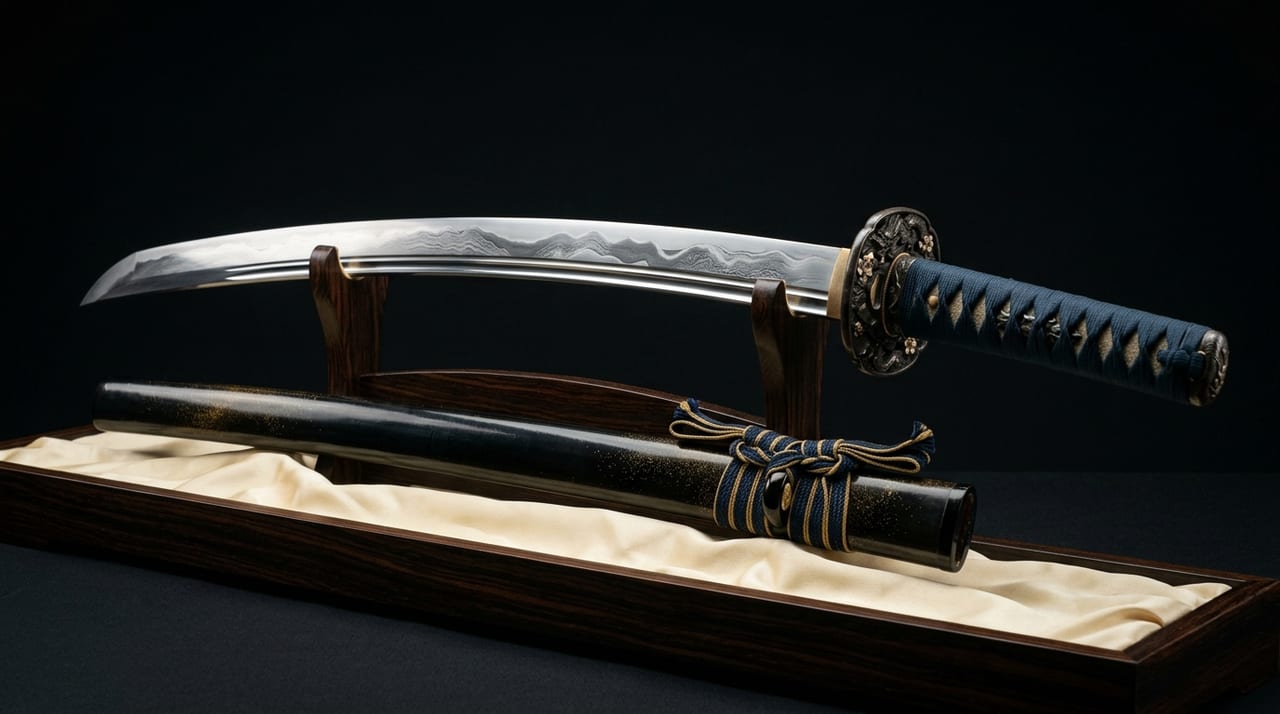
 * Image is for illustrative purposes only.
Inaba Rai Kunimitsu
稲葉来国光
Also known as: Inaba Rai Kunimitsu · Finest masterpiece of the Rai school, formerly in the Kaga Maeda collection · Listed in the Kyōhō Meibutsu-chō
Description
The Inaba Rai Kunimitsu is among the most renowned blades crafted by Rai Kunimitsu, who is considered the apex of the Yamashiro Rai school. The beautiful hamon, which combines the Rai school's characteristic straight blade with subtle irregularities, together with the refined small-scale mokume jihada, embodies the essence of the late Kamakura Yamashiro tradition. The blade retains a clear two-character signature, making it a signed Rai Kunimitsu of exceptional documentary value. After being transmitted to the Kaga Maeda family, it entered the collection of the Ishikawa Prefectural Museum of Art, where it continues to be highly regarded by scholars as a masterpiece representative of the Rai school. With a blade length of approximately 50 centimeters, it demonstrates practical proportions that symbolize the functional beauty characteristic of Kamakura warrior swords.
Legends & Stories
Rai Kunimitsu was a master swordsmith representing the Rai school, a distinguished Yamashiro lineage descended from Rai Kuniyuki and Raiguni Kunishow, and was active from the late Kamakura shogunate period through the early Northern and Southern Courts era. The name 'Inaba Rai Kunimitsu' became established because the blade was transmitted to the Inaba family, but the manner in which the Inaba acquired this blade is not necessarily clear. According to one account, following the Battle of Sekigahara, the blade is said to have been transferred from western provinces to Owari and subsequently to Kaga as a reward for military service. Since works by Rai Kunimitsu are few in total, and wakizashi forms are particularly rare among them, this blade is regarded as one of the benchmark works in Rai school research. Having a history of being carefully preserved as a treasured possession of the Maeda family, after the Meiji Restoration it was transferred from the hands of the former daimyo to a public museum, and has been passed down to the present day as a treasure of Japanese sword culture.