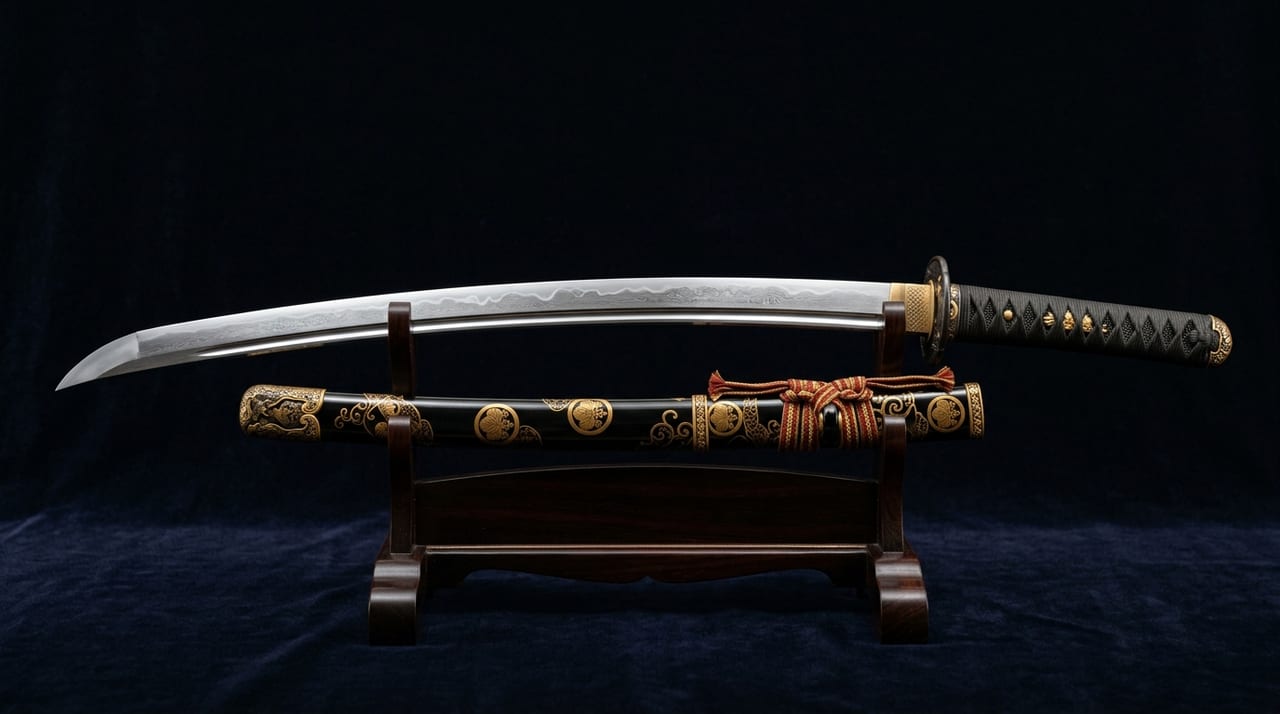
 * Image is for illustrative purposes only.
Beloved Sword of Katō Kiyomasa
加藤清正の愛刀
Also known as: Kiyomasa's Sword — Tachi of the Tiger Slayer of Korea, Former Bizen Nagamitsu Tradition
Description
The beloved sword of Katō Kiyomasa is a tachi worn as a lifelong companion by Katō Kiyomasa (1562–1611), the fierce general who reigned as the first lord of Higo-Kumamoto domain from the late Sengoku period to the early Edo period. Traditionally attributed to Sukesada of the Fukuoka Ichimonji school, Bizen province, during the mid-Kamakura period, this blade later came to be presented to Tokugawa Ieyasu and enshrined at Nikko Tōshōgū as the national treasure "Nikko Sukesada." The sword stands out for its characteristic bright ōchōji-midare hamon distinctive to Sukesada and the refined grain of its ji-tetsu, representing the highest standard of Kamakura-period Bizen craftsmanship. Kiyomasa was celebrated for his tiger hunts, and the sword is said to have accompanied him during the Korean campaigns (Bunroku-Keichō no Eki). With a blade length of approximately 71.2 centimeters, it demonstrates robust durability suited to actual combat use. As the personal sword of the man credited with constructing Kumamoto Castle, it has long been held in special reverence in his home province.
Legends & Stories
Katō Kiyomasa was renowned as one of the most ferocious generals among Toyotomi Hideyoshi's retainers, and legends of his tiger hunts during the Korean campaigns have been passed down to the present day. 'Kiyomasa's Tiger Hunt' became a popular subject in paintings and stories, symbolizing his fierce courage. Local tradition holds that this very sword was used to strike down a tiger in the Korean mountains. After Hideyoshi's death, Kiyomasa aligned himself with the Tokugawa faction, supported the Eastern Army at the Battle of Sekigahara, and was confirmed as lord of the entire Higo domain. He later devoted himself to the stone masonry of Kumamoto Castle, earning the title 'Master of Stone Construction.' After Kiyomasa's death, the sword passed from the Katō clan to the Hosokawa clan, who inherited Kumamoto domain, and following the Meiji Restoration it was eventually housed in the Kumamoto Museum, where it remains a source of local pride.