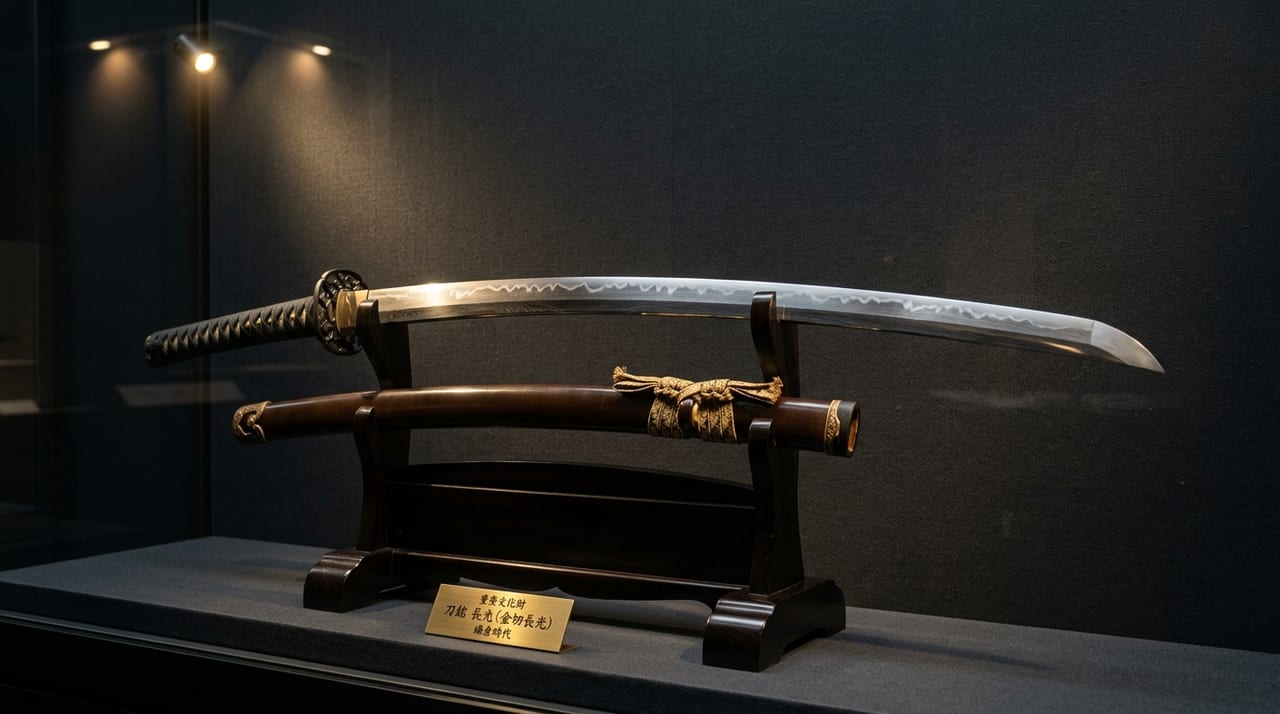
 * Image is for illustrative purposes only.
Tantō by Shizu Kaneuji
志津兼氏の短刀
Also known as: Shizu Tanto — Short Blade of the Mino Shizu Tradition in Sōshū Style
- Smith
- Shizu Kaneuji
- Era
- Nanbokuchō period (14th century)
- Type
- Tantō
- Designation
- Meibutsu (listed in the Kyōhō Meibutsu-chō)
- Location
- Tokugawa Art Museum, Nagoya
Description
This tantō by Shizu Kaneuji is a single blade in tantō form left by Kaneuji, the progenitor of the smiths who transplanted the Sōshū tradition to Mino Province. It is a masterpiece that condenses the skill of Kaneuji, who is renowned as one of the Masamune Juttetsu (Ten Great Disciples of Masamune). It is a tantō with a length of 8 sun 9 bu (about 27 centimeters) and no curvature (muzori). The bōshi is midaregomi, with the tip swept back (hakikake), the kaeri is long, and the mune is also burnt in places. Although this blade is unsigned (mumei), it has been authenticated as the work of Shizu Kaneuji. It was transmitted to the Owari Tokugawa family as the famous piece 'Togawa Shizu' and is now held in the collection of the Tokugawa Art Museum.
Legends & Stories
Shizu Kaneuji is counted among the Masamune Juttetsu (Ten Great Disciples of Masamune). He moved from Sōshū to Shizu in Mino Province (around present-day Yōrō District, Gifu Prefecture) and is a key figure in sword history for transmitting the techniques of the Sōshū tradition to that place. Kaneuji's blades, made after receiving Masamune's direct transmission, strongly inherit the beauty of their master's bold jigane (ground steel) and deep nie, while showing an original character that subtly reflects the qualities of the Mino region. After Kaneuji's death, his lineage moved to neighboring Naoe and came to be called the Naoe Shizu school, which led to the establishment of the Mino tradition. This tantō is called 'Togawa Shizu' after its possession by Togawa Higo-no-kami Michiyasu, a chief retainer (karō) of the Ukita family. Later, Maeda Toshitsune of Kaga purchased it, and in Kan'ei 6 (1629) it was presented to the retired shogun (Ōgosho) Tokugawa Hidetada. Afterwards it passed through Yorinobu of the Kii Tokugawa family and was transmitted to the Owari Tokugawa family.