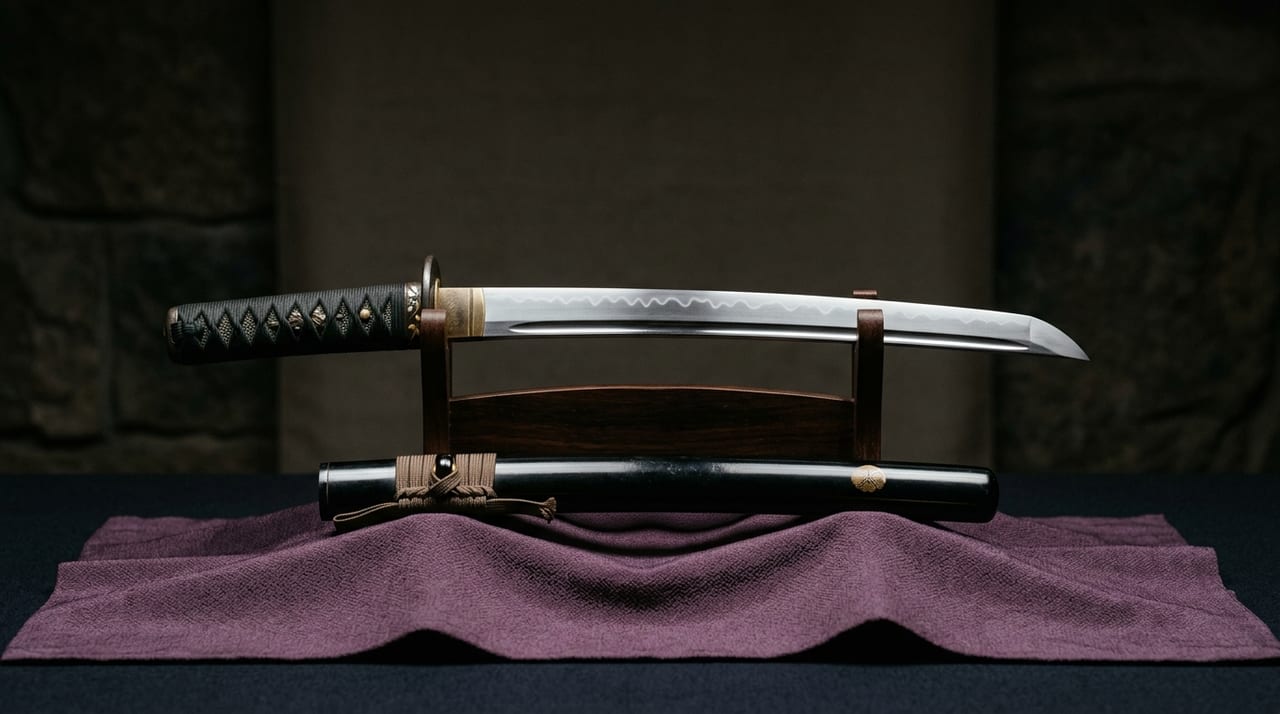
 * Image is for illustrative purposes only.
Hōchō Tōshirō
包丁藤四郎
Also known as: Kitchen-Knife Tōshirō; Miyoshi Nagayoshi's Blade
Description
Overview of the Sword
Hōchō Tōshirō is a masterwork tantō forged by Awataguchi Yoshimitsu and bears an exceptionally unusual name in the history of Japanese swords: a name meaning "kitchen knife Tōshirō." The term "kitchen knife" (hōchō/pāo dīng) originally derives from a passage in the Chinese classic Zhuangzi, referring to the master cook Pao Ting, and its adoption as the name of a Japanese sword reflects a tradition of praise: "the sharpness of this blade rivals that of a kitchen knife." The narrative underlying this appellation — from the famous chapter "Pao Ting Butchers an Ox" in Zhuangzi, wherein the master cook's perfect technique allows his blade to glide between bones without ever dulling — speaks to both the cutting edge's sharpness and its endurance. The blade is a hira-zukuri tantō measuring approximately 27.0 cm. The refined ji-gane (field steel) and serene hamon (blade pattern) characteristic of Yoshimitsu are comparable to those of the Gotō Tōshirō and Hakata Tōshirō, establishing Hōchō as a masterpiece within the Tōshirō series and earning its recognition among sword connoisseurs. Historically owned by Ōtani Yoshitsugu, the blade passed to Tokugawa Ieyasu following the Battle of Sekigahara and subsequently entered the Owari Tokugawa clan as part of the Sunpu Gobutsumono (divided treasures from Sunpu Castle). Its name — far more quotidian and singular than other Tōshirō appellations — continues to attract attention across seven centuries, serving as a gateway for people to approach masterwork swords.
Miyoshi Nagayoshi as Precursor — A Ruler of All Under Heaven Before Nobunaga
Miyoshi Nagayoshi (1522–1564), a Sengoku daimyō from Awa Province (present-day Tokushima Prefecture), rose to dominance by displacing Hosokawa Harumoto and the Ashikaga shogunate to exercise effective control over the Kinai region (Kyoto, Sakai, Settsu, Kawachi, and Izumi). Recent historical scholarship has significantly reassessed him as the "precursor to the ruler of all under heaven" — a figure who preceded Oda Nobunaga. Beyond his formidable military power, Nagayoshi was a cultivated aesthete deeply versed in linked verse, Noh drama, and tea ceremony. He built his authority upon a dual cultural and economic foundation encompassing both the merchant culture of Sakai and the court culture of Kyoto. Though Nagayoshi's regime functioned as a de facto ruler of all under heaven, it formally maintained the pretense of serving the Ashikaga shogunate, a posture that led posterity to underestimate his historical significance. Contemporary Sengoku historiography, however, now properly evaluates his regime as representing "proto-Nobunaga innovation," and scholars increasingly examine Hōchō Tōshirō as "the blade of Nagayoshi." That this culturally refined potentate possessed a Yoshimitsu tantō further testifies to the elevated cultural standing of Yoshimitsu's works.
Etymology of "Kitchen Knife" — Praise for Sharpness or Allusion to a Narrative?
Multiple theories surround the name "Hōchō Tōshirō." The most widely transmitted explanation holds that the blade earned its appellation as praise for Yoshimitsu's tantō — comparing its sharpness to a kitchen knife and alluding to the Zhuangzi passage wherein the master cook Pao Ting achieves such perfect disassembly of an ox that his blade slides between joints and bones, never dulling. In this reading, the naming celebrates both the cutting edge's acuteness and its durability. An alternative theory attributes the name to the blade's physical form — its shape and thinness resembling those of a kitchen knife. Regardless, the paradox of a quotidian term — "kitchen knife" — becoming the designation of a supreme masterwork has sustained public fascination with the sword. The philosophy embedded in Zhuangzi's "Pao Ting Butchers an Ox" — the attainment of technique through accordance with natural principle, accomplishing one's task without resistance — aligns perfectly with a metaphor for Yoshimitsu's tantō: a blade so refined that it seems to know where it need not be applied. This represents a supremely sophisticated naming sensibility.
"Kitchen Knife" Among Yoshimitsu Tantō — The Subtlety of Comparative Appreciation
Within Yoshimitsu's Tōshirō series — including Gotō Tōshirō, Hakata Tōshirō, Maeda Tōshirō, and Akita Tōshirō — Hōchō Tōshirō stands out through the singularity of its name, "kitchen knife." This appellation has drawn remarkable historical context and narrative richness, making it among the most widely known of the Tōshirō blades among sword enthusiasts. In terms of blade beauty, Hōchō rivals the refinement of its Tōshirō counterparts and remains indispensable in comparative appreciation of Yoshimitsu's work. It is presently held by the Tokugawa Art Museum in Nagoya. Were a special exhibition to bring together Hōchō Tōshirō, Gotō Tōshirō, and Hakata Tōshirō for direct comparison, the aesthetic principles underlying Yoshimitsu's tantō would illuminate from multiple angles, offering visitors the finest opportunity to experience the richness of the "Tōshirō series" as a body of Yoshimitsu's work.
The Crossing of Zhuangzi's Philosophy and the Aesthetics of Japanese Swords
Zhuangzi stands as one of the supreme literary masterworks of Chinese Daoist philosophy, expounding the core tenets of Daoism — spontaneity in accordance with nature and the unity of all things — through allegorical narrative. The chapter "Pao Ting Butchers an Ox" ranks among Zhuangzi's most celebrated passages, expressing the Daoist insight that the pinnacle of technical mastery transcends technique itself to become natural, spontaneous action — a truth conveyed through the everyday act of cooking. That this philosophical allegory became the wellspring of a Japanese sword's name attests to the profound permeation of Chinese classical philosophy into samurai culture, and embodies a particular conception of swords: that their essence lies not in warfare but in the natural sharpness of the blade. Hōchō Tōshirō represents a rare convergence wherein the craftsmanship of a blade maker seven centuries past intersects with the wisdom of Chinese philosophy from over two millennia ago, meeting through the medium of the Japanese sword. The name illuminates a truth often obscured: that Japanese sword culture is not merely a history of weaponry but rather a comprehensive expression of East Asian intellectual and aesthetic tradition.
Influence on Modern Culture
In Touken Ranbu ("Sword Dances"), Hōchō Tōshirō has been reimagined as a "sword warrior" character whose distinctive persona has significantly elevated awareness of Yoshimitsu tantō among younger audiences. The paradox embedded in the blade's name — the quotidian "kitchen knife" paired with the extraordinary status of a supreme masterwork — resonates readily with contemporary popular culture. Alongside renewed scholarly attention to Miyoshi Nagayoshi as "a ruler of all under heaven before Nobunaga," Hōchō Tōshirō has attracted heightened interest from both history enthusiasts and sword aficionados alike.
Legends & Stories
The Zhuangzi's Cook Pao and Yoshimitsu's Blade—Philosophy and Sword in Encounter
The Zhuangzi's "Cook Pao Carving an Ox" anecdote tells how the master cook Pao Ting, when carving an ox, follows the natural spaces between bones, so his blade never dulls or chips despite years of use. What this anecdote signifies is the Daoist wisdom that "technique in harmony with nature's principles does not wear away"; to cite this tale as a compliment to a blade's cutting power is the highest praise—that Yoshimitsu's blade possesses such acuteness that it "instinctively finds the spaces where the edge need not strike." The name Hōchō Tōshirō exemplifies a rare convergence: the blade-forging art of a master smith from seven hundred years ago intersects with Chinese philosophy from two thousand years past, mediated through the Japanese sword. It demonstrates that sword culture is not merely a history of weapons, but the totality of East Asian intellectual and aesthetic tradition.
Miyoshi Nagayoshi and the Realm Before Nobunaga—A History of Reassessment
Miyoshi Nagayoshi long received relatively modest esteem in Japanese historical narratives as "a precursor to Oda Nobunaga" or "a powerful figure in the transitional period before Nobunaga's rise," but recent Sengoku scholarship has undertaken proper reassessment. Nagayoshi was a politician of comparable innovation to Nobunaga in that he surpassed the traditional authority of the Hosokawa clan and the Ashikaga shogunate through superior force to govern the Kinai region. Moreover, his deep knowledge of tea ceremony, renga poetry, and noh theater could well have served as a model for Nobunaga in leveraging culture to strengthen political authority. The authenticated provenance of Hōchō Tōshirō begins with Taga Takatada, who served as Kyoto Deputy (Shoshidai) of the Muromachi shogunate, passing through a townsman of Sakai and the father-and-son pair Torikai Sokei and Yohe Sosei, and subsequently to Toyotomi Hideyoshi and the Tokugawa house. No historical documents confirm Miyoshi Nagayoshi's possession of the blade.
Yoshimitsu's Workshop Site and Modern Kyoto
Awataguchi is situated in present-day Higashiyama Ward, Kyoto City, near Keage, the starting point of the Tokaido highway, at its intersection with Sanjo Avenue. From the late Heian through the Kamakura period, families of sword smiths congregated at this location, forming Kyoto's preeminent center of blade production. Today, the Awataguchi area preserves historical sites including Awata Shrine, echoing the memory of the ancient smithing village. That Hōchō Tōshirō was forged in this place speaks across more than seven hundred years to people today as the legacy left by a master smith of Yamashiro Province.