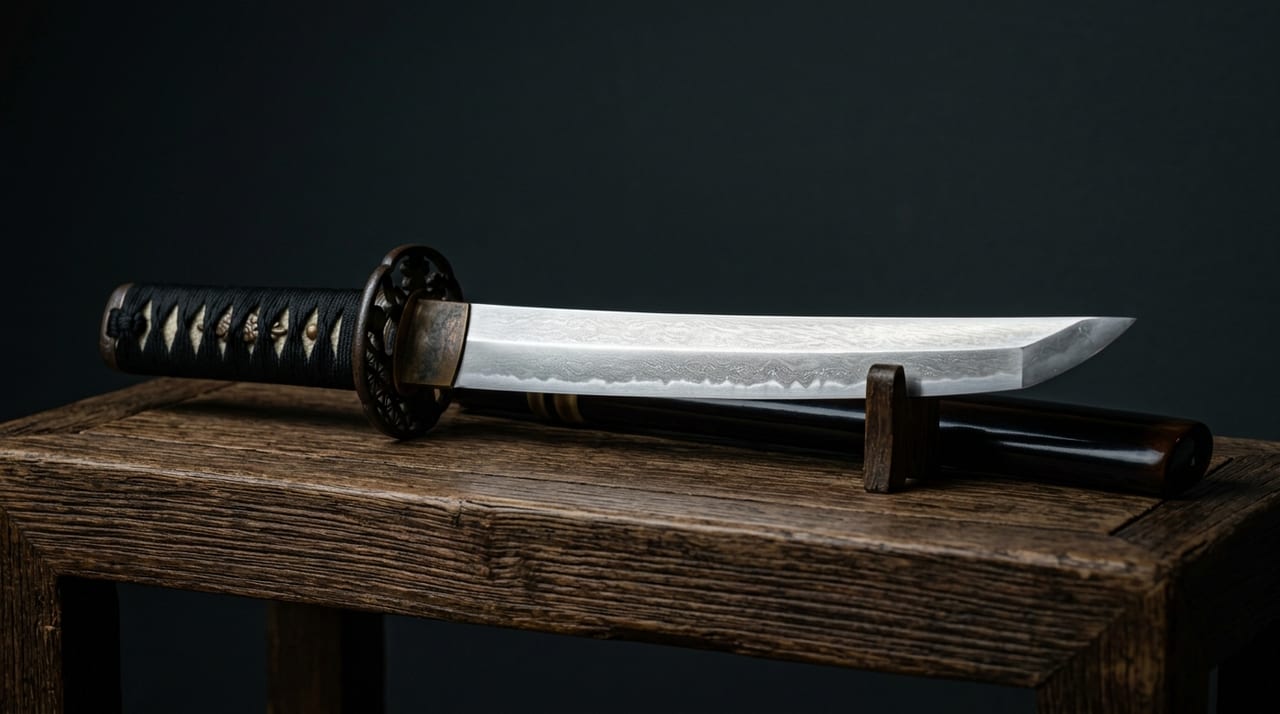
 * Image is for illustrative purposes only.
Hirano Tōshirō
平野藤四郎
Also known as: Hirano Tōshirō · Tanto passed down through the Hirano family · Masterwork of Yoshimitsu
Description
Overview of the Blade
Hirano Tōshirō is a tanto forged by Awataguchi Yoshimitsu, named after the Settsu merchant Hirano Michi who once owned it, and is now a celebrated masterpiece held in the Imperial collection. Among the Tōshirō group of short swords, it uniquely embodies Yoshimitsu's characteristic refined and elegant workstyle, earning recognition among sword scholars as the "standard example of Yoshimitsu tantos," occupying an important position. A compact tanto measuring nine sun nine bu (approximately 30.0 cm) in blade length, displaying elegant hirazukuri construction with Yoshimitsu's distinctive refined steel and a brilliant, sharp straight-edge blade that achieve perfect harmony. The name "Hirano Tōshirō" derives from Kimura Shigetsugu acquiring it from the Settsu merchant Hirano Michi for thirty gold pieces, though detailed records of when and how the Hirano family acquired this blade do not survive.
Yoshimitsu's Workstyle and Hirano Tōshirō
The essence of Yoshimitsu's tantos lies in the combination of refined, lustrous steel and clear, straight or near-straight edge geometry. Hirano Tōshirō embodies this essence in its purest form. The densely packed small wood-grain steel with finely-applied ji-nie creates a lustrous, light-colored iron tone that exemplifies the Awataguchi school's character. The hamon displays an elegant, gently undulating straight-edge form with a tightly-drawn and brilliantly-clear boundary, possessing a calm and serene beauty. The hoshi exhibits a graceful, gently rounded form. The tang bears the signature "Yoshimitsu" in the original unpolished state, leaving no doubt of its authenticity. The thickness is moderate, with robust construction capable of practical use, yet the external appearance is remarkably refined and dignified. Lacking ostentation or distinctive peculiarities, this blade reveals the technical foundation of Yoshimitsu's true skill most honestly. There exists no more sincere answer to "What is a Yoshimitsu tanto?" than this blade itself.
Lineage from the Hirano Family to the Imperial Household
The name "Hirano" originates from Kimura Shigetsugu acquiring the blade from Settsu merchant Hirano Michi. Thereafter it was presented to Toyotomi Hideyoshi by Kimura Shigetsugu, later passed to the Maeda clan, and presented to the Meiji Emperor in 1882, after which it became an Imperial treasure.
Significance as a "Standard Example" Among Yoshimitsu's Tantos
Many examples of Yoshimitsu's tantos survive, each bearing its own name and provenance. The Yakiba Tōshirō carries legendary accounts of cutting prowess; the Atsushi Tōshirō is distinguished by exceptional thickness; the Midare Tōshirō displays unusual undulating patterns; the Namazuo Tōshirō features its unique pry-bar shape—each Tōshirō tanto possesses strong individual character. In contrast, Hirano Tōshirō lacks particularly spectacular legends or distinctive form, yet is highly regarded by sword scholars as the "standard example for understanding Yoshimitsu" for most faithfully displaying his typical workstyle. How was Yoshimitsu's work remarkable?—Hirano Tōshirō provides the simplest answer, and precisely because it lacks ostentation, Yoshimitsu's true mastery becomes most evident, lending it a paradoxical value.
Current Ownership and Cultural Evaluation
Currently held as an Imperial treasure and managed by the Imperial Household Agency, the blade is periodically displayed at special exhibitions. Compared to other Yoshimitsu tantos, Hirano Tōshirō possesses a relatively understated character, making it particularly cherished by sword enthusiasts who value depth over spectacle. In Touken Ranbu, it is portrayed as a courteous and sincere character, a characterization that aligns perfectly with the blade's calm, dignified bearing.
Yoshimitsu's Hirazukuri Tantos—The Pinnacle of Elegant Beauty
Among the technical features of Hirano Tōshirō, particularly noteworthy is the perfect harmony of Yoshimitsu's characteristic refined steel and crystalline straight-edge blade. The steel features small wood-grain patterns as its primary texture, densely and uniformly forged, with fine iron particles arranged closely and uniformly, also described as "mixed with straight-grain texture." Fine ji-nie falls uniformly across the entire surface with clear steel reflections. The hamon is straight-edged with narrow to moderate width, displaying Yoshimitsu's refined quality through its sharp, clear ha-nioi boundary. Fine nie particles appear uniformly throughout the blade, with a perfectly straight-edge geometry free of any undulation—an expression in which Yoshimitsu excelled. The hoshi curves shallowly and gracefully, displaying refined workmanship. The hamon area and mune boundary are clearly defined. The tang shows the original unpolished state (unaltered since creation), with "Yoshimitsu" rendered in two characters with clean precision. The overall proportioned form of the entire blade, combined with the pure beauty of hamon and steel, is evaluated as best exemplifying the typical style of Yoshimitsu tantos. It is held as an Imperial treasure.
Legends & Stories
The Origin of the Name "Hirano Tōshirō"
The name "Hirano Tōshirō" does not derive from Hirano Nagataka, the general of the Shizugatake Seven Spears, but is said to be named after Hirano Doyuki, the Settsu merchant who possessed this tanto. Kimura Shigetsugu acquired it from Hirano Doyuki for thirty gold pieces, polished it lightly, and presented it to Toyotomi Hideyoshi. Subsequently, Maeda Toshinao received it from Hideyoshi, and in 1605 (Keicho 10) presented it to Tokugawa Hidetada, the second Shogun. In 1617 (Genwa 3), Maeda Toshinari received it from Tokugawa Hidetada, after which it remained in the Maeda family lineage.
The Spirituality Embodied in Yoshimitsu's Tantos
Yoshimitsu's tantos occupy a unique spiritual place in Japanese sword culture precisely because of their refinement. Rather than being described as "beautiful but cold," Yoshimitsu's tantos are often praised as "beautiful and warm." The lustrous iron color of the jigane, the pure radiance of the straight-edge—these convey not merely beauty but an approachability as if the maker's spirit were infused into the blade itself. Hirano Tōshirō best embodies this spiritual quality of Yoshimitsu's work, shining quietly and enduringly. When a warrior held this blade, one imagines they felt not merely the acquisition of a weapon, but as though entrusted with something precious.
Hirano Tōshirō in Touken Ranbu
In Touken Ranbu, Hirano Tōshirō is characterized as a courteous and serious "honor student" type, gathering steady popularity as an understated figure among the Yoshimitsu tanto group. Many fans have developed interest in this blade through the game. This cultural continuum—from the medieval master craftsman to the general, from the general to the shogun's household, from the shogun's household to museums, and from there to modern games and young fans—demonstrates the vitality of Japanese sword culture.
Maeda Family Lineage and the Keiho Meibuts-cho
Yoshimitsu's tantos have received the highest evaluation as one of the "Three Heavenly Craftsmen" since the Kamakura period, and ownership itself demonstrated prestige. After Maeda Toshinao received it from Toyotomi Hideyoshi and it passed through Tokugawa Hidetada to Maeda Toshinari, it remained a cherished family treasure of the Maeda house. The Keiho Meibuts-cho records "Hirano Tōshirō" as a named meibuts (famous blade), sometimes treating it as the foremost among Yoshimitsu tantos.
Hirano Tōshirō in the Modern Era
After the Meiji Restoration, Hirano Tōshirō was presented to the Imperial Household and is currently managed by the Imperial Household Agency Chamberlain's Office as an imperial treasure (imperial private property). As an imperial treasure, it is not subject to designation as a National Treasure or Important Cultural Property, yet it is recognized among Yoshimitsu tantos as a work of extraordinary quality and is regarded as extremely significant in Japanese sword research. In the sword game "Touken Ranbu," Hirano Tōshirō appears as a popular character and is affectionately called "Hirachan." The "best friends" relationship with Namazuo Tōshirō is particularly beloved by fans, and the approachable characterization of these two swords has contributed to heightening young people's interest in Japanese swords. The long journey of Hirano Tōshirō—from the martial exploits of Hirano Nagataka, through the Toyotomi and Tokugawa periods, to contemporary popular culture—continues to this day.
Yoshimitsu's Legacy—What the Tōshirō Group Conveys
The fact that Awataguchi Yoshimitsu's tanto group is collectively known by the affectionate name "Tōshirō," with each blade bearing its own individual name and being transmitted to the present day, reveals a unique aspect of Japanese sword culture. In most civilizations, weapons are used as tools and discarded, with craftsmen's names quickly forgotten. In Japan, however, tantos forged by the Kamakura-period master smith Yoshimitsu remain individually named and carefully preserved after more than seven hundred years, protected as National Treasures and Important Cultural Properties. Hirano Tōshirō, as one such blade, preserves the name of its owner, the merchant Hirano Doyuki, in the blade's designation, transmitting to the present the history of its lineage through the Toyotomi, Maeda, and Tokugawa houses. This transcends mere preservation of art objects—it is the continuation of cultural and historical memory. Blades rust and corrode; in battle they break and disappear. Yet that Yoshimitsu's tanto group has been carefully preserved for more than seven centuries speaks to how Japanese people have found meaning in swords beyond mere weaponry—spirituality, aesthetic sensibility, and historical testimony. Hirano Tōshirō stands as a symbolic embodiment of this, destined to continue shining at the pinnacle of Japanese sword culture.