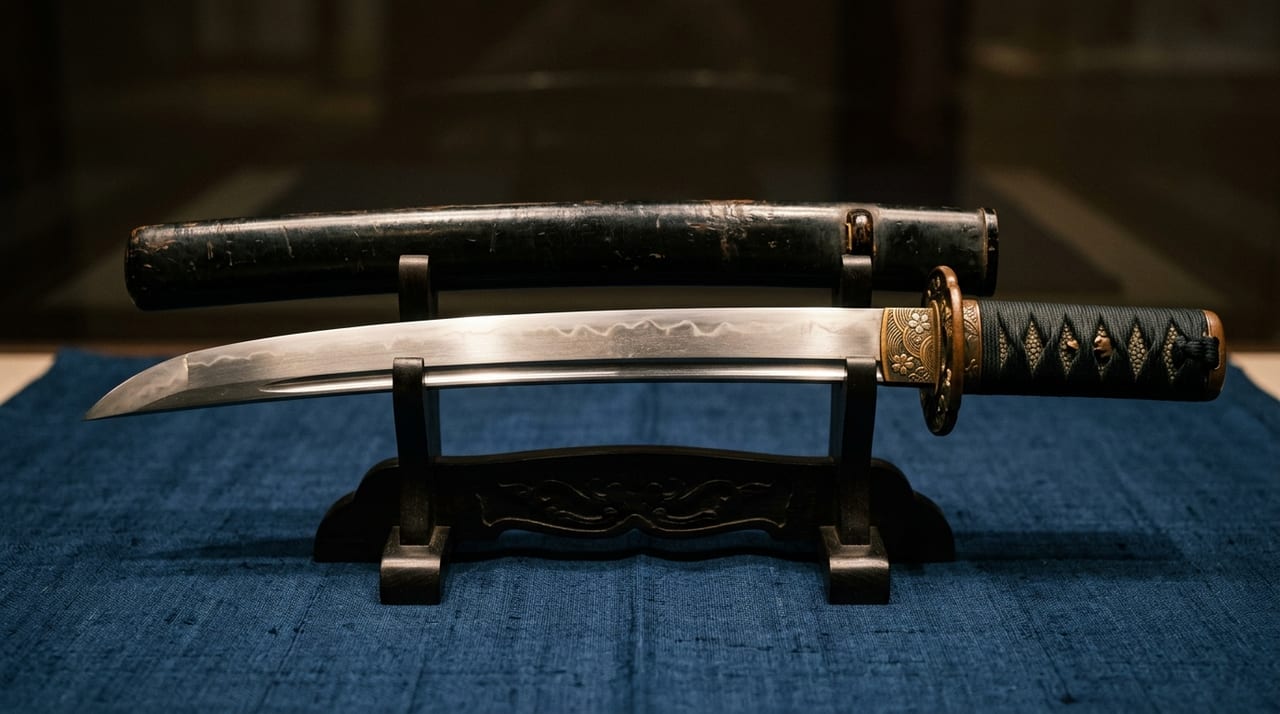
 * Image is for illustrative purposes only.
Gokotai
五虎退
Also known as: Gokotai: The Short Sword That Drove Back Five Tigers
Description
Gokotai — A Famous Tantō by Awataguchi Yoshimitsu
Gokotai is a tantō forged by Awataguchi Yoshimitsu (Tōshirō Yoshimitsu), a master smith active in Awataguchi, Yamashiro Province, in the mid-Kamakura period, and it is known as a famous sword transmitted in the Uesugi family. Yoshimitsu is said to be the greatest tantō maker in the history of Japanese swords, and his works were prized by the most powerful rulers of their era, including the Ashikaga shogunate, the Toyotomi family, and the Tokugawa shogunate. Gokotai was designated an Important Art Object in 1937. It is currently held in a private collection and is on deposit and displayed at the Uesugi Museum, Yonezawa.
Origin of the Name — The Legend of Driving Off Five Tigers
The name 'Gokotai' derives from a legendary anecdote in which 'five tigers were driven off.' According to tradition, an envoy who had crossed over to the Ming by order of the Ashikaga shogun was attacked by five tigers, and he drove them off using this tantō. Within Japan's sword-faith culture, which attributes spiritual power to swords, this story has been widely retold as a typical example of the narrative pattern in which a famous sword saves its bearer from peril.
Transmission to the Uesugi Family
Gokotai was presented to the imperial court by Ashikaga Yoshimitsu, and it is said that Uesugi Kenshin, a Sengoku daimyō of Echigo who went up to the capital in Eiroku 2 (1559), received it from Emperor Ōgimachi. It was then carefully handed down as a treasured heirloom of the Uesugi family. It is also counted among the 'Uesugi Kagekatsu Otesen Sanjūgoyō' (Thirty-Five Swords Selected by Uesugi Kagekatsu), said to have been chosen by Uesugi Kagekatsu, and it is one of the most renowned swords among the famous blades associated with the Uesugi family.
Awataguchi Yoshimitsu and the Beauty of the Tantō
Awataguchi Yoshimitsu was a swordsmith active in Awataguchi, Yamashiro Province, in the mid-Kamakura period, and he received unmatched acclaim as a master of the tantō. His tantō reached the highest standard in all of 'the refinement of the jigane (steel), the dignity of the hamon (temper line), and the balance of the form,' and they were prized as 'Tōshirō-mono.' The jigane is dense with small itame grain and fine ji-nie, and the hamon is based on a calm chokuba (straight temper line) that shows a serene dignity. Among these Yoshimitsu tantō, Gokotai is widely cherished as one of the most renowned works, owing to its legendary name and its provenance in the Uesugi family. Through its appearance in the sword-themed game 'Tōken Ranbu,' it has also become widely known to younger generations.
The Kyōhō Meibutsuchō and Yoshimitsu's Famous Works
The Kyōhō Meibutsuchō (Kyōhō Register of Famous Swords) of the Tokugawa shogunate records numerous works by Yoshimitsu, and together with famous blades such as Ichigo Hitofuri and Hirano Tōshirō, Yoshimitsu is positioned as the most renowned tantō maker in the history of Japanese swords. Gokotai, as one of the works in this lineage of Yoshimitsu's famous blades, continues to receive high evaluation in sword history.
Legends & Stories
A Spirit Sword That Drove Off Five Tigers — The Mysterious Power of the Tantō
The legend told by the name Gokotai — 'when a person carrying this tantō was surrounded by five tigers, the tigers, frightened by the spiritual aura of the sword, fled' — stands out among Japan's legends of famous swords as a story rich in exotic atmosphere. The tiger holds a special status as the 'king of the beasts' in the cultures of China and the Korean Peninsula, and tiger hunting likewise carried special meaning in warrior culture as a symbol of heroism and mystical power. The background to this anecdote lies in exchanges with the Ming during the Ashikaga shogunate, namely trade by kenminsen (envoy ships to the Ming) and a fondness for karamono (Chinese imports), and the legend of 'a sword that drives off tigers' reflects the mysterious awe that Japanese of the time felt toward the tiger. Tigers do not inhabit Japan in reality, and although this legend should be understood not as an actual event but as a symbolic expression of 'the spiritual power of the sword,' legends of this kind have been passed down with great earnestness within Japan's sword-faith culture, which attributes spiritual power to famous swords.