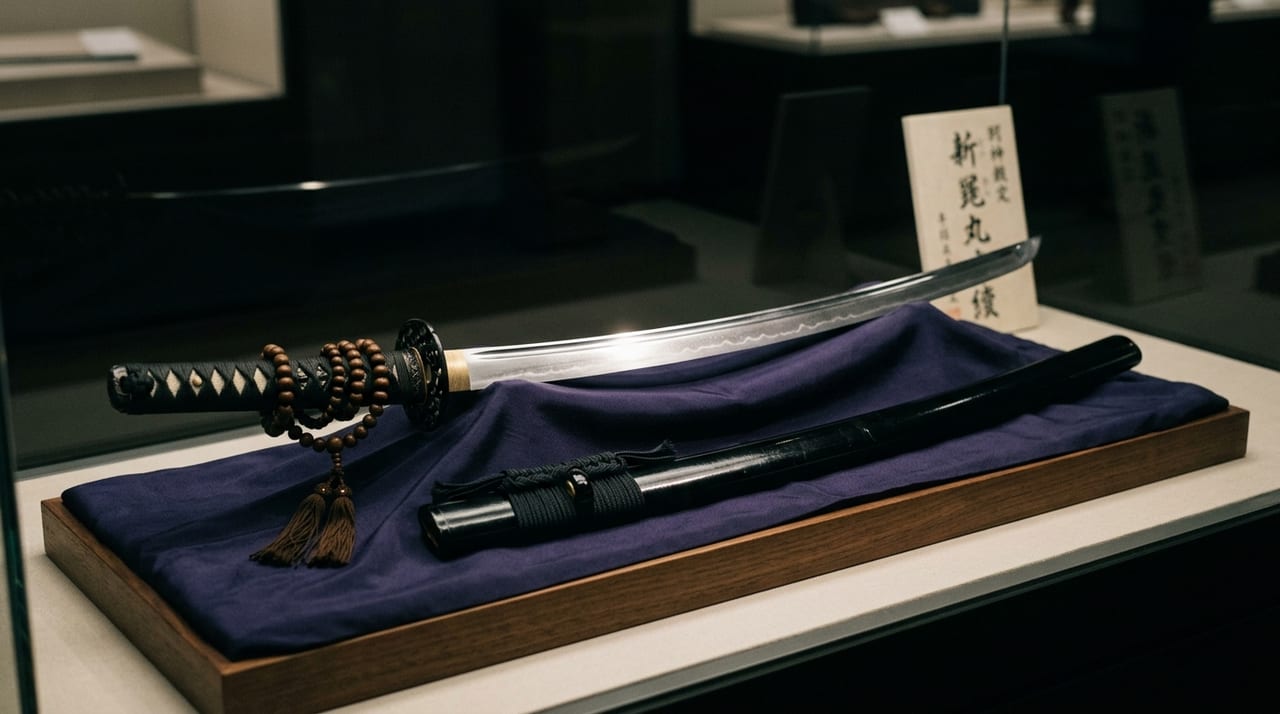
 * Image is for illustrative purposes only.
Gassan Sadayoshi
月山貞吉
Also known as: Restorer of the Gassan Tradition, Reviver of Ayasugi Hada, Sword-Forging Deity of the Late Edo Period
Description
Gassan Sadayoshi: Overview—Revival of the Gassan Tradition
Gassan Sadayoshi was a swordsmith who flourished from the late Edo to early Meiji period, and occupies an important position in Japanese sword history as the "Restorer of the Gassan Tradition," having revived the ancient sword tradition known as the "Gassan-den." The Gassan-den is an ancient tradition originating from the sacred mountain Gassan in Dewa Province (present-day Yamagata Prefecture), and its greatest characteristic is the distinctive grain pattern of the jigane called "ayasugi hada." This tradition had gradually declined since the Muromachi period, but Sadayoshi revived this nearly lost technique through self-study and research, establishing the foundation of a new Gassan school bearing his name. His son, Gassan Sadaichi (first generation), further developed this tradition and became a central figure in the sword revival of the Meiji period. Today, the name Gassan Sadaichi continues to receive the highest evaluation as the "Last Great Master."
Ayasugi Hada—The Gassan Tradition's Unique and Incomparable Characteristic
The greatest characteristic that distinguishes Gassan Sadayoshi's work from that of other swordsmiths is the "ayasugi hada." Ayasugi hada is a type of forge finish in which a complex wave-like, wood-grain pattern resembling cedar leaves arranged in a row appears on the jigane surface. This pattern is created by the flow of steel layers during the forging (tanren) process intersecting in specific directions. Technically extremely difficult, it is said that only craftsmen of the Gassan school could intentionally produce ayasugi hada. The pattern evokes in the viewer the shadow of a cedar grove at twilight, providing a special aesthetic experience of "jigane perfected as ornament." This ayasugi hada, praised as "steel painting" transcending mere surface treatment of swords, is the fundamental reason for the Gassan tradition's existence and the core significance of Sadayoshi's revival of this technique.
The Late Edo Period's Historical Context and the Swordsmith's Mission
The late Edo period in which Gassan Sadayoshi flourished (mid-19th century) marked the beginning of upheaval in Japanese society following Commodore Perry's arrival (1853) and contact with Western civilization. At this time, Japanese swords faced dual pressures—on one hand, the superiority of modern military technology (firearms) called into question the practical value of swords, while on the other, movements in nativist scholarship and the sonno-joi (revere the emperor, expel the foreigners) cause increasingly re-evaluated the sword as a "symbol of the Japanese spirit" and a return to Japan's traditional culture. It was within this historical context that Sadayoshi undertook the revival of the Gassan tradition, and the very act of "reviving lost Japanese technique" embodied a political and cultural assertion of "Japanese cultural independence." Sadayoshi's swords hold special historical significance as works that responded to the urgent desire of Japanese people to reconfirm their cultural identity during the transformative period of the late Edo and Meiji eras.
Technical Inquiry—Rediscovery of Lost Techniques
Reproducing ayasugi hada is technically extremely difficult, and clear records do not exist regarding how Gassan Sadayoshi rediscovered this lost technique. According to tradition, Sadayoshi thoroughly studied works by the old Gassan school and, by observing the structure of jigane, independently deduced and reproduced the principles of the forging method that produced ayasugi hada. This was literally a "reverse-engineering" rediscovery of technique, an extraordinary achievement requiring both advanced analytical ability to decode forging technique from existing swords and practical technical skill. Sadayoshi's revival of ayasugi hada embodies the essence of Japanese craftsmanship culture—"knowledge of craftsmen can be learned from their works"—and is highly regarded as a precedent to be consulted in modern preservation and revival of traditional techniques.
The Meiji Abolishment of Swords and the Succession of the Gassan Tradition
The 1876 Abolishment of Swords Edict (haitorei) was a historical turning point that legally ended the practical significance of the Japanese sword, forcing many swordsmiths to cease their work. However, the Gassan tradition revived by Gassan Sadayoshi was carried forward through these difficult times by his son, Gassan Sadaichi (first generation). In 1906 (Meiji 39), Sadaichi received the highest honor of being appointed "Imperial Artisan" (teishitsu gigei-in) alongside Miyamoto Hosenori, the first swordsmiths to receive this designation, and played a central role in redefining the Japanese sword as a "traditional craft and cultural property" in modern Japanese society. This transmission of technique and spirit from father Sadayoshi to son Sadaichi is remembered as one of the most successful examples of inheritance in Japanese traditional craftsmanship, and is the reason Sadayoshi's achievements continue to live not merely in his own era but to the present day.
Gassan Sadayoshi's Evaluation in Modern Times
In the modern sword world, Gassan Sadayoshi receives the highest evaluation for the historical significance of achieving the "revival of the Gassan tradition in the late Edo period," and his works are protected as Important Cultural Properties and Important Swords. In particular, works of exceptional refinement in ayasugi hada have become premier teaching materials for sword appreciation as masterpieces demonstrating the epitome of "jigane aesthetics." Through Gassan Sadayoshi's works, those who encounter the Gassan tradition can experientially understand that the jigane of Japanese swords is not merely surface treatment of material but "intentionally created artistic expression." The wave-like beauty of ayasugi hada reveals the infinite expressive possibilities inherent in the material of iron, providing the most direct evidence for why the Japanese sword is a "steel artwork unparalleled in the world."
Legends & Stories
The Legend of Ayasugi Hada and the Spiritual Power of Mount Gassan
Mount Gassan (elevation 1,984 m), one of the Three Mountains of Dewa, has been revered since ancient times as a sacred mountain. It is the sacred site of Shugendō (mountain asceticism), where yamabushi (mountain priests) undertake harsh austerities, and is believed to be the "gateway to the land of the dead," symbolizing death and rebirth. The swordsmiths of the Gassan school, bearing the name of this sacred mountain, are said to have forged their swords with the spiritual mission of "infusing the mountain's vital essence into steel," and the distinctive ayasugi hada pattern has been legendarily narrated as the product of this spiritual forging process. The interpretation that Mount Gassan's "ayasugi" (cedar)—the sacred form of cedar trees growing on the holy mountain—is imprinted within the steel both explains the origin of the name ayasugi hada and speaks to the core of the mysterious aesthetic of "the memory of the sacred mountain dwelling in the depths of the jigane" possessed by Gassan-den swords. The significance of Gassan Sadayoshi's revival of Gassan tradition technique together with this ancient legend and spirituality must be evaluated not only in its technical aspects but also in the cultural dimension of "the deep connection between Japan's mountain worship and sword culture."
The Turbulence of the Late Edo Period and the Swordsmiths' Choice
The late Edo period during which Gassan Sadayoshi flourished (1840s-1870s) was a turbulent era in which political conflict between the sonnō-jōi (revere the emperor, expel the barbarians) faction and the advocates of opening the country and supporting the shogunate intensified, with actual armed conflicts—the Sakuradamon Incident (1860), the Kinmon Incident (1864), and the Boshin War (1868-69)—continuing. The swordsmiths of this era approached their work feeling the realistic rising demand that "swords would be used again in actual combat." As a rare era in which demand for durable swords capable of withstanding real combat and cultural demands to perfect "the beauty and spirituality of the Japanese sword" in a climate of spiritual exaltation arose simultaneously, the late Edo period provided an extraordinarily special creative environment for swordsmiths. Sadayoshi's revival of the Gassan tradition can be evaluated as an attempt to realize swords answering both demands—combining practical strength with unique aesthetic value—and represents one of the clearest expressions of the spirit of the late Edo period.
From Father to Son—Sadayoshi to Sadaichi
The undertaking of the Gassan tradition's revival, which Gassan Sadayoshi initiated, came into full flower under his son, Gassan Sadaichi (first generation, 1836-1918). While inheriting his father's technique, Sadaichi further elevated the technical possibilities of the Gassan tradition to the limit through study of older Gassan tradition works and his own creative experimentation, reaching a state that was positioned as "the pinnacle of sword art" in modern Japan during the Meiji, Taisho, and early Showa periods. The honor of Sadaichi's appointment as Imperial Artisan (equivalent to today's Living National Treasure) in 1906 (Meiji 39) would never have been realized without Sadayoshi's revival undertaking, and in that sense, Sadayoshi's achievements received a "belated ultimate evaluation" through his son Sadaichi's honors. The Gassan tradition's revival as a collaborative undertaking of father and son occupies a special position in the history not only of sword culture but of Japan's cultural property protection as one of the most successful examples of intergenerational transmission of technique in Japanese traditional craftsmanship.
The Dignity of Swordsmiths After the Abolishment of Swords
The 1876 (Meiji 9) Abolishment of Swords Edict meant not only the practical prohibition on carrying swords, but the end of the cultural practice of "samurai bearing swords" that had continued for more than a thousand years, and demanded a fundamental redefinition of the social significance of the swordsmith profession. While many swordsmiths were forced to cease operations or change professions, the swordsmiths of the Gassan tradition continued their work after the abolishment, anticipating the modern value shift that "swords are art, not weapons." This was not merely a choice for livelihood but a cultural act that, with complete commitment, proved the assertion that "the cultural and spiritual value of the Japanese sword stands independently apart from practical military use." The way Gassan Sadayoshi and Sadaichi father and son continued to preserve the Gassan tradition amid the drastic upheaval of the late Edo to Meiji era is a story of historical resistance and creation that anticipated and embodied what would later become the philosophical foundation for traditional craft protection under Japan's system of "Important Intangible Cultural Properties" and "Living National Treasures."
Ayasugi Hada and Modern Scientific Elucidation
The formation mechanism of ayasugi hada, the greatest secret of the Gassan tradition, is gradually being elucidated by modern materials science and metallurgy. It has become clear that the forging technique of layering and folding steel in specific patterns forms specific patterns in the carbon distribution and crystal structure within the steel, and through polishing and wiping finishing, these patterns become manifest as visual "ayasugi patterns." This scientific elucidation does not diminish the artistic value of the Gassan tradition, but rather is evaluated as scientific confirmation of the essential creative principle of the Japanese sword—"beauty born from precise control of materials." The fact that the forging technique Gassan Sadayoshi independently rediscovered in the late Edo period is being elucidated 150 years later by the latest analytical equipment serves as a moving example demonstrating that the intuitive knowledge of a genius craftsman can precede scientific truth, and continues to hold fresh brilliance even in the modern era as we continually question the boundary between science and art. The name Gassan Sadayoshi is an eternally engraved great chapter in the history of Japanese sword revival, and the successors of the Gassan school living in the modern era continue to inherit his spirit with pride.