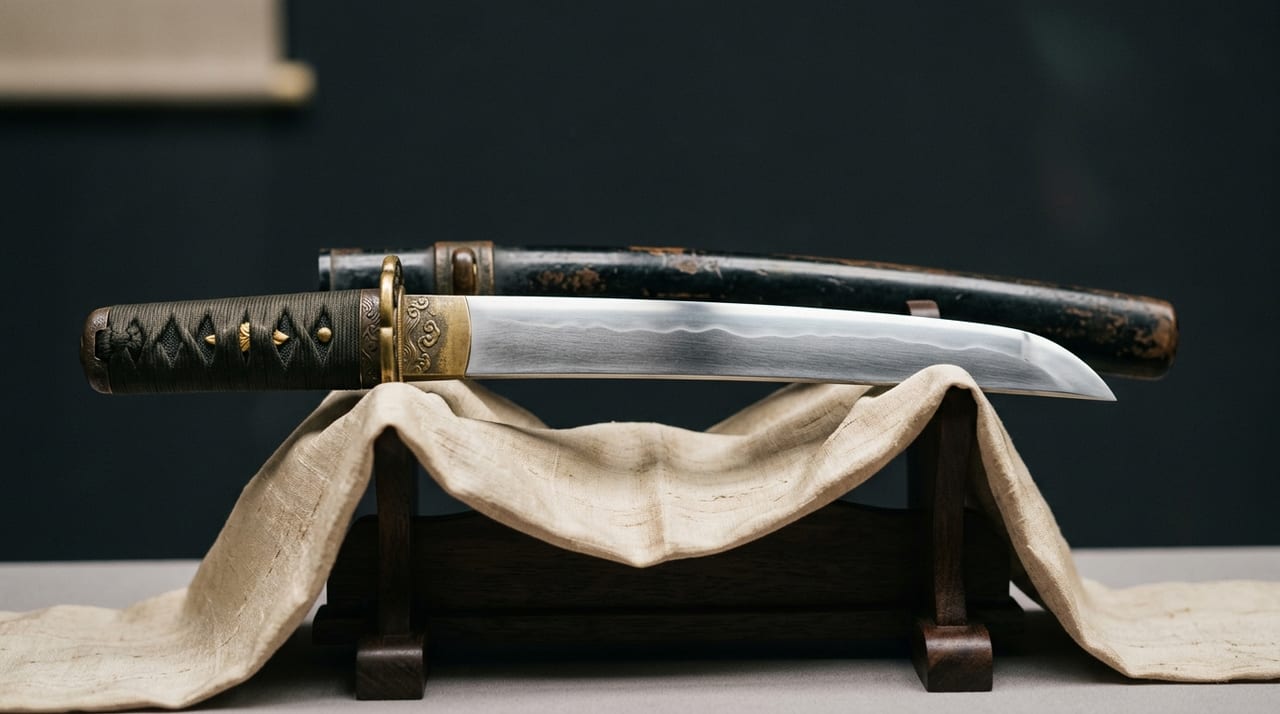
 * Image is for illustrative purposes only.
Akita Tōshirō
秋田藤四郎
Also known as: Akita Tōshirō — Tantō by Awataguchi Yoshimitsu; Listed in the Kyōhō Meibutsuchō; Important Cultural Property
Description
Akita Tōshirō is a tantō forged by Awataguchi Yoshimitsu, the master smith who worked in the Awataguchi district of Kyoto during the mid-to-late Kamakura period, and is one of the famous swords (meibutsu) recorded in the Kyōhō Meibutsuchō — the authoritative catalogue of celebrated swords compiled under the Tokugawa shogunate. "Tōshirō" is the common name (tsūshō) of Yoshimitsu, and many of his surviving tantō and short blades bear names in the form "○○ Tōshirō" — "Hakata Tōshirō," "Maeda Tōshirō," "Gotō Tōshirō," and others. Akita Tōshirō stands among these as a sword with an especially clear historical provenance, documented in the Kyōhō Meibutsuchō. The Kyōhō Meibutsuchō is a catalogue of famous swords compiled under the command of the Tokugawa shogunate during the Kyōhō era (1716–1736). It remains one of the most authoritative classical references in Japanese sword scholarship, serving as a foundational primary source for sword research to this day. The fact that Akita Tōshirō appears in this catalogue means that the foremost sword appraisers of the Edo period officially recognized its status as a meibutsu (celebrated object) and confirmed its historical value. The blade presents the form typical of Yoshimitsu's tantō: broad in width, thick in the spine, hira-zukuri (flat construction) with uchi-zori (inward curvature) or mu-zori (no curvature), conveying an archaic dignity. The jigane is ko-itame-hada densely packed, with abundant ji-nie that carries a deep, moist luster. The hamon — centered on ko-chōji with intermixed gunome and pointed togari-ha — is an intricately complex midare pattern with rich hataraki (interior activity) that rewards close study. The sword is now housed in the Tokyo National Museum, where it may be exhibited to the public on special exhibition occasions. The name "Akita" derives from the sword's transmission through the Akita domain (Kubota han, the Satake clan). The Satake were a warrior house with roots in the Kamakura period; in the Edo era they continued as lords of the Akita domain, governing Dewa Province (present-day Akita Prefecture).
Legends & Stories
The name "Akita Tōshirō" derives from the fact that this tantō was once owned by Akita Sanesue, a Sengoku-era daimyō who held the title of Akita Jōnosuke. Awataguchi Yoshimitsu was a master craftsman who flourished in Kyoto during the mid-Kamakura period, and among his works, this tantō is distinguished by its particularly small and delicate form. Through the ages, legends concerning the sword veneration surrounding this tantō have been recounted among the warrior class, and it is said that a belief took hold that divine spirits dwell within tantō crafted by the master Yoshimitsu.
According to tradition, when Yoshimitsu forged a sword, he would seclude himself within his Awataguchi residence and offer prayers for seven days and seven nights before lighting the forge. The belief that "a divine spirit dwells within this tantō" was passed down through successive generations of its owners. During the Edo period, the tantō came into the possession of the Ogasawara clan, the daimyō of Buzen Kokura domain, and was carefully preserved as a family heirloom.
Although this tantō does not appear in the Kyōhō Meibutsuchō, it is known as an "okiena meibutsu" (clan treasure) due to its provenance from Akita Jōnosuke. From the modern era onward, it passed through the hands of sword collectors and is presently housed in the Kyoto National Museum.