New Arrivals — Browse our catalog for the latest authentic Japanese sword arrivals. Browse →
July 8, 1853 (Kaei 6, 6th month, 3rd day)
Off Uraga and Kurihama, at the mouth of Edo Bay (present-day Yokosuka, Kanagawa Prefecture)
Forces
The Tokugawa shogunate
The American squadron
About 7 min read
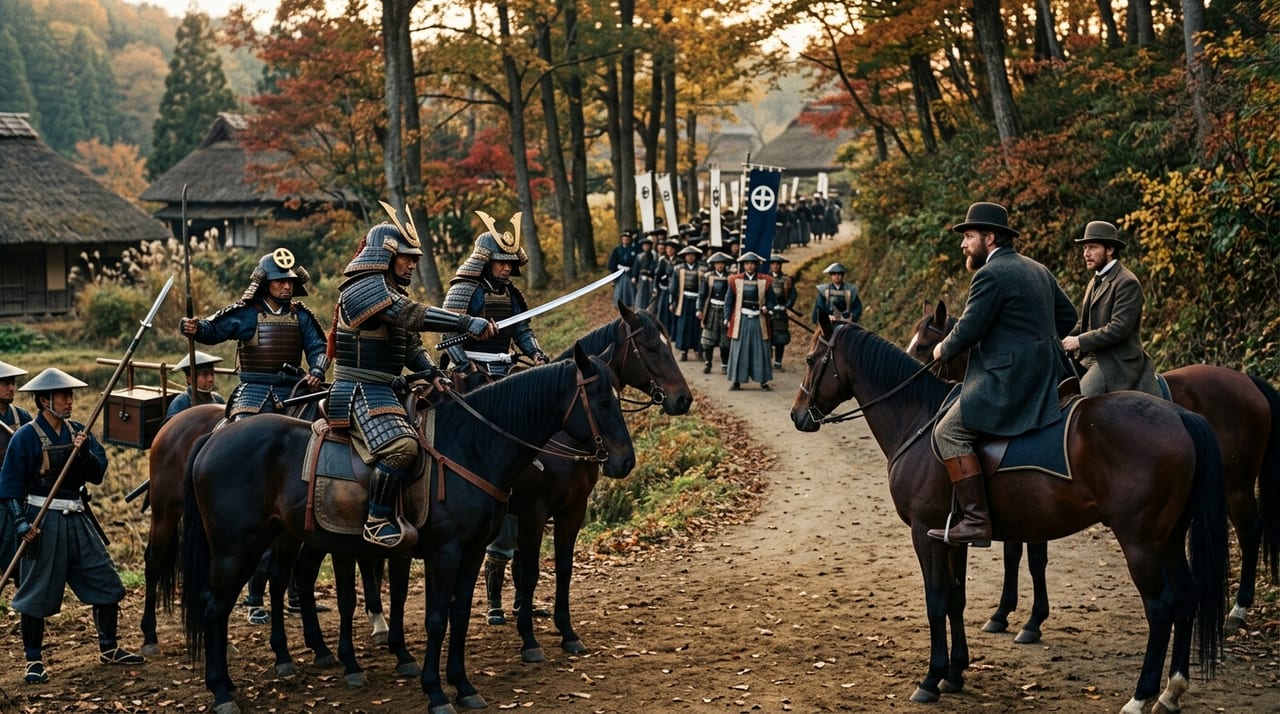
On the evening of the 3rd day of the 6th month of Kaei 6 (July 8, 1853), an American squadron anchored off Uraga. It consisted of four ships: the steam paddle frigates Susquehanna (the flagship) and Mississippi, and the sailing sloops Saratoga and Plymouth. This is the event known as the arrival of the "Black Ships," and it set the Tokugawa shogunate on the path to the Treaty of Peace and Amity concluded the following year.
Officials of the Uraga magistracy, Nakajima Saburōsuke and Kayama Eizaemon, dealt with the squadron. Perry's side is reported to have demanded that a high-ranking official receive the President's letter, threatening to sail up Edo Bay otherwise. During the stay, the squadron's boats entered Edo Bay to take soundings.
Abe Masahiro, the chief senior councillor (rōjū shuza), permitted Perry's party to land at Kurihama on the 9th day of the 6th month (July 14). The Uraga magistrates Toda Ujiyoshi and Ido Hiromichi met them and received the President's letter. The shogunate asked for time to reply, citing the shogun's illness; Perry announced he would return in a year and withdrew on July 17.
Abe showed a Japanese translation of the letter to the daimyo and sought opinions widely, including from the shogunate's retainers. Following an inspection of Edo Bay by Egawa Hidetatsu and others, the construction of batteries (daiba) off Shinagawa was decided, and in the 9th month of Kaei 6 the ban on building large ships was lifted. The shogunate thus pursued coastal defense and the gathering of opinion at the same time.
Perry returned on the 16th day of the 1st month of Kaei 7 (February 13, 1854), and after negotiation over the venue, talks were held at Yokohama. The shogunate's policy was to permit only the rescue of shipwrecked sailors and the supply of provisions, and to refuse trade; the matter of trade was set aside, partly owing to the strong opposition of Tokugawa Nariaki.
The treaty was signed on the 3rd day of the 3rd month of Kaei 7 (March 31, 1854) at Kanagawa (the reception hall at Yokohama village). The Japanese plenipotentiary was Hayashi Fukusai, and the American was Perry. Ratifications were exchanged at Shimoda on February 21, 1855, and the treaty took effect. Its main provisions were:
- Article 1: Permanent peace and amity between the two countries - Article 2: Shimoda opened immediately and Hakodate after one year, with supplies of firewood, water, provisions and coal - Article 3: Shipwrecked Americans to be conveyed to Shimoda or Hakodate - Articles 4 and 5: Americans staying in Japan not to be restricted as the Dutch and Chinese were at Nagasaki; at Shimoda they were allowed to move within seven ri - Article 9: One-sided most-favored-nation treatment - Article 10: Ships forbidden to call at ports other than Shimoda and Hakodate except in distress or bad weather - Article 11: The United States may station a consul at Shimoda after eighteen months, if both governments deem it necessary
The Shimoda supplementary agreement (13 articles) setting out detailed rules was signed at Ryōsen-ji in Shimoda in the 5th month of the same year.
The arrival marked a turning point in the shogunate's foreign policy, which had been maintained under the seclusion system. The shogunate's broad consultation with the daimyo and its own retainers, together with military changes such as the construction of batteries and the lifting of the ban on large ships, are described as the starting point of the political movements of the Bakumatsu period.
ペリー来航後の激動期に刀匠たちが感じた社会変動と、尊王攘夷思想が生み出した幕末最後の高品質古典刀の実態を探る。
2026-05-17
2026-08-12
江戸後期の新々刀期に活躍した固山宗次は、水心子正秀の弟子として古流を研究し復興した刀工。その刃文と地鉄の特徴、代表作、現代における評価を詳解する。
2026-04-20
幕末動乱期(1850〜1868年)に活躍した志士・武士たちが愛用した刀剣と、その歴史的背景を解説する。坂本龍馬の陸奥守吉行、近藤勇の長曽祢虎徹、西郷隆盛の刀への姿勢など、人物と刀の関係から激動の時代を読み解く。
2026-04-15