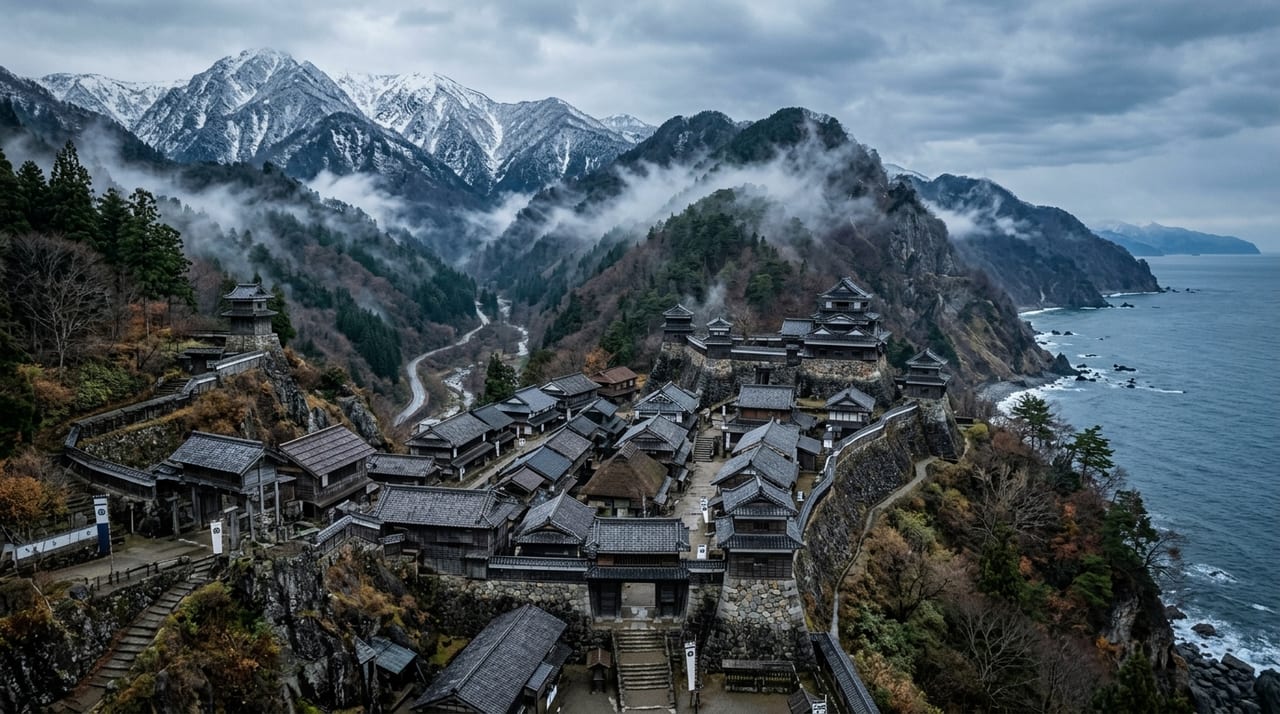
 * Image is for illustrative purposes only.
Etchu Tradition
越中伝
The swordsmithing tradition of Etchu Province (present-day Toyama Prefecture), distinguished by a robust, independently interpreted adaptation of Soshu-den influence and a jihada shaped by the material and climatic conditions of the northern Japan Sea coast. Etchu-den supplied the practical blades for the province's warrior class before Maeda clan consolidation and transmitted its techniques southward into the Kaga sword culture.
Description
Etchu Province, occupying what is now Toyama Prefecture on the Japan Sea coast, was a crossroads connecting Kaga (Ishikawa) to the west, Echigo (Niigata) to the northeast, Hida (Gifu) to the south, and Shinano (Nagano) to the east. This geographic position created an environment in which Yamato-den from the south, Bizen-den from the southwest, and later Soshu-den from the east all intersected, and Etchu smiths synthesized these influences into a distinctive regional tradition clearly distinguishable from its neighbors.
Etchu smiths appear in the documentary record from the late Kamakura period, initially producing robust practical blades drawing on Yamato and Bizen techniques adapted to the battlefield requirements of Hokuriku's mountain and coastal terrain. The tradition's distinctive character crystallized in the Nanbokuchō period, when Soshu-den techniques — particularly the turbulent midare-hamon (irregular temper pattern) and the rich kinsuji and sunagashi characteristic of Sagami-school tempering — reached Etchu. Local smiths interpreted these techniques through the lens of Etchu's own sand-iron deposits and water quality, producing what might be called a "northern Soshu" regional variant.
Etchu-den's most distinctive feature is the vigor of its hamon. Embracing and adapting Soshu-den's dynamic temper patterns, Etchu smiths favored aggressive gunome-midare and deep ō-midare (large-scale irregular hamon) that combined visual power with the cutting performance demanded by actual combat. The jihada typically shows a mixture of itame and masame grain with a somewhat rough surface quality, reflecting the characteristics of local Etchu sand-iron and the demanding cold-weather forging conditions of the northern coast.
The Norishige lineage is the most celebrated in Etchu-den. Etchu Norishige, active from the late Kamakura into the Nanbokuchō period, is considered the defining figure of the tradition. His characteristic "ishime-ji" (stone-surface grain) — a rough, granular jihada with abundant ji-nie and ji-kei (dark diagonal lines in the body) — has been described by generations of scholars as approaching the achievement of Soshu-den itself. Multiple Norishige blades are held in the Tokyo National Museum and other major collections at the Important Cultural Property and National Treasure level.
The Sengoku period placed Etchu at the turbulent intersection of Uesugi, Takeda, and Ikko-ikki influence, generating intense sword demand. In the Edo period, as Etchu fell under Maeda clan jurisdiction as part of the Kaga domain, many Etchu smiths relocated southward to Kanazawa, directly contributing their technical tradition to Kaga sword culture's development. Contemporary smiths in Toyama Prefecture maintain an explicit connection to the Etchu Norishige tradition, making Etchu-den one of Japan's living regional inheritances.
Characteristics of This Era
- Distinctive rough ishime-ji jihada — the defining visual signature of Etchu-den established by Norishige
- Vigorous gunome-midare and ō-midare hamon — northern interpretation of Soshu-den tempering expressed with regional force
- Abundant ji-nie and ji-kei — metallic luminosity and dynamic surface effects from local Etchu sand-iron
- Robust, practical sugata for mountain and coastal combat — functional construction meeting Hokuriku battlefield demands
- Technical contribution to Kaga sword culture — Etchu smith migration southward under Maeda jurisdiction