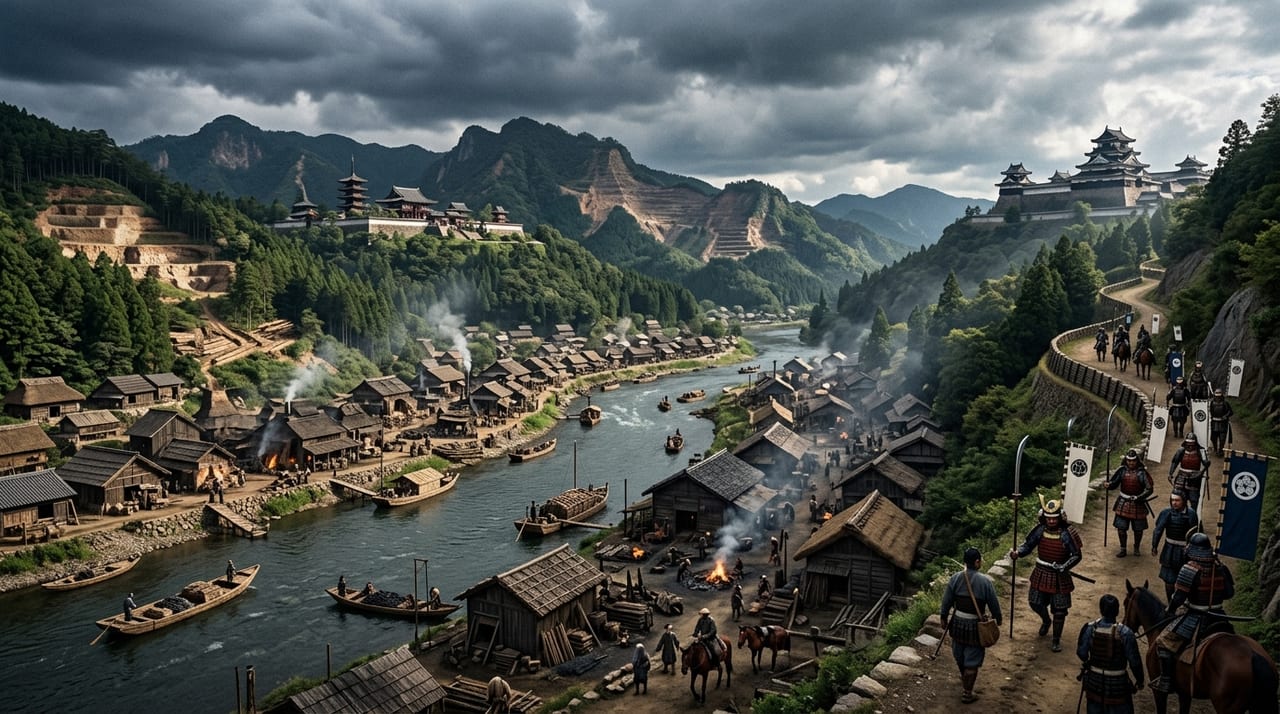
 * Image is for illustrative purposes only.
Sukesada Lineage
祐定一派
The most prolific sword-making lineage of the Muromachi-Sengoku period, centered in Osafune, Bizen. Multiple generations of smiths bearing the name Sukesada built an industrial-scale production system supplying weapons to warlords and commoners alike. Swords signed Sukesada survive in very large numbers.
Description
Rise of the Sukesada Lineage in Osafune
Osafune in Bizen Province (present-day Osafune-chō, Setouchi City, Okayama Prefecture) lies along the Yoshii River. Taking advantage of high-quality iron sand, abundant fuel, and water transport, it developed from ancient times into Japan's largest sword-producing center. In Osafune, Bizen, which produced generations of master smiths, including Mitsutada, Nagamitsu, Kagemitsu, and Masanaga of the Kamakura period, and Kanemitsu, Nagayoshi, and Morimitsu of the Nanbokuchō period, a lineage of smiths calling themselves Sukesada (祐定) rose to prominence from the mid-Muromachi period onward.
The Sukesada inscription was not the name of a single smith. It was a signature shared by a family of smiths across multiple generations. The peak of Sukesada-signed blades falls in the late 15th to 16th century, the Sengoku period following the Ōnin War. During this era, numerous Sukesada smiths bearing office-title inscriptions (kanto-mei) and given-name inscriptions (kana-mei), such as Yosazaemon-no-jō Sukesada, Hikobei-no-jō Sukesada, and Genbei-no-jō Sukesada, were active simultaneously.
Sengoku-Period Demand and Mass-Production Systems
The arrival of the Sengoku period (second half of the 15th century to the end of the 16th century) caused demand for Japanese swords to explode. As regional lords organized their armies, everyone from ashigaru foot soldiers to senior samurai needed a sword, and the number of blades required grew to a scale incomparable to the individual commissions of earlier aristocratic and samurai classes. The Sukesada school of Osafune, Bizen, had the production system best suited to meet this demand efficiently.
The Sukesada production system was organized in a way close to a modern factory-style handicraft system. Multiple smiths divided the work, streamlining the forging of the jigane (blade steel), the quench-hardening that forms the hamon (temper line), and the finishing polish. This allowed them to produce several times the output of other schools of the same era. They supplied both carefully made chūmon-uchi (made-to-order blades) for customers and kazuuchi (mass-produced blades, also called sokutō).
As a result, many Muromachi- and Sengoku-period swords signed Sukesada survive today, and it is said to be the most numerous single signature in Japanese sword history. Some dismiss them, saying, "There are so many Sukesada that their value is low." Yet the fact that they were produced in such numbers and still maintain a certain quality today is also evidence of the high technical standard of the time.
Superior Works and Masterpieces: The Pinnacle of Sukesada
Even with its mass-production system, the Sukesada school showed exceptional skill when it accepted top-quality commissions. Masterworks reflecting the aesthetic tastes of their patrons also survive, such as the Eishō-era katana by Yosazaemon-no-jō Sukesada, designated an Important Cultural Property.
Among masterpieces made to order, some Sukesada blades display in their finest form the gorgeous gunome-midare hamon (a wave-like temper line with irregular, sawtooth-like peaks) typical of the Muromachi-period Bizen tradition. Some also show utsuri (a pale, cloud-like shadow in the jigane). Utsuri is a whitish, misty shadow floating on the blade steel, arising from structural changes peculiar to the Bizen quenching technique, and it is a hallmark of Bizen blades. Sukesada utsuri is clear and well balanced, and in high-quality works of the same era it is equal in appearance to that of other Bizen smiths.
Carvings and Decoration: Added Value in Sukesada Blades
Many Sengoku-period Sukesada blades bear finely executed carvings (horimono) on the blade. Carvings such as Fudō Myōō, a kurikara dragon, bonji (Sanskrit characters), gomabashi (fire-ritual sticks), and hi (blood grooves) adorn the blade, adding religious and decorative value to its function as a weapon. Religious carvings commissioned by warriors heading into battle in search of spiritual efficacy were an important element that raised Sukesada blades above mere mass-produced goods.
Transition to the Edo Period and Decline
After the Battle of Sekigahara (1600) and the consolidation of Tokugawa rule, the demand for mass production of the Sengoku era disappeared, and the sword market shifted to small-batch, high-quality production. Amid this change, the Sukesada school's mass-production system no longer fit the times. The Osafune production center itself had already suffered catastrophic damage from a great flood of the Yoshii River in the late Tenshō era. In the Edo period, smiths such as Yokoyama Sukesada carried on the Sukesada name, but the former prosperity was lost.
However, the historical fact that the Sukesada school continued to supply swords to samurai and commoners throughout Japan during the Sengoku period is important evidence that Japanese swords were not mere luxury goods of aristocrats and elite samurai, but cultural objects that permeated society broadly. Today, many Sengoku-period Sukesada blades are still kept by private collectors and museums across the country, and they are valuable historical materials that convey the broad popular reach of Japanese sword culture.
Characteristics of This Era
- Industrial-scale production — workshop division of labor achieving unmatched output; the 'sword industry' of the Sengoku period
- Chūmon-uchi and kazuuchi — carefully made commissioned swords supplied alongside mass-produced swords (tabagatana)
- Maintained Bizen tradition in top works — utsuri, gunome-midare, and refined jigane preserved in high-grade pieces despite the production scale
- Abundant religious carvings — fudō, kurikara dragon, Sanskrit inscriptions reflecting warrior faith demands