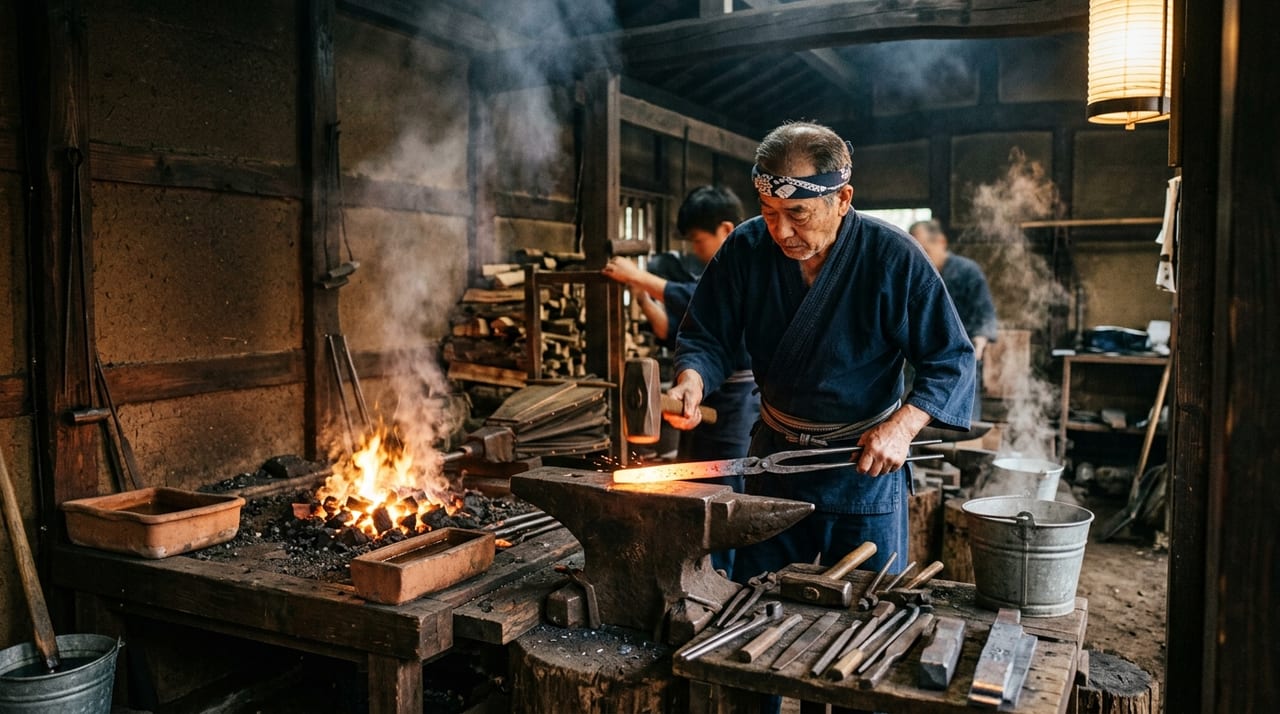
 * Image is for illustrative purposes only.
Osafune Sukesada
長船祐定
Description
Sukesada was a swordsmith who arose in Osafune in Bizen Province (present-day Osafune-chō, Setouchi City, Okayama Prefecture), and is a signature representative of the so-called Late Bizen in the late Muromachi period. "Sukesada" does not designate a single individual; rather, many smiths in the Osafune area bore the same signature, forming a succession of them that was handed down generation after generation from the late Muromachi period through the Sengoku period. Among them, Yosozaemon-no-jō Sukesada is considered the most skilled, and is regarded as the foremost master of Late Bizen. Other smiths bearing the same signature are known, including Hikobei-no-jō Sukesada and Genbei-no-jō Sukesada, each leaving works prefixed with his common name. Yosozaemon-no-jō Sukesada is thought to have been active from Bunki through Eishō, Daiei, and Kyōroku to around Tenbun, and many dated, signed works by him are transmitted.
The background to this lies in the rise in demand for weapons after the Ōnin-Bunmei Disturbance. In Osafune, in response to the age of warfare, smiths forged large quantities of mass-produced blades called kazuuchi-mono and supplied them to samurai across the regions, while in parallel, superior commissioned works made to the requests of influential patrons were also produced. Sukesada-signed works encompass both extremes: there is a large gap in quality between lower-grade blades mass-produced without a personal name and refined superior works inscribed with a personal name, such as those of Yosozaemon-no-jō. The fact that works with a personal name are generally rated higher reflects these production circumstances.
The forging style shows a well-compressed ko-itame hada with jinie, and the utsuri characteristic of the Bizen tradition stands out. The hamon is based on a koshi-biraki gunome, mixed with chōji-ba and togari-ba, and often shows a distinctive form in which the yakigashira splits into two, popularly called "kani no tsume-ba" (crab-claw blade), reminiscent of a crab's claw. Also characteristic are the gorgeous, undulating patterns common to the Late Bizen lineage, beginning with kobushigata chōji, in which clove patterns string together into fist-like shapes. The nioi-deki carries ko-nie, with kinsuji and sunagashi, and the nioiguchi is bright and crisp. Works by Yosozaemon-no-jō Sukesada are especially refined in both ji and ha, and are known as superior pieces combining strength and beauty.
As a representative work, a sword by Yosozaemon-no-jō Sukesada bearing a dated inscription of Eishō 18 (1521) has been designated an Important Cultural Property, and conveys his high technical skill to the present day. In sword rankings it is placed in the chūjō-saku grade, and he is counted among the representative smiths of Late Bizen, alongside Tadamitsu, Katsumitsu, and Munemitsu.
Famous Works
- Katana, dated Eishō 18 (Important Cultural Property)