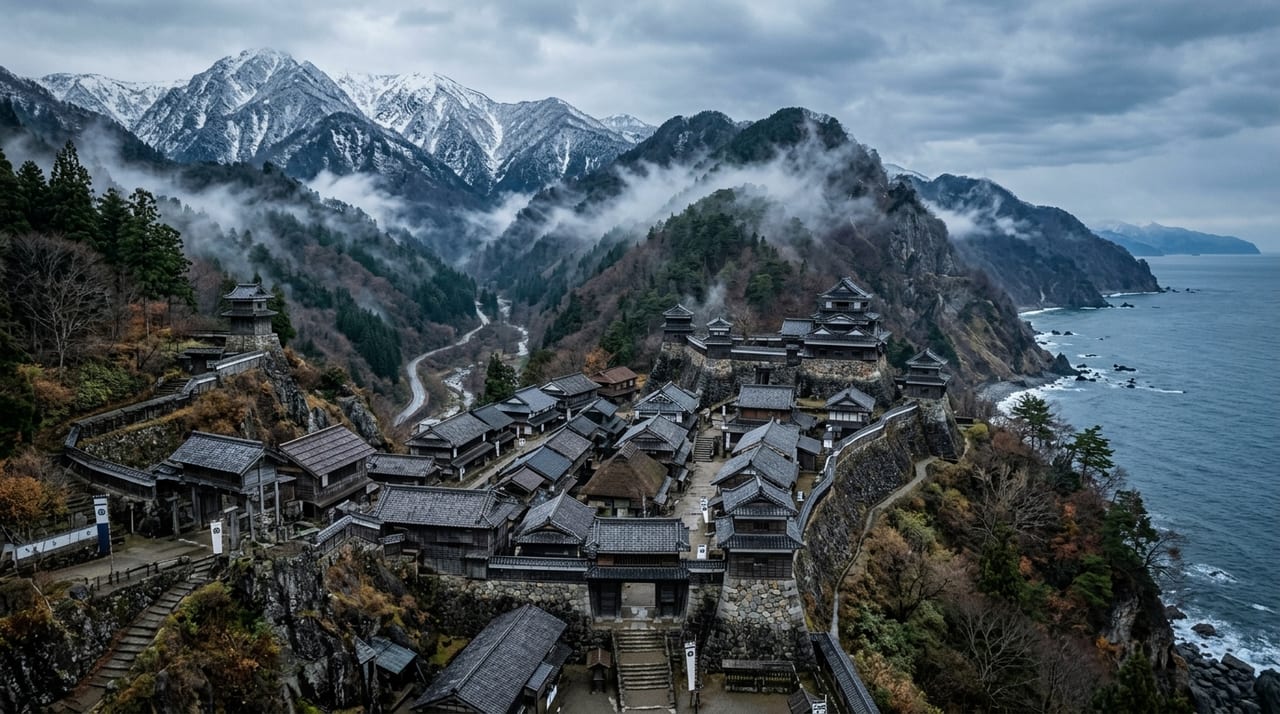
 * Image is for illustrative purposes only.
Taima School — Temple Smith Tradition of the Yamato Five Schools
当麻派——大和五派の一角を担う寺院鍛冶集団
A group of swordsmiths who were active based at Taima-dera in Katsuragi City, Nara Prefecture. As one of the Yamato Five Schools, it stood alongside the Senjuin, Shikkake, Hōshō, and Tegai schools of the same Yamato tradition, and was active from the mid-Kamakura period through the Nanboku-chō period. It is characterized by a wood-grain-like forging texture with masame mixed in, and by a sugu-ba mixed with niju-ba and uchinoke.
Description
Historical Background
The Taima school was a group of swordsmiths based at Taima-dera temple in Taima, Katsuragi City, Nara Prefecture. It is counted as one of the Yamato Five Schools (Senjuin, Shikkake, Taima, Hōshō, and Tegai). It was active from the mid-Kamakura period through the Nanboku-chō period (13th–14th centuries) and carried the temple- and shrine-service sword culture of Yamato Province.
Since antiquity, Yamato Province (present-day Nara Prefecture) had many powerful temples and shrines, such as Tōdai-ji, Kōfuku-ji, and Kasuga Taisha, which maintained sōhei (warrior monks) to protect their safety and interests. To meet the demand of these institutions, dedicated swordsmith groups formed around the temples. One of them, rooted at Taima-dera, was the Taima school.
Characteristics of the Style
The jigane (steel) of Taima school swords is a finely forged ko-itame with masame mixed in, and shows chikei (ground lines) and yubashiri (hot-water flow). The hamon is based on sugu-ba of nie-deki (nie-formed), and accompanying activities such as niju-ba (double hamon), uchinoke, and hakikake appear frequently.
The Taima school shares several features with other Yamato-den schools: the overall tendency toward sugu-ba, the masame component in the jigane, and a purely practical construction. However, its jigane changes, especially yubashiri and chikei, are particularly pronounced, which gives it a unique position in appraisal.
Representative Smiths
The notable smiths of the Taima school are Kuniyuki and Kunikiyo. Kuniyuki is said to be the founder of the Taima school and to have been active around the Shōō to Shōwa eras (1288–1317). His representative tachi are designated National Treasures, and his kodachi are designated Important Cultural Properties.
Cultural Context and Significance
Taima-dera is an ancient temple said to have been founded in the 20th year of the reign of Empress Suiko (612). It is renowned as the temple of the Taima Mandala, a mandala painting known as a National Treasure. The smith group that served this sacred ground was the Taima school. Their swords were not merely arms but were positioned within the religious context of temple protection, ritual, and dedication.
After the late Kamakura period, the Yamato Five Schools gradually declined through the turmoil of the Nanboku-chō period, and by the mid-Muromachi period their activity as independent schools had nearly ended. However, Yamato-den techniques were later reevaluated through the Horikawa school in the Shintō period and the Bakumatsu fukkō-tō (archaic-style sword) movement, and were incorporated into the chain of transmission in the history of the Japanese sword.
Characteristics of This Era
- Fine mokume-hada mixed with masame; frequent chikei and yubashiri
- Sugu-ba based on nie-deki; niju-ba, uchinoke, and hakikake appear
- Yamato-tradition masame component and functionally focused construction