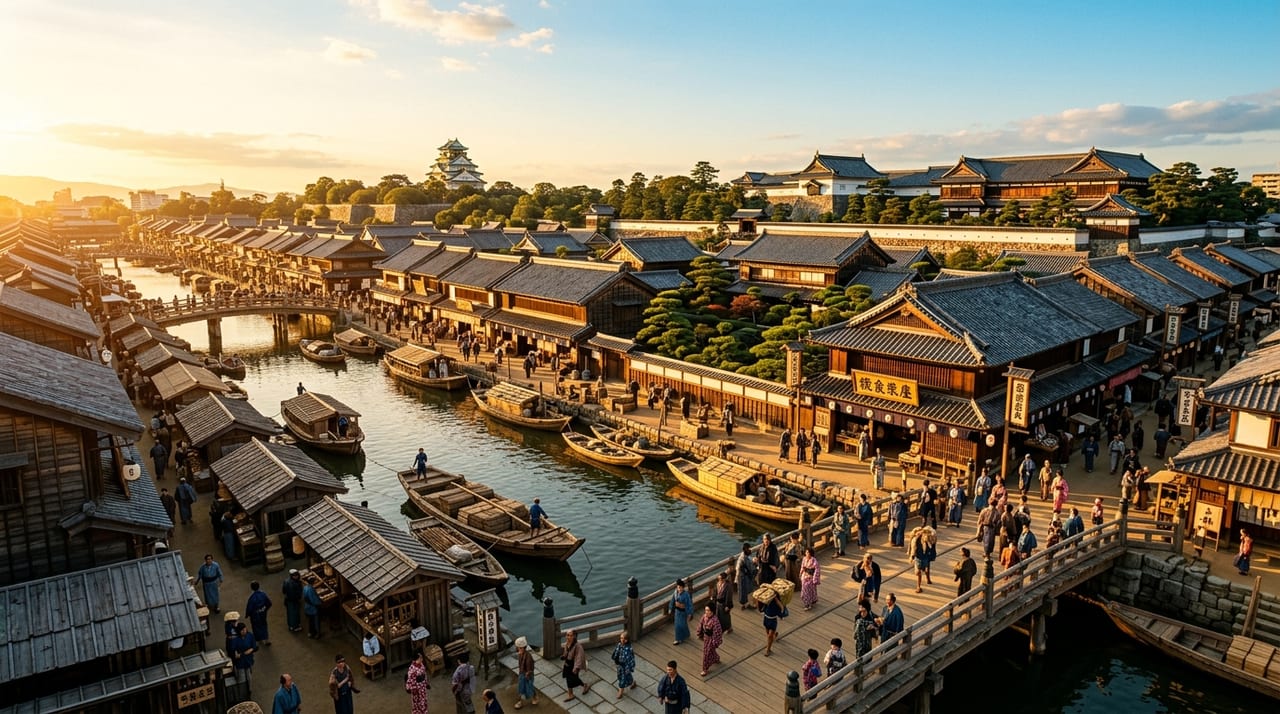
 * Image is for illustrative purposes only.
Osaka Shintō
大坂新刀
Flourishing on the wealth of Osaka, the "Kitchen of the Nation," this was the finest sword culture of the Shintō period. Inoue Shinkai's nie-deki and Tsuda Sukehiro's tōran-ba stood as twin peaks, and the period produced many famous blades of high artistic finish that embody the splendor of merchant culture.
Description
Commercial City Osaka
In the early Edo period, Osaka, known as the "Kitchen of the Nation," was a great commercial city where rice, grain, and goods from across the country gathered and were distributed, and it enjoyed unprecedented prosperity. As wealthy merchants such as Yodoya, Kōnoike, and Kajimaya amassed enormous fortunes and acquired cultural refinement no less than that of the samurai, demand for fine swords naturally rose. It was under these economic and cultural conditions that Osaka Shintō flourished.
Concentration of Swordsmiths
The greatest hallmark of Osaka Shintō lies in its bright, clear jigane and its splendid nie-deki hamon. Whereas the Bizen tradition of the kotō period centered on nioi-deki and had jigane with hues unique to its place of origin, Osaka Shintō, though using uniform Shintō steel, achieved bright hamon in which the nie grains shine with exceptional clarity, owing to outstanding quenching skill. That brilliance is regarded as the pinnacle of quenching technique in the Shintō period.
Decoration and Practicality
The founder of Osaka Shintō was Izumi no Kami Kunisada I (Oya-Kunisada). Kunisada, who trained under Horikawa Kunihiro, brought his master's techniques to Osaka and established a refined style that met the cultural demands of the merchant capital. The swords of Oya-Kunisada display, in their vigorous gunome-midare hamon, the strong nie inherited from Kunihiro, and his achievements in laying the foundation for Osaka swordsmithing are immeasurable.
Regional Characteristics
His son, the second Izumi no Kami Kunisada, namely Inoue Shinkai, is a master regarded as the supreme peak of Osaka Shintō and the finest work of Shintō as a whole. Shinkai reached his peak from the Kanbun era (1661–1673) through the Enpō era. His style is mainly suguha, and rarely he features ō-notare or gunome-midare. The jigane, with thick ji-nie, is among the most beautiful in Osaka Shintō; the nioiguchi is clear, and the nie within the hamon is well-developed, making it splendid. The epithet "Osaka Masamune" praises a nie vigor comparable to the Sōshū (Sagami) tradition of Masamune, and it is said that anyone who holds a Shinkai sword is captivated by its overwhelming presence. Shinkai changed his signature from Kunisada to "Shinkai" in 1672 (Kanbun 12), and works bearing the Shinkai signature, of which there are few, receive especially high regard. Wealthy merchants of Osaka competed to acquire Shinkai's swords, and that splendor was the very essence of Osaka townsman culture, which preceded Genroku culture.
Master Smiths
Shinkai's rival as another great master was Tsuda Echizen no Kami Sukehiro. Sukehiro was the adopted son of the first Soboro Sukehiro. In his early years he produced works such as ashinaga-chōji inherited from his adoptive father, but in his prime he founded a revolutionary hamon called "tōran-ba," which likened large ō-gunome-midare to waves. Tōran-ba is a dynamic hamon, as if the rolling waves of the open sea were breaking, with a large difference in height between the valleys (the lowest parts) and the peaks (the highest parts) of the blade, and it is characterized by an undulating sense of motion. This hamon is not mere decoration. The application of tsuchi-oki (the way the yakiba-tsuchi is applied) demanded advanced skill, and it was an artistic expression realized only through Sukehiro's outstanding quenching technique. Tōran-ba thereafter became one style in Osaka Shintō and was further developed by Ikkanshi Tadatsuna and others who revered Sukehiro.
Evaluation of the Works
Kawachi no Kami Kunisuke was a leading smith of Osaka alongside Kunisada, and as a prestigious line continuing from the first through the third generation, he supported the sword culture of Osaka. Most of Kunisuke's swords feature a ko-mokume jigane with splendid nie-deki hamon, and the second generation (Naka-Kawachi) gained popularity for a distinctive hamon called kobushigata-chōji. Awataguchi Ōmi no Kami Tadatsuna was a master smith active in Osaka, and his son, the second-generation Tadatsuna, was Ikkanshi Tadatsuna.
Osaka Shintō possesses a distinctive aesthetic sensibility that is splendid and bright, differing both from the delicate, introspective beauty of the Yamashiro tradition of Kyoto and from the blunt, plain, and vigorous strength of Edo Shintō. It is a direct reflection of the open and expansive spirit of the merchant city Osaka, and it is a product of the era in which the culture of cherishing swords as works of art, rather than mere weapons, was at its most mature. The fact that relatively many well-preserved works remain is also an appeal of Osaka Shintō, and superb works by Shinkai and Sukehiro remain the eternal objects of admiration for sword enthusiasts as the peak of Shintō.
Characteristics of This Era
- The bright, clear jigane is the greatest hallmark of Osaka Shintō. Forging uniform Shintō steel with superb quenching skill, the smiths achieved a distinctive beauty in which nie grains shine brilliantly against a white, luminous surface.
- Deep-nie suguha and ō-notare, typified by Inoue Shinkai, are also representative hamon of Osaka Shintō. Crisp nioiguchi stands out against beautiful jigane with dense ji-nie, and the blade interior is well covered with nie, presenting a splendid vista.
- The tōran-ba, pioneered by Tsuda Echizen no Kami Sukehiro, is a dynamic hamon resembling the rolling waves of the open sea. Its large variation between troughs and crests gives a surging sense of movement, and it is an artistic expression that demands advanced skill in clay application (tsuchioki) before quenching.
- A splendid and cheerful style reflecting the open, vigorous spirit of Osaka, the mercantile capital. It is the product of the era in which the culture of appreciating swords not only as weapons but as works of art reached its greatest maturity, and wealthy merchants competed to acquire famous blades.
- The lively activity of nie, with pronounced sunagashi, kinsuji, and chikei, is a highlight of Osaka Shintō. The size, brightness, and vigor of nie grains clearly reflect the level of quenching technique, and Shinkai's works stand at its pinnacle.
- The standard form is a somewhat wide mihaba and a well-balanced taihai with a chūbō tip. Most have shallow sakizori curvature, giving a refined proportion that combines practicality and beauty.
- Relatively many works survive in good condition, and their artistic evaluation is extremely high. As the group of Shintō blades with the greatest artistic completeness, they are coveted by collectors.