Ikkanshi Tadatsuna: The Osaka Shinto Master of Blade Carving
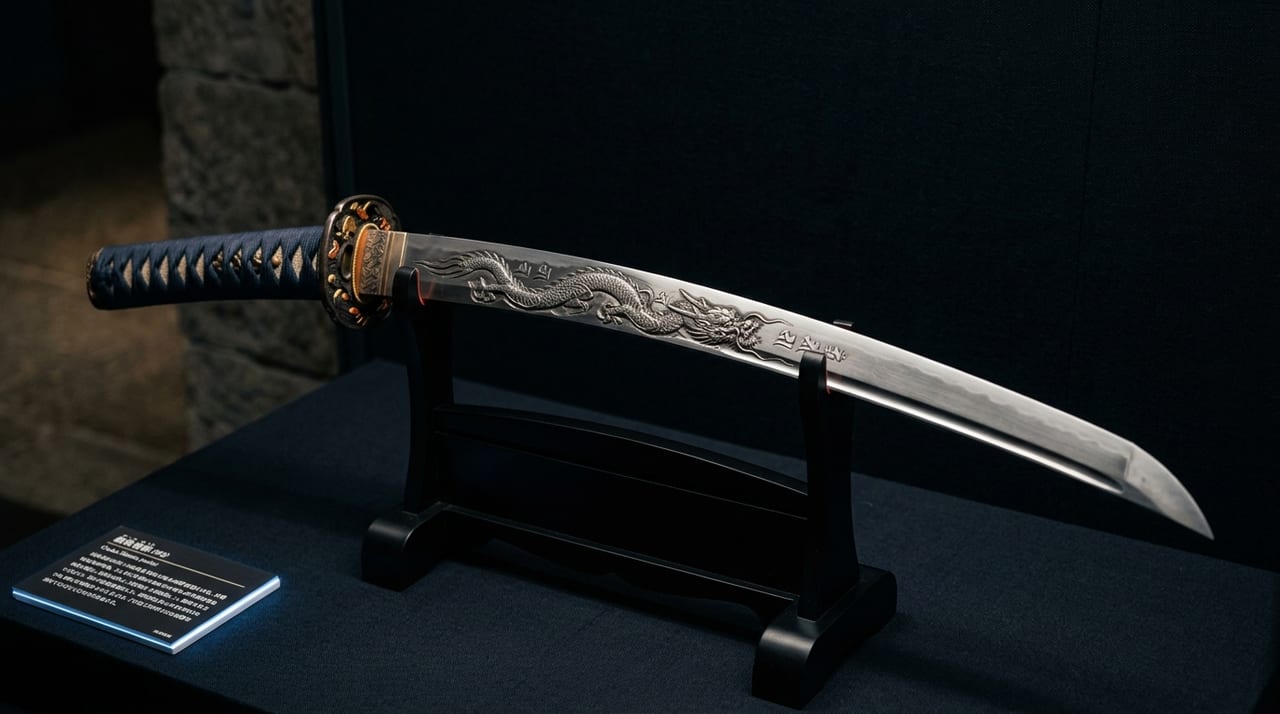 * Image is for illustrative purposes only.
Table of Contents
Ikkansshi Tadatsuna: Master Carver of Osaka Shinto
Ikkansshi Tadatsuna was a sword smith active in Osaka, Settsu Province, from the Genroku period through the Kyoho era (late 17th to early 18th century) during the middle Edo period. "Tadatsuna" was one of the family names of Osaka sword smiths passed down through generations, and "Ikkansshi" was his nom de guerre. While the names Sukehiro and Shinkai are well known as representative masters of Osaka Shinto, Ikkansshi Tadatsuna is positioned as a sword smith who established a unique place through mastery in a different field—namely blade carving (horimono)—distinct from their achievements.
Osaka Shinto refers to a group of swords that, around the Bunbun era (1661–1673), established a style of form and jigane distinct from the earlier Keichō Shinto. Against a backdrop of economic prosperity in the Kansai region, orders increased not only from samurai but also from wealthy merchant classes, and among sword smiths there developed a spirit of competition for visual elegance and individuality alongside practicality. Ikkansshi Tadatsuna's devotion to carving is believed to have been born from this historical context.
The Nom de Guerre "Ikkansshi" and the Lineage of the Tadatsuna Family
The Tadatsuna family of Osaka was a lineage of sword smiths extending through generations from the founding Tadatsuna, and Ikkansshi Tadatsuna represents a generation particularly known as a master of carving within that line. From the Bunbun period onward, Osaka Shinto formed a group known for shallow curves, bold forms, and refined jigane and hamon, but a major characteristic of Ikkansshi Tadatsuna's works is the addition of finely detailed carving to these qualities.
It was common for most sword smiths of the time to outsource blade carving to specialist carvers. In contrast, Ikkansshi Tadatsuna is regarded as exceptional for reportedly handling the carving himself. Examples of a single sword smith bearing both blade forging technique and carving technique are not numerous even throughout the Shinto period.
Technical Characteristics of Blade Carving
Ikkansshi Tadatsuna's carvings are evaluated for the richness of their subjects and the fineness of their execution. Representative subjects include the following:
- Dragons: Kurikara dragons in ascending and descending forms, featuring dynamic compositions
- Acala: A devotional motif depicting the Buddhist deity carved into the blade
- Sanskrit characters: Carving using Sanskrit seed characters for prayers and protective talismans
- Arhats and human figures: Representational imagery that transcends simple decorative patterns
These carvings are valued not merely as ornamentation but for how they are positioned to harmonize with the notable features of the blade's jigane and hamon. The carved lines are deep and clear, and many works have been transmitted in which the designs remain legible even after wear from age.
Differences from Sukehiro and Shinkai: Positioning Individuality in Osaka Shinto
Sukehiro, a representative master of Osaka Shinto, is known for a hamon called tōran-ba that resembles great waves, while Shinkai excelled in graceful and powerful straight hamon and notare hamon. Both are sword smiths primarily evaluated for the beauty of their hamon and jigane.
In contrast, Ikkansshi Tadatsuna can be said to be a sword smith with a different evaluation framework within contemporary Osaka Shinto, in that he added the additional value of carving to the blade alongside the perfection of hamon and jigane.
- Sukehiro: Innovation in hamon expression through the tōran-ba pattern
- Shinkai: Graceful form and consistently high quality of execution
- Ikkansshi Tadatsuna: A comprehensive artistic domain combining carving and forging technique
These differences show that Osaka Shinto did not remain a single unified style but produced diverse approaches based on each sword smith's specialty. Living in the same land of Osaka and the same Shinto period, yet each smith honed his skills in different directions, with the result that Osaka Shinto became an entity offering diverse appreciation and enjoyment even today.
Modern Evaluation and Appraisal Points
Ikkansshi Tadatsuna's works continue to attract high interest in modern times because of the fineness of their carving. In appraisal, it is considered important to confirm the depth of the carved lines and the completeness of composition, along with the density of the blade's jigane and the quality of the hamon. Even if the carving alone is superior, if the blade itself does not match in quality, the evaluation decreases, so a perspective that examines both the carving and the jigane and hamon in balanced fashion is required.
Furthermore, it is known that carvings are sometimes added or altered by other hands in later periods, so careful dating of the carving in conjunction with dating of the blade itself is also noted as a point to consider carefully in appraisal practice.
Such knowledge can be applied as a fundamental perspective not only to Ikkansshi Tadatsuna's works but to the appreciation and appraisal of swords in general that feature carving. When encountering Japanese swords with carving, one must evaluate the blade itself and the carved work separately, and develop the acumen to discern whether both harmonize at a high level.
Conclusion: A Rare Sword Smith Who Combined Forging and Carving
Ikkansshi Tadatsuna was a sword smith who built a unique position from the same foundation of Osaka Shinto through "carving"—a different angle than Sukehiro and Shinkai. The element of blade carving speaks to how the Japanese sword functioned not merely as a weapon but also as a medium for inscribing faith and aesthetic sensibility. Ikkansshi Tadatsuna's style is an indispensable reference point for understanding the diversity of Osaka Shinto. The fact that there was a sword smith who inscribed individuality into the blade through carving as an expressive means, separate from the trend of competing in the beauty of hamon and jigane, is also a fine example demonstrating that the evaluation framework for Japanese swords is not singular but has become multifaceted over time.