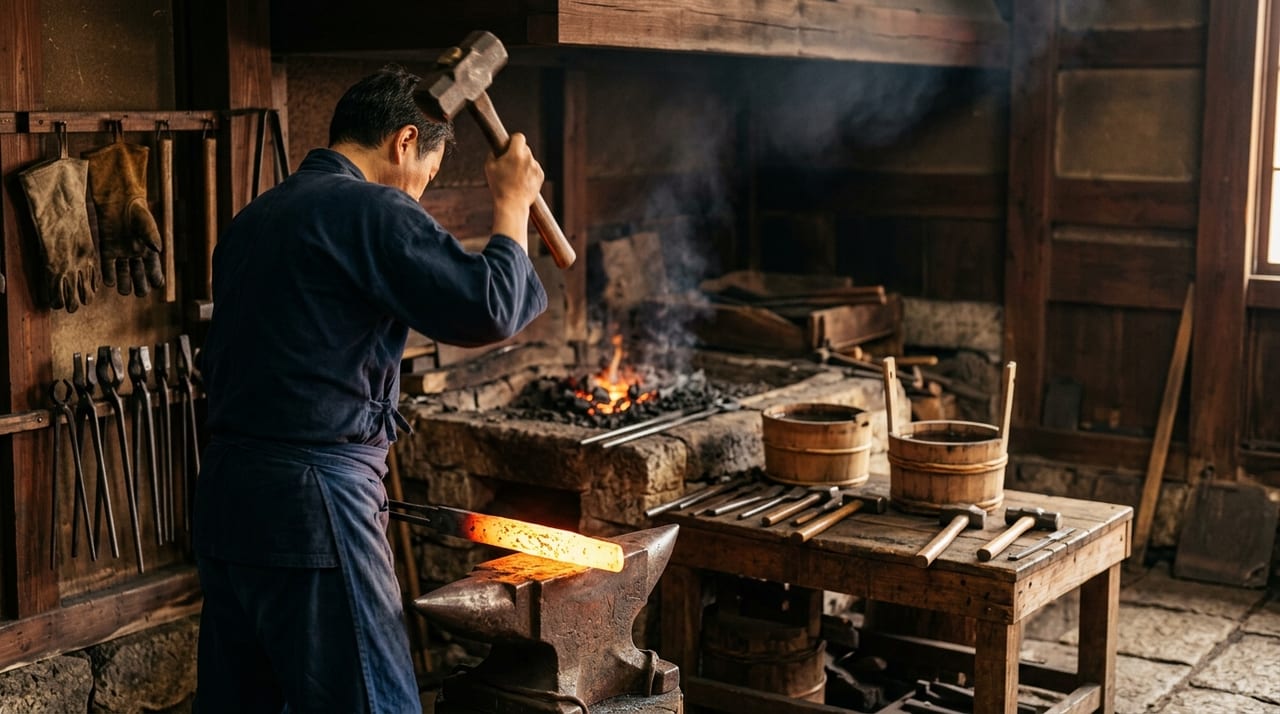
 * Image is for illustrative purposes only.
Rai Kuniyuki
来国行
Description
Rai Kuniyuki was a swordsmith active in Yamashiro Province (present-day southern Kyoto Prefecture) in the mid-Kamakura period, and is regarded as the de facto founder of the Rai school, a prestigious line representative of Kyoto. The legendary founder of the Rai school is said to be Rai Kuniyoshi, but no securely signed work by him is confirmed to survive. Kuniyuki is the first smith whose extant works make it possible to clarify the style of the school. He is traditionally said to have gone by the common name Tarō, and there is also a theory that he was a disciple of Ayanokōji Sadatoshi. As for the origin of the name Rai, the Kanchiin-bon Meizukushi and other sources transmit the theory that his ancestors were craftsmen who came from Goryeo (Koryŏ) on the Korean Peninsula, and that the name Goryeo was corrupted into Rai. Kuniyuki himself, however, signed his name with the two characters Kuniyuki and did not use the Rai character as a surname.
His style is distinctive in that tanto are rare, while there are many fine tachi. The tachi have a somewhat broad blade width and display an elegant form of wazori, with the curve peaking at the middle of the blade. There is little difference between the width at the base (moto-haba) and the width at the tip (saki-haba). The jigane includes works with densely packed ko-itame and works showing an ō-hada character, and both are thickly covered with ji-nie. Rai school jigane often shows, in places, a hada with weak forging, which is called Rai-hada and is treated as a point of interest in appraisal. The hamon divides into works of calm character, in which chōji is mixed into suguha, and showy works in which chōji-midare is the main element. In particular, the distinctive warabite-chōji, which takes the form of a karimata (forked arrowhead), is known as a highlight of this smith. The refined quality typical of Kyō-mono runs through the whole.
The most celebrated representative work is the National Treasure Akashi Kuniyuki (tachi, signed Kuniyuki). Because it was handed down to the Matsudaira family of Akashi in Harima, it is known by this name. Its blade length is approximately 76.5 centimeters. It has high koshizori and a sturdy fumbari, and shows ko-itame jigane with ji-nie, while its refinement is all the more elevated. It is a rare blade with a relief of a sanko-ken (vajra-hilted sword) within the groove at the koshimoto. It is now owned by the Nihon Bijutsu Tōken Hozon Kyōkai (NBTHK), at the Japanese Sword Museum in Tokyo. Other works that have been transmitted include the Important Cultural Property tachi signed Kuniyuki, held by the Touken World Foundation, and the tachi Habaki Kuniyuki, known as a favorite sword of Date Masamune (held by the Sendai City Museum). Habaki Kuniyuki was presented to Masamune by Kampaku Toyotomi Hideyoshi in Tenshō 17 (1589), and the name is said to derive from the fact that it had a habaki made by Kuniyuki.
The Rai school also developed greatly in terms of lineage. After Kuniyuki, Kunitoshi, said to be his son, succeeded him. As for Niji Kunitoshi, whose signature is cut as the two characters for Kunitoshi, and Rai Kunitoshi, whose signature is cut as three characters, there are theories holding that they are the same person based on differences in style, and theories holding that they are different people. In the different-person theory, the prevailing view is that Niji Kunitoshi was the son of Kuniyuki and that Rai Kunitoshi (Magotarō) was his successor. The question remains unresolved to this day. After Rai Kunitoshi, Rai Kunimitsu and Rai Kunitsugu appeared and carried on the line. It is said that Rai Kunimura went down to Kyushu and became the founder of the Enju school. The Rai school shared popularity and renown with the Awataguchi school of the same Yamashiro Province, and from the mid-Kamakura period onward it showed momentum surpassing that school. It grew into the school representing the Yamashiro tradition among the Gokaden (five traditions). Rai Kuniyuki, who laid that foundation, has been highly valued by later generations for his elegant forms, lustrous jigane, and dignified range of work. His name lives on today as a master ranked among the jōkō (top-rank smiths).
Famous Works
- tachi (Important Cultural Property)