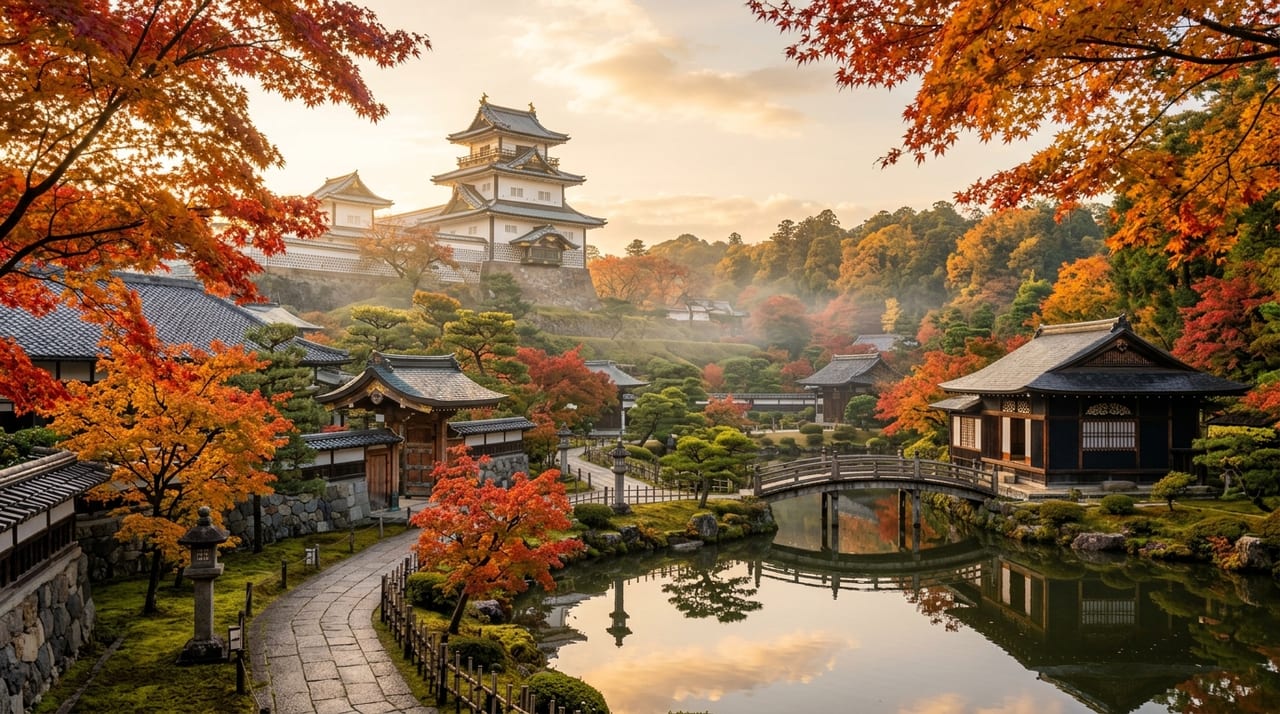
 * Image is for illustrative purposes only.
Kaga Sword Culture
加賀の刀剣文化
The sword culture that flourished under the lavish patronage of the Kaga domain (Maeda clan), the wealthiest non-Tokugawa domain in Japan. Kaga's rich craft tradition — gold and lacquerwork, Kutani ceramics, Kaga Yuzen — infused local sword fittings with exceptional artistic refinement recognized across the country.
Description
The Kaga Domain (present-day Ishikawa and Toyama Prefectures) was a major tozama daimyō domain ruled by the Maeda family. Its assessed yield of one million koku made it second only to the Tokugawa family. Wary of the Edo shogunate, the Maeda family focused on promoting culture and crafts rather than military affairs, and actively invited artisans from Kyoto to develop a distinctive craft culture in Kanazawa. This cultural soil naturally also had a deep influence on sword culture.
Kaga's sword culture had two aspects. One was the making of blades; the other was the refinement of sword fittings (metalwork and lacquerwork). As for blades, the Maeda family retained several swordsmiths as official domain smiths. In particular, lineages of smiths who had migrated from Mino and elsewhere developed uniquely in Kaga. Among the representative Kaga smiths, the Kashū Kiyomitsu lineage is well known. Its style, marked by beautiful jigane (steel texture) and a gentle hamon (temper line), embodies the spirit of Kaga.
On the fittings side, koshirae (sword mounts) that made full use of Kaga maki-e, Kaga zōgan, and Kanazawa gold leaf earned the highest reputation in the country. Numerous fittings survive that show a level of craftsmanship not seen in other domains. These include menuki and fuchigashira incorporating the Maeda family crest, Ken Umebachi, precisely carved Kaga-bori tsuba, and saya with gold maki-e on black lacquer. These fittings are currently held by the Ishikawa Prefectural Museum of Art and the Maeda Ikutokukai, and they are studied as first-class materials in the history of Japanese metalwork and lacquerwork.
Also, since the Kaga Domain was a cultural center of the tea ceremony, Noh theater, and haikai poetry, swords were emphasized not merely as weapons but as kanshō-tō (appreciation swords) that harmonized with tea rooms and other cultural settings. Kaga's sword culture is a unique realm of Hokuriku that pursued the peak of beauty rather than the practice of martial prowess.
Characteristics of This Era
- Exceptional koshirae using Kaga maki-e and Kaga zōgan — unrivaled regional craft precision
- Gentle, visually refined jihada and hamon — blades conceived for appreciation over battlefield use
- Cultural refinement under Maeda patronage — sword aesthetics integrated with tea ceremony and Noh
- A lineage of swordsmiths unique to Kaga, founded on Mino-den and related traditions
- Collaborative koshirae culture between smiths and Kanazawa metalworkers and lacquerers